Yoonseok Choi, Elizabeth Zambrano Garza, Theresa Pauly, Maureen C Ashe, Kenneth M Madden, Denis Gerstorf, Christiane A Hoppmann
{"title":"Everyday emotion-goal pursuit associations in older adults are moderated by goal representations.","authors":"Yoonseok Choi, Elizabeth Zambrano Garza, Theresa Pauly, Maureen C Ashe, Kenneth M Madden, Denis Gerstorf, Christiane A Hoppmann","doi":"10.1038/s44271-025-00213-w","DOIUrl":null,"url":null,"abstract":"<p><p>This study examines intra- and interindividual differences in everyday goal pursuit in older adults focusing on the role of emotions and goal representations. Assuming a prioritization of self-preservation in old age, we expected that reduced negative (and elevated positive) emotions would be associated with increased everyday goal pursuit. These links were expected to be moderated by goal representations such that positive emotions would be more strongly linked to greater goal pursuit when goals were represented as hopes, whereas negative emotions would be less strongly linked to reduced goal pursuit when goals were represented as fears. We used up to 21 surveys from 236 individuals collected over 7 days (Age: Mean = 70.5, 60-87 years). Multilevel models revealed that more intense positive emotional experiences and less intense negative emotional experiences were each associated with elevated everyday goal pursuit. As expected, hoped-for goals were associated with stronger positive emotion-goal pursuit associations. Feared goals were associated with weaker negative emotion (particularly worry)-goal pursuit links. Moderations were limited to the most salient goal. These findings provide insights into how everyday emotion dynamics and goal pursuit may be shaped by the way older adults represent their goals.</p>","PeriodicalId":501698,"journal":{"name":"Communications Psychology","volume":"3 1","pages":"49"},"PeriodicalIF":0.0000,"publicationDate":"2025-03-25","publicationTypes":"Journal Article","fieldsOfStudy":null,"isOpenAccess":false,"openAccessPdf":"https://www.ncbi.nlm.nih.gov/pmc/articles/PMC11936831/pdf/","citationCount":"0","resultStr":null,"platform":"Semanticscholar","paperid":null,"PeriodicalName":"Communications Psychology","FirstCategoryId":"1085","ListUrlMain":"https://doi.org/10.1038/s44271-025-00213-w","RegionNum":0,"RegionCategory":null,"ArticlePicture":[],"TitleCN":null,"AbstractTextCN":null,"PMCID":null,"EPubDate":"","PubModel":"","JCR":"","JCRName":"","Score":null,"Total":0}
引用次数: 0
Abstract
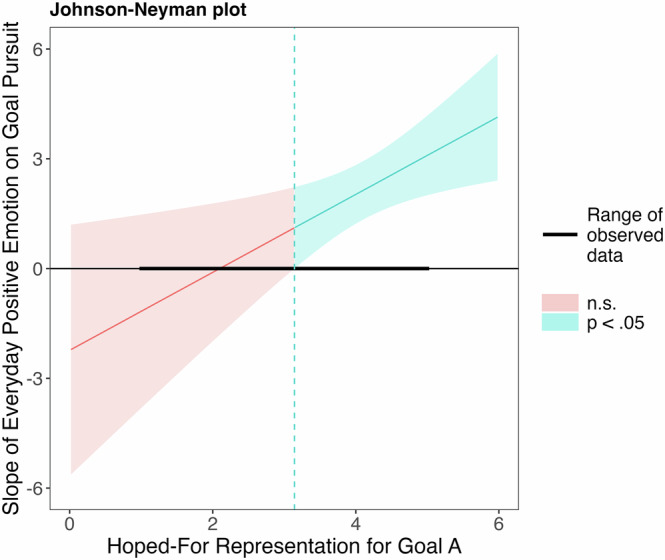
This study examines intra- and interindividual differences in everyday goal pursuit in older adults focusing on the role of emotions and goal representations. Assuming a prioritization of self-preservation in old age, we expected that reduced negative (and elevated positive) emotions would be associated with increased everyday goal pursuit. These links were expected to be moderated by goal representations such that positive emotions would be more strongly linked to greater goal pursuit when goals were represented as hopes, whereas negative emotions would be less strongly linked to reduced goal pursuit when goals were represented as fears. We used up to 21 surveys from 236 individuals collected over 7 days (Age: Mean = 70.5, 60-87 years). Multilevel models revealed that more intense positive emotional experiences and less intense negative emotional experiences were each associated with elevated everyday goal pursuit. As expected, hoped-for goals were associated with stronger positive emotion-goal pursuit associations. Feared goals were associated with weaker negative emotion (particularly worry)-goal pursuit links. Moderations were limited to the most salient goal. These findings provide insights into how everyday emotion dynamics and goal pursuit may be shaped by the way older adults represent their goals.




 京公网安备 11010802042870号
京ICP备2023020795号-1
京公网安备 11010802042870号
京ICP备2023020795号-1

 分享
分享

 求助内容:
求助内容: 应助结果提醒方式:
 扫码关注我们
