Abraham Sánchez-Caballero, Javier Zamudio-García, Lucía dos Santos-Gómez, Iván da Silva, Domingo Pérez-Coll, José M. Porras-Vázquez, David Marrero-López
{"title":"Reduced Thermal Expansion and Improved Electrochemical Performance in Pr-Substituted SrFeO3 as Symmetrical Electrode for Solid Oxide Fuel Cells","authors":"Abraham Sánchez-Caballero, Javier Zamudio-García, Lucía dos Santos-Gómez, Iván da Silva, Domingo Pérez-Coll, José M. Porras-Vázquez, David Marrero-López","doi":"10.1021/acsami.4c21980","DOIUrl":null,"url":null,"abstract":"Advances in doping strategies have significantly improved the properties of SrFeO<sub>3</sub>-based electrodes. However, challenges such as high thermal expansion coefficients and limited redox stability remain critical issues that require further investigation. This study focuses on the optimization of (Sr<sub>1–<i>x</i></sub>Pr<sub><i>x</i></sub>)<sub>0.95</sub>FeO<sub>3–δ</sub> (0 < <i>x</i> ≤ 1) series, evaluating the effects of praseodymium content on thermal expansion, redox stability, and electrochemical performance for potential application as both air and fuel electrodes in symmetrical solid oxide fuel cells. Rietveld refinements of X-ray and neutron diffraction data reveal a phase transformation from tetragonal to cubic symmetry with Pr content (0.2 ≤ <i>x</i> ≤ 0.4), followed by a transition to orthorhombic symmetry (<i>x</i> ≥ 0.6). Thermogravimetric and dilatometric analyses demonstrate that higher Pr content effectively reduces both oxygen nonstoichiometry and the thermal expansion coefficients, which decrease from 31 × 10<sup>–6</sup> K<sup>–1</sup> for <i>x</i> = 0.2 to 8.4 × 10<sup>–6</sup> K<sup>–1</sup> for <i>x</i> = 1. Meanwhile the electrical conductivity remains relatively unaffected by the Pr-content up to <i>x</i> = 0.8, reaching values as high as 116 S cm<sup>–1</sup> at 700 °C in air. Additionally, the electrode polarization resistances are relatively low across the series, e.g. 0.11 Ω cm<sup>2</sup> in air and 0.09 Ω cm<sup>2</sup> in H<sub>2</sub> for <i>x</i> = 0.6 at 700 °C, while exhibiting excellent redox cycling stability. These findings indicate that (Sr<sub>1–<i>x</i></sub>Pr<sub><i>x</i></sub>)<sub>0.95</sub>FeO<sub>3–δ</sub> (<i>x</i> ≥ 0.6) materials are promising electrodes, offering tunable thermal expansion and electrochemical properties for reliable performance in both oxidizing and reducing environments.","PeriodicalId":5,"journal":{"name":"ACS Applied Materials & Interfaces","volume":"57 1","pages":""},"PeriodicalIF":8.2000,"publicationDate":"2025-03-27","publicationTypes":"Journal Article","fieldsOfStudy":null,"isOpenAccess":false,"openAccessPdf":"","citationCount":"0","resultStr":null,"platform":"Semanticscholar","paperid":null,"PeriodicalName":"ACS Applied Materials & Interfaces","FirstCategoryId":"88","ListUrlMain":"https://doi.org/10.1021/acsami.4c21980","RegionNum":2,"RegionCategory":"材料科学","ArticlePicture":[],"TitleCN":null,"AbstractTextCN":null,"PMCID":null,"EPubDate":"","PubModel":"","JCR":"Q1","JCRName":"MATERIALS SCIENCE, MULTIDISCIPLINARY","Score":null,"Total":0}
引用次数: 0
Abstract
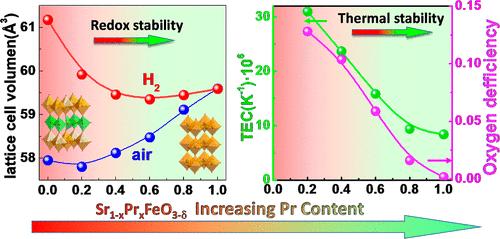
Advances in doping strategies have significantly improved the properties of SrFeO3-based electrodes. However, challenges such as high thermal expansion coefficients and limited redox stability remain critical issues that require further investigation. This study focuses on the optimization of (Sr1–xPrx)0.95FeO3–δ (0 < x ≤ 1) series, evaluating the effects of praseodymium content on thermal expansion, redox stability, and electrochemical performance for potential application as both air and fuel electrodes in symmetrical solid oxide fuel cells. Rietveld refinements of X-ray and neutron diffraction data reveal a phase transformation from tetragonal to cubic symmetry with Pr content (0.2 ≤ x ≤ 0.4), followed by a transition to orthorhombic symmetry (x ≥ 0.6). Thermogravimetric and dilatometric analyses demonstrate that higher Pr content effectively reduces both oxygen nonstoichiometry and the thermal expansion coefficients, which decrease from 31 × 10–6 K–1 for x = 0.2 to 8.4 × 10⁻⁶ K–1 for x = 1. Meanwhile the electrical conductivity remains relatively unaffected by the Pr-content up to x = 0.8, reaching values as high as 116 S cm–1 at 700 °C in air. Additionally, the electrode polarization resistances are relatively low across the series, e.g. 0.11 Ω cm2 in air and 0.09 Ω cm2 in H2 for x = 0.6 at 700 °C, while exhibiting excellent redox cycling stability. These findings indicate that (Sr1–xPrx)0.95FeO3–δ (x ≥ 0.6) materials are promising electrodes, offering tunable thermal expansion and electrochemical properties for reliable performance in both oxidizing and reducing environments.
期刊介绍:
ACS Applied Materials & Interfaces is a leading interdisciplinary journal that brings together chemists, engineers, physicists, and biologists to explore the development and utilization of newly-discovered materials and interfacial processes for specific applications. Our journal has experienced remarkable growth since its establishment in 2009, both in terms of the number of articles published and the impact of the research showcased. We are proud to foster a truly global community, with the majority of published articles originating from outside the United States, reflecting the rapid growth of applied research worldwide.



 京公网安备 11010802042870号
京ICP备2023020795号-1
京公网安备 11010802042870号
京ICP备2023020795号-1

 分享
分享
 求助内容:
求助内容: 应助结果提醒方式:
 扫码关注我们
