Danil A. Kolosovsky , Timur M. Zalyalov , Sergei A. Ponomarev , Nikolay B. Miskiv , Alexey A. Morozov , Yuri G. Shukhov , Alexander V. Shevlyagin , Aleksandr A. Kuchmizhak , Sergey V. Starinskiy
{"title":"Adhesion layer free room-temperature pulsed laser deposition of ultrathin Au films","authors":"Danil A. Kolosovsky , Timur M. Zalyalov , Sergei A. Ponomarev , Nikolay B. Miskiv , Alexey A. Morozov , Yuri G. Shukhov , Alexander V. Shevlyagin , Aleksandr A. Kuchmizhak , Sergey V. Starinskiy","doi":"10.1016/j.apsusc.2025.163077","DOIUrl":null,"url":null,"abstract":"<div><div>The unique optical and electrical characteristics of ultrathin Au films make them ideal for plasmonic, optoelectronic, and metamaterial applications. However, fabricating continuous Au films just a few nanometers thick remains highly challenging. Conventional approaches require adhesion layers, which increase optical losses and often fail to meet optoelectronic device specifications. Another technique involves cooling the substrate to cryogenic levels, but this can cause structural peeling and cracking. We suggest employing pulsed laser deposition in a low-pressure oxygen atmosphere to form ultrathin conductive Au films at room temperature without adhesion layers. In this process, the percolation threshold of Au films is reduced due to the high flux and low kinetic energy of arriving atoms. The direct simulation Monte Carlo shows that at an oxygen pressure of 10 Pa, the kinetic energy of deposited atoms drops roughly tenfold, and their flux decreases by 30 % compared to vacuum expansion. The resulting films are about 5 nm thick, exhibit 72 % average transmittance in visible light, and have a sheet resistance of 30 <!--> <!-->Ω/sq, yielding a high figure of merit of 0.55 <!--> <!-->Ω<sup>−1/10</sup>.</div></div>","PeriodicalId":247,"journal":{"name":"Applied Surface Science","volume":"698 ","pages":"Article 163077"},"PeriodicalIF":6.9000,"publicationDate":"2025-07-30","publicationTypes":"Journal Article","fieldsOfStudy":null,"isOpenAccess":false,"openAccessPdf":"","citationCount":"0","resultStr":null,"platform":"Semanticscholar","paperid":null,"PeriodicalName":"Applied Surface Science","FirstCategoryId":"88","ListUrlMain":"https://www.sciencedirect.com/science/article/pii/S0169433225007913","RegionNum":2,"RegionCategory":"材料科学","ArticlePicture":[],"TitleCN":null,"AbstractTextCN":null,"PMCID":null,"EPubDate":"2025/3/26 0:00:00","PubModel":"Epub","JCR":"Q2","JCRName":"CHEMISTRY, PHYSICAL","Score":null,"Total":0}
引用次数: 0
Abstract
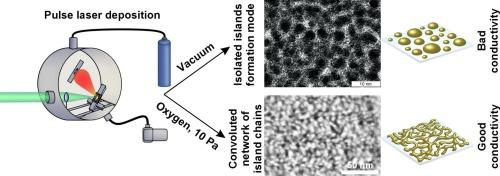
The unique optical and electrical characteristics of ultrathin Au films make them ideal for plasmonic, optoelectronic, and metamaterial applications. However, fabricating continuous Au films just a few nanometers thick remains highly challenging. Conventional approaches require adhesion layers, which increase optical losses and often fail to meet optoelectronic device specifications. Another technique involves cooling the substrate to cryogenic levels, but this can cause structural peeling and cracking. We suggest employing pulsed laser deposition in a low-pressure oxygen atmosphere to form ultrathin conductive Au films at room temperature without adhesion layers. In this process, the percolation threshold of Au films is reduced due to the high flux and low kinetic energy of arriving atoms. The direct simulation Monte Carlo shows that at an oxygen pressure of 10 Pa, the kinetic energy of deposited atoms drops roughly tenfold, and their flux decreases by 30 % compared to vacuum expansion. The resulting films are about 5 nm thick, exhibit 72 % average transmittance in visible light, and have a sheet resistance of 30 Ω/sq, yielding a high figure of merit of 0.55 Ω−1/10.
期刊介绍:
Applied Surface Science covers topics contributing to a better understanding of surfaces, interfaces, nanostructures and their applications. The journal is concerned with scientific research on the atomic and molecular level of material properties determined with specific surface analytical techniques and/or computational methods, as well as the processing of such structures.




 京公网安备 11010802042870号
京ICP备2023020795号-1
京公网安备 11010802042870号
京ICP备2023020795号-1

 分享
分享
 求助内容:
求助内容: 应助结果提醒方式:
 扫码关注我们
