Boyu Zhou , Bicheng Wang , Jian Huang, Mengyu Liu, Chenhao Zhang, Ying Ye, Min Liu, Yuxiang Zhang, Xuanli Zheng, Chunmiao Zhang, Yiyan Cao, Feiya Xu, Xu Li, Yaping Wu, Zhiming Wu, Junyong Kang
{"title":"Comprehensive comparison regarding carrier separation characteristics of MoS2/WS2 lateral and vertical heterojunctions","authors":"Boyu Zhou , Bicheng Wang , Jian Huang, Mengyu Liu, Chenhao Zhang, Ying Ye, Min Liu, Yuxiang Zhang, Xuanli Zheng, Chunmiao Zhang, Yiyan Cao, Feiya Xu, Xu Li, Yaping Wu, Zhiming Wu, Junyong Kang","doi":"10.1016/j.apsusc.2025.163093","DOIUrl":null,"url":null,"abstract":"<div><div>Two-dimensional heterojunctions with a type-II band alignment have great potential for high-performance optoelectronic devices due to their inherent carrier separation properties. Herein, we synthesized lateral and vertical MoS<sub>2</sub>/WS<sub>2</sub> heterojunctions through a two-step chemical vapor deposition method and deeply investigated the impact of the interface structures on carrier separation efficiency. The experimental results demonstrate that the structures of MoS<sub>2</sub>/WS<sub>2</sub> heterojunctions can be controlled by adjusting the Mo/S ratio. In addition, lateral heterojunctions exhibit a significantly higher carrier separation efficiency than vertical heterojunctions. Specifically, the interlayer charge transfer time in the lateral heterojunction is approximately 1.2 ps, in contrast to the value of about 4.0 ps in the vertical heterojunction. First-principles simulation reveals that the lateral heterojunction has stronger interface coupling and orbital hybridization, contributing to its faster charge transfer rate. This work demonstrates the superiority of lateral heterojunctions in carrier separation, offering valuable insights for high-performance optoelectronic devices.</div></div>","PeriodicalId":247,"journal":{"name":"Applied Surface Science","volume":"698 ","pages":"Article 163093"},"PeriodicalIF":6.9000,"publicationDate":"2025-07-30","publicationTypes":"Journal Article","fieldsOfStudy":null,"isOpenAccess":false,"openAccessPdf":"","citationCount":"0","resultStr":null,"platform":"Semanticscholar","paperid":null,"PeriodicalName":"Applied Surface Science","FirstCategoryId":"88","ListUrlMain":"https://www.sciencedirect.com/science/article/pii/S0169433225008074","RegionNum":2,"RegionCategory":"材料科学","ArticlePicture":[],"TitleCN":null,"AbstractTextCN":null,"PMCID":null,"EPubDate":"2025/3/26 0:00:00","PubModel":"Epub","JCR":"Q2","JCRName":"CHEMISTRY, PHYSICAL","Score":null,"Total":0}
引用次数: 0
Abstract
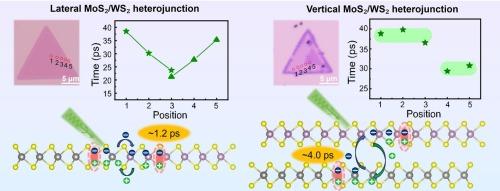
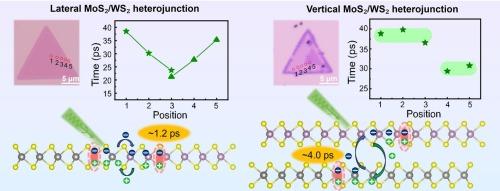
Two-dimensional heterojunctions with a type-II band alignment have great potential for high-performance optoelectronic devices due to their inherent carrier separation properties. Herein, we synthesized lateral and vertical MoS2/WS2 heterojunctions through a two-step chemical vapor deposition method and deeply investigated the impact of the interface structures on carrier separation efficiency. The experimental results demonstrate that the structures of MoS2/WS2 heterojunctions can be controlled by adjusting the Mo/S ratio. In addition, lateral heterojunctions exhibit a significantly higher carrier separation efficiency than vertical heterojunctions. Specifically, the interlayer charge transfer time in the lateral heterojunction is approximately 1.2 ps, in contrast to the value of about 4.0 ps in the vertical heterojunction. First-principles simulation reveals that the lateral heterojunction has stronger interface coupling and orbital hybridization, contributing to its faster charge transfer rate. This work demonstrates the superiority of lateral heterojunctions in carrier separation, offering valuable insights for high-performance optoelectronic devices.
期刊介绍:
Applied Surface Science covers topics contributing to a better understanding of surfaces, interfaces, nanostructures and their applications. The journal is concerned with scientific research on the atomic and molecular level of material properties determined with specific surface analytical techniques and/or computational methods, as well as the processing of such structures.




 京公网安备 11010802042870号
京ICP备2023020795号-1
京公网安备 11010802042870号
京ICP备2023020795号-1

 分享
分享
 求助内容:
求助内容: 应助结果提醒方式:
 扫码关注我们
