Sebastian Pazos, Kaichen Zhu, Marco A. Villena, Osamah Alharbi, Wenwen Zheng, Yaqing Shen, Yue Yuan, Yue Ping, Mario Lanza
{"title":"Synaptic and neural behaviours in a standard silicon transistor","authors":"Sebastian Pazos, Kaichen Zhu, Marco A. Villena, Osamah Alharbi, Wenwen Zheng, Yaqing Shen, Yue Yuan, Yue Ping, Mario Lanza","doi":"10.1038/s41586-025-08742-4","DOIUrl":null,"url":null,"abstract":"Hardware implementations of artificial neural networks (ANNs)—the most advanced of which are made of millions of electronic neurons interconnected by hundreds of millions of electronic synapses—have achieved higher energy efficiency than classical computers in some small-scale data-intensive computing tasks1. State-of-the-art neuromorphic computers, such as Intel’s Loihi2 or IBM’s NorthPole3, implement ANNs using bio-inspired neuron- and synapse-mimicking circuits made of complementary metal–oxide–semiconductor (CMOS) transistors, at least 18 per neuron and six per synapse. Simplifying the structure and size of these two building blocks would enable the construction of more sophisticated, larger and more energy-efficient ANNs. Here we show that a single CMOS transistor can exhibit neural and synaptic behaviours if biased in a specific (unconventional) manner. By connecting one additional CMOS transistor in series, we build a versatile 2-transistor-cell that exhibits adjustable neuro-synaptic response (which we named neuro-synaptic random access memory cell, or NS-RAM cell). This electronic performance comes with a yield of 100% and an ultra-low device-to-device variability, owing to the maturity of the silicon CMOS platform used—no materials or devices alien to the CMOS process are required. These results represent a short-term solution for the implementation of efficient ANNs and an opportunity in terms of CMOS circuit design and optimization for artificial intelligence applications. A standard commercial CMOS FET can exhibit synaptic-like long-term potentiation and depression or neuron-like leaky-integrate-and-fire and adaptive frequency-bursting behaviour when biased in a specific but unconventional way.","PeriodicalId":18787,"journal":{"name":"Nature","volume":"640 8057","pages":"69-76"},"PeriodicalIF":48.5000,"publicationDate":"2025-03-26","publicationTypes":"Journal Article","fieldsOfStudy":null,"isOpenAccess":false,"openAccessPdf":"https://www.nature.com/articles/s41586-025-08742-4.pdf","citationCount":"0","resultStr":null,"platform":"Semanticscholar","paperid":null,"PeriodicalName":"Nature","FirstCategoryId":"103","ListUrlMain":"https://www.nature.com/articles/s41586-025-08742-4","RegionNum":1,"RegionCategory":"综合性期刊","ArticlePicture":[],"TitleCN":null,"AbstractTextCN":null,"PMCID":null,"EPubDate":"","PubModel":"","JCR":"Q1","JCRName":"MULTIDISCIPLINARY SCIENCES","Score":null,"Total":0}
引用次数: 0
Abstract
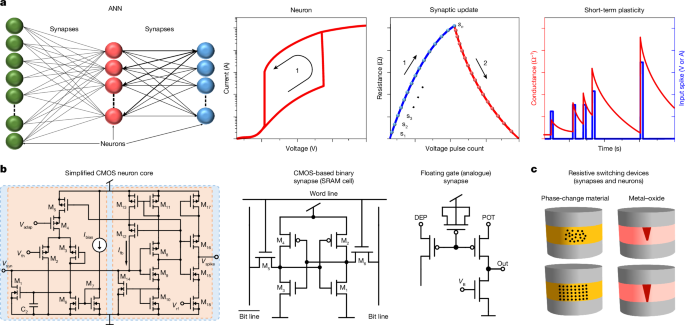
Hardware implementations of artificial neural networks (ANNs)—the most advanced of which are made of millions of electronic neurons interconnected by hundreds of millions of electronic synapses—have achieved higher energy efficiency than classical computers in some small-scale data-intensive computing tasks1. State-of-the-art neuromorphic computers, such as Intel’s Loihi2 or IBM’s NorthPole3, implement ANNs using bio-inspired neuron- and synapse-mimicking circuits made of complementary metal–oxide–semiconductor (CMOS) transistors, at least 18 per neuron and six per synapse. Simplifying the structure and size of these two building blocks would enable the construction of more sophisticated, larger and more energy-efficient ANNs. Here we show that a single CMOS transistor can exhibit neural and synaptic behaviours if biased in a specific (unconventional) manner. By connecting one additional CMOS transistor in series, we build a versatile 2-transistor-cell that exhibits adjustable neuro-synaptic response (which we named neuro-synaptic random access memory cell, or NS-RAM cell). This electronic performance comes with a yield of 100% and an ultra-low device-to-device variability, owing to the maturity of the silicon CMOS platform used—no materials or devices alien to the CMOS process are required. These results represent a short-term solution for the implementation of efficient ANNs and an opportunity in terms of CMOS circuit design and optimization for artificial intelligence applications. A standard commercial CMOS FET can exhibit synaptic-like long-term potentiation and depression or neuron-like leaky-integrate-and-fire and adaptive frequency-bursting behaviour when biased in a specific but unconventional way.
期刊介绍:
Nature is a prestigious international journal that publishes peer-reviewed research in various scientific and technological fields. The selection of articles is based on criteria such as originality, importance, interdisciplinary relevance, timeliness, accessibility, elegance, and surprising conclusions. In addition to showcasing significant scientific advances, Nature delivers rapid, authoritative, insightful news, and interpretation of current and upcoming trends impacting science, scientists, and the broader public. The journal serves a dual purpose: firstly, to promptly share noteworthy scientific advances and foster discussions among scientists, and secondly, to ensure the swift dissemination of scientific results globally, emphasizing their significance for knowledge, culture, and daily life.



 京公网安备 11010802042870号
京ICP备2023020795号-1
京公网安备 11010802042870号
京ICP备2023020795号-1

 分享
分享
 求助内容:
求助内容: 应助结果提醒方式:
 扫码关注我们
