Yuekang Chen , Lijuan Zeng , Kai Chen , Meiling Yin , Xiongkai Zheng , Yuting Zhou , Yanping Deng , Jiehong Ye , Zhi Dang , Chuling Guo
{"title":"The behavior of NOM-Cu(Ⅱ)colloids at the goethite interface","authors":"Yuekang Chen , Lijuan Zeng , Kai Chen , Meiling Yin , Xiongkai Zheng , Yuting Zhou , Yanping Deng , Jiehong Ye , Zhi Dang , Chuling Guo","doi":"10.1016/j.watres.2025.123562","DOIUrl":null,"url":null,"abstract":"<div><div>Natural organic matter (NOM), due to its high reactivity, often facilitates the formation of NOM-heavy metal colloids. However, the impact of mineral components on the behavior of these colloids remains poorly understood. In present research, to investigate the interfacial reaction properties of NOM-Cu(II) colloids with goethite at varying C/Cu(II) ratios, nano-sized Cu(Ⅱ) colloids with different C/Cu(Ⅱ) ratios were synthesized under aerobic conditions by combining humic acid with Cu(Ⅱ). Adsorption experiments showed that NOM-Cu(Ⅱ) colloids enhanced Cu(Ⅱ) adsorption onto goethite at low C/Cu(Ⅱ) ratios (C/Cu(Ⅱ) ≤ 25). Conversely, the adsorption of Cu(Ⅱ) was hindered at high C/Cu(Ⅱ) ratios (C/Cu(Ⅱ) ≥ 50), while Fe release is promoted, facilitating further reactions with NOM-Cu(II) colloids to form Fe-NOM-Cu(II) colloids. HR-TEM and QCM-D experimental results indicated that NOM-Cu(II) colloids aggregated and formed a softer deposit layer on mineral surfaces at low C/Cu(II) ratios. Conversely, at high C/Cu(II) ratio, HA formed a dense adsorption layer on goethite, while Fe-NOM-Cu(II) colloids were observed in the liquid phase samples. In situ ATR-FTIR spectroscopy, ITC experiments, and theoretical calculations further demonstrated that the adsorption mechanism was not dominant at low C/Cu(II) ratios. Instead, the aggregation and deposition of colloids induced by goethite promote Cu(II) adsorption. At high C/Cu(II) ratio, the suppression of Cu(II) adsorption was attributed to the formation of a dense adsorption layer by free HA, which coordinated with goethite surfaces via carboxyl groups, occupying adsorption sites. Additionally, the high concentration of HA intensified the stability of colloids in solution. This research provides crucial insights into the interactions between NOM-Cu(II) colloid and environmental minerals, elucidating the molecular mechanisms influencing colloidal behavior on mineral surfaces, which is vital for understanding the geochemical cycling of heavy metals.</div></div>","PeriodicalId":443,"journal":{"name":"Water Research","volume":"281 ","pages":"Article 123562"},"PeriodicalIF":12.4000,"publicationDate":"2025-03-26","publicationTypes":"Journal Article","fieldsOfStudy":null,"isOpenAccess":false,"openAccessPdf":"","citationCount":"0","resultStr":null,"platform":"Semanticscholar","paperid":null,"PeriodicalName":"Water Research","FirstCategoryId":"93","ListUrlMain":"https://www.sciencedirect.com/science/article/pii/S0043135425004750","RegionNum":1,"RegionCategory":"环境科学与生态学","ArticlePicture":[],"TitleCN":null,"AbstractTextCN":null,"PMCID":null,"EPubDate":"","PubModel":"","JCR":"Q1","JCRName":"ENGINEERING, ENVIRONMENTAL","Score":null,"Total":0}
引用次数: 0
Abstract
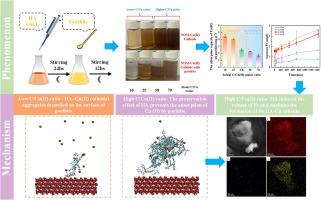
Natural organic matter (NOM), due to its high reactivity, often facilitates the formation of NOM-heavy metal colloids. However, the impact of mineral components on the behavior of these colloids remains poorly understood. In present research, to investigate the interfacial reaction properties of NOM-Cu(II) colloids with goethite at varying C/Cu(II) ratios, nano-sized Cu(Ⅱ) colloids with different C/Cu(Ⅱ) ratios were synthesized under aerobic conditions by combining humic acid with Cu(Ⅱ). Adsorption experiments showed that NOM-Cu(Ⅱ) colloids enhanced Cu(Ⅱ) adsorption onto goethite at low C/Cu(Ⅱ) ratios (C/Cu(Ⅱ) ≤ 25). Conversely, the adsorption of Cu(Ⅱ) was hindered at high C/Cu(Ⅱ) ratios (C/Cu(Ⅱ) ≥ 50), while Fe release is promoted, facilitating further reactions with NOM-Cu(II) colloids to form Fe-NOM-Cu(II) colloids. HR-TEM and QCM-D experimental results indicated that NOM-Cu(II) colloids aggregated and formed a softer deposit layer on mineral surfaces at low C/Cu(II) ratios. Conversely, at high C/Cu(II) ratio, HA formed a dense adsorption layer on goethite, while Fe-NOM-Cu(II) colloids were observed in the liquid phase samples. In situ ATR-FTIR spectroscopy, ITC experiments, and theoretical calculations further demonstrated that the adsorption mechanism was not dominant at low C/Cu(II) ratios. Instead, the aggregation and deposition of colloids induced by goethite promote Cu(II) adsorption. At high C/Cu(II) ratio, the suppression of Cu(II) adsorption was attributed to the formation of a dense adsorption layer by free HA, which coordinated with goethite surfaces via carboxyl groups, occupying adsorption sites. Additionally, the high concentration of HA intensified the stability of colloids in solution. This research provides crucial insights into the interactions between NOM-Cu(II) colloid and environmental minerals, elucidating the molecular mechanisms influencing colloidal behavior on mineral surfaces, which is vital for understanding the geochemical cycling of heavy metals.
天然有机质(NOM)由于具有较高的反应活性,往往有利于无机重金属胶体的形成。然而,矿物成分对这些胶体行为的影响仍然知之甚少。为了研究不同C/Cu(II)比下no- Cu(II)胶体与针铁矿的界面反应性质,在好氧条件下,腐植酸与Cu(Ⅱ)结合,合成了不同C/Cu(Ⅱ)比的纳米Cu(Ⅱ)胶体。吸附实验表明,在低C/Cu(Ⅱ)比(C/Cu(Ⅱ)≤25)条件下,mn -Cu(Ⅱ)胶体增强了铜(Ⅱ)在针铁矿上的吸附。反之,在高C/Cu(Ⅱ)比(C/Cu(Ⅱ)≥50)时,Cu(Ⅱ)的吸附受到阻碍,而Fe的释放得到促进,有利于与NOM-Cu(II)胶体进一步反应形成Fe-NOM-Cu(II)胶体。HR-TEM和QCM-D实验结果表明,在低C/Cu(II)比条件下,无机Cu(II)胶体在矿物表面聚集形成较软的沉积层。相反,在高C/Cu(II)比时,HA在针铁矿上形成致密的吸附层,而fe - nomo -Cu(II)在液相样品中观察到胶体。原位ATR-FTIR光谱、ITC实验和理论计算进一步证明,在低C/Cu(II)比下,吸附机制不占主导地位。相反,针铁矿诱导胶体的聚集和沉积促进了Cu(II)的吸附。在高C/Cu(II)比下,自由HA形成致密吸附层,通过羧基与针铁矿表面配合,占据吸附位点,抑制了Cu(II)的吸附。此外,高浓度的透明质酸增强了溶液中胶体的稳定性。本研究为研究no - cu (II)胶体与环境矿物之间的相互作用提供了重要的见解,阐明了影响矿物表面胶体行为的分子机制,这对理解重金属的地球化学循环至关重要。
期刊介绍:
Water Research, along with its open access companion journal Water Research X, serves as a platform for publishing original research papers covering various aspects of the science and technology related to the anthropogenic water cycle, water quality, and its management worldwide. The audience targeted by the journal comprises biologists, chemical engineers, chemists, civil engineers, environmental engineers, limnologists, and microbiologists. The scope of the journal include:
•Treatment processes for water and wastewaters (municipal, agricultural, industrial, and on-site treatment), including resource recovery and residuals management;
•Urban hydrology including sewer systems, stormwater management, and green infrastructure;
•Drinking water treatment and distribution;
•Potable and non-potable water reuse;
•Sanitation, public health, and risk assessment;
•Anaerobic digestion, solid and hazardous waste management, including source characterization and the effects and control of leachates and gaseous emissions;
•Contaminants (chemical, microbial, anthropogenic particles such as nanoparticles or microplastics) and related water quality sensing, monitoring, fate, and assessment;
•Anthropogenic impacts on inland, tidal, coastal and urban waters, focusing on surface and ground waters, and point and non-point sources of pollution;
•Environmental restoration, linked to surface water, groundwater and groundwater remediation;
•Analysis of the interfaces between sediments and water, and between water and atmosphere, focusing specifically on anthropogenic impacts;
•Mathematical modelling, systems analysis, machine learning, and beneficial use of big data related to the anthropogenic water cycle;
•Socio-economic, policy, and regulations studies.




 京公网安备 11010802042870号
京ICP备2023020795号-1
京公网安备 11010802042870号
京ICP备2023020795号-1

 分享
分享
 求助内容:
求助内容: 应助结果提醒方式:
 扫码关注我们
