{"title":"Random Terpolymerization as a Design Strategy to Modulate Aggregation in NDI-Based Polymer Acceptors for All-Polymer Solar Cells","authors":"Dasol Chung, Stephanie Samson, Sungmo Moon, Seyeon Yoon, Wei You, Sung Yun Son","doi":"10.1021/acsmacrolett.5c00122","DOIUrl":null,"url":null,"abstract":"Naphthalene diimide (NDI)-based conjugated polymers are prominent polymer acceptors in all-polymer solar cells (all-PSCs). However, these polymers tend to exhibit strong self-aggregation, which can cause excessive phase separation and hinder optimal donor–acceptor mixing in the bulk heterojunction blend. To address this issue, random terpolymerization was employed to modulate the aggregation of NDI-based polymer acceptors, aiming to enhance the corresponding device performance of all-PSCs. Four terpolymers (PNDI-T21, PNDI-T23, PNDI-T25, and PNDI-RT) were synthesized by incorporating 10 mol % thiophene derivatives into PNDI-T2, a reference polymer with a regular configuration. Increased thiophene content enhanced backbone planarity, leading to greater aggregation and crystallinity, while a highly randomized backbone reduced both. When used as polymer acceptors in all-PSCs, PNDI-T21, with the weakest aggregation, achieved the highest power conversion efficiency (5.3%), whereas PNDI-T25, with the strongest aggregation, showed the lowest efficiency (3.2%).","PeriodicalId":18,"journal":{"name":"ACS Macro Letters","volume":"19 1","pages":"484-489"},"PeriodicalIF":5.2000,"publicationDate":"2025-03-26","publicationTypes":"Journal Article","fieldsOfStudy":null,"isOpenAccess":false,"openAccessPdf":"","citationCount":"0","resultStr":null,"platform":"Semanticscholar","paperid":null,"PeriodicalName":"ACS Macro Letters","FirstCategoryId":"92","ListUrlMain":"https://doi.org/10.1021/acsmacrolett.5c00122","RegionNum":0,"RegionCategory":null,"ArticlePicture":[],"TitleCN":null,"AbstractTextCN":null,"PMCID":null,"EPubDate":"","PubModel":"","JCR":"Q1","JCRName":"POLYMER SCIENCE","Score":null,"Total":0}
引用次数: 0
Abstract
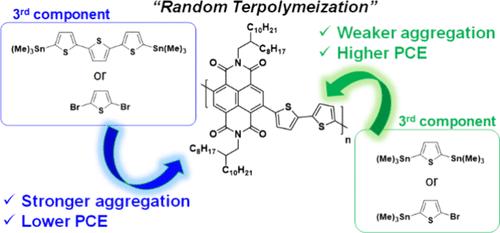
Naphthalene diimide (NDI)-based conjugated polymers are prominent polymer acceptors in all-polymer solar cells (all-PSCs). However, these polymers tend to exhibit strong self-aggregation, which can cause excessive phase separation and hinder optimal donor–acceptor mixing in the bulk heterojunction blend. To address this issue, random terpolymerization was employed to modulate the aggregation of NDI-based polymer acceptors, aiming to enhance the corresponding device performance of all-PSCs. Four terpolymers (PNDI-T21, PNDI-T23, PNDI-T25, and PNDI-RT) were synthesized by incorporating 10 mol % thiophene derivatives into PNDI-T2, a reference polymer with a regular configuration. Increased thiophene content enhanced backbone planarity, leading to greater aggregation and crystallinity, while a highly randomized backbone reduced both. When used as polymer acceptors in all-PSCs, PNDI-T21, with the weakest aggregation, achieved the highest power conversion efficiency (5.3%), whereas PNDI-T25, with the strongest aggregation, showed the lowest efficiency (3.2%).
期刊介绍:
ACS Macro Letters publishes research in all areas of contemporary soft matter science in which macromolecules play a key role, including nanotechnology, self-assembly, supramolecular chemistry, biomaterials, energy generation and storage, and renewable/sustainable materials. Submissions to ACS Macro Letters should justify clearly the rapid disclosure of the key elements of the study. The scope of the journal includes high-impact research of broad interest in all areas of polymer science and engineering, including cross-disciplinary research that interfaces with polymer science.
With the launch of ACS Macro Letters, all Communications that were formerly published in Macromolecules and Biomacromolecules will be published as Letters in ACS Macro Letters.



 京公网安备 11010802042870号
京ICP备2023020795号-1
京公网安备 11010802042870号
京ICP备2023020795号-1

 分享
分享
 求助内容:
求助内容: 应助结果提醒方式:
 扫码关注我们
