Mélanie Girardot, Jean-François Tahon, Joël Lyskawa, Sophie Barrau
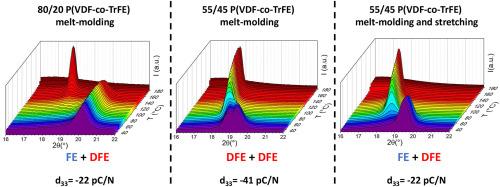
{"title":"New insights on the crystal structure of P(VDF-co-TrFE) copolymer (55/45 mol%) and influence on the high piezoelectric response","authors":"Mélanie Girardot, Jean-François Tahon, Joël Lyskawa, Sophie Barrau","doi":"10.1016/j.polymer.2025.128317","DOIUrl":null,"url":null,"abstract":"<div><div>Copolymers of vinylidene fluoride (VDF) and trifluoroethylene (TrFE), P(VDF-co-TrFE), exhibit remarkable electroactive properties. More precisely, the copolymers with a molar fraction of VDF between 49 % and 55 % present high piezoelectric properties. However, the literature on P(VDF-co-TrFE) with this composition range is limited, and there are divergences regarding the attribution of crystal phases, unlike the copolymers containing around 70 %–80 % of VDF, which have been extensively studied. In this study, wide-angle X-ray scattering (WAXS) experiments were conducted on a 55/45 P(VDF-co-TrFE) film to gain a better understanding of its crystal structure in correlation to its high piezoelectric properties. For comparison, a 80/20 P(VDF-co-TrFE) film is used as a reference. The results reveal that 55/45 P(VDF-co-TrFE) is mainly composed of two defective ferroelectric (DFE) phases, unlike 80/20 P(VDF-co-TrFE), which contains a mixture of a small fraction of DFE phase and a high fraction of ferroelectric (FE) phases. The stretching of 55/45 copolymer film induces the transformation of DFE phases to FE phase to obtain a structure very similar to that of the unstretched 80/20 copolymer. After poling, the unstretched 55/45 P(VDF-co-TrFE) film exhibits a high piezoelectric coefficient d<sub>33</sub> of −41 pC/N, compared to more classical values of −22 pC/N for both the stretched 55/45 P(VDF-co-TrFE) and the unstretched 80/20 P(VDF-co-TrFE). This result is mainly explained by the exclusive presence of DFE phases in the unstretched 55/45 P(VDF-co-TrFE), which have greater mobility and then a better ability to polarize compared to the FE phase. This study thus highlights the importance of the DFE phase presence impacted by the film elaboration process in achieving a high piezoelectric coefficient in copolymers. This investigation contributes to a better understanding of the relationships between elaboration, structure and properties of P(VDF-co-TrFE) films, which is a key issue for the design of advanced electroactive organic devices.</div></div>","PeriodicalId":405,"journal":{"name":"Polymer","volume":"325 ","pages":"Article 128317"},"PeriodicalIF":4.5000,"publicationDate":"2025-04-22","publicationTypes":"Journal Article","fieldsOfStudy":null,"isOpenAccess":false,"openAccessPdf":"","citationCount":"0","resultStr":null,"platform":"Semanticscholar","paperid":null,"PeriodicalName":"Polymer","FirstCategoryId":"92","ListUrlMain":"https://www.sciencedirect.com/science/article/pii/S0032386125003039","RegionNum":2,"RegionCategory":"化学","ArticlePicture":[],"TitleCN":null,"AbstractTextCN":null,"PMCID":null,"EPubDate":"2025/3/26 0:00:00","PubModel":"Epub","JCR":"Q2","JCRName":"POLYMER SCIENCE","Score":null,"Total":0}
引用次数: 0
Abstract
Copolymers of vinylidene fluoride (VDF) and trifluoroethylene (TrFE), P(VDF-co-TrFE), exhibit remarkable electroactive properties. More precisely, the copolymers with a molar fraction of VDF between 49 % and 55 % present high piezoelectric properties. However, the literature on P(VDF-co-TrFE) with this composition range is limited, and there are divergences regarding the attribution of crystal phases, unlike the copolymers containing around 70 %–80 % of VDF, which have been extensively studied. In this study, wide-angle X-ray scattering (WAXS) experiments were conducted on a 55/45 P(VDF-co-TrFE) film to gain a better understanding of its crystal structure in correlation to its high piezoelectric properties. For comparison, a 80/20 P(VDF-co-TrFE) film is used as a reference. The results reveal that 55/45 P(VDF-co-TrFE) is mainly composed of two defective ferroelectric (DFE) phases, unlike 80/20 P(VDF-co-TrFE), which contains a mixture of a small fraction of DFE phase and a high fraction of ferroelectric (FE) phases. The stretching of 55/45 copolymer film induces the transformation of DFE phases to FE phase to obtain a structure very similar to that of the unstretched 80/20 copolymer. After poling, the unstretched 55/45 P(VDF-co-TrFE) film exhibits a high piezoelectric coefficient d33 of −41 pC/N, compared to more classical values of −22 pC/N for both the stretched 55/45 P(VDF-co-TrFE) and the unstretched 80/20 P(VDF-co-TrFE). This result is mainly explained by the exclusive presence of DFE phases in the unstretched 55/45 P(VDF-co-TrFE), which have greater mobility and then a better ability to polarize compared to the FE phase. This study thus highlights the importance of the DFE phase presence impacted by the film elaboration process in achieving a high piezoelectric coefficient in copolymers. This investigation contributes to a better understanding of the relationships between elaboration, structure and properties of P(VDF-co-TrFE) films, which is a key issue for the design of advanced electroactive organic devices.
期刊介绍:
Polymer is an interdisciplinary journal dedicated to publishing innovative and significant advances in Polymer Physics, Chemistry and Technology. We welcome submissions on polymer hybrids, nanocomposites, characterisation and self-assembly. Polymer also publishes work on the technological application of polymers in energy and optoelectronics.
The main scope is covered but not limited to the following core areas:
Polymer Materials
Nanocomposites and hybrid nanomaterials
Polymer blends, films, fibres, networks and porous materials
Physical Characterization
Characterisation, modelling and simulation* of molecular and materials properties in bulk, solution, and thin films
Polymer Engineering
Advanced multiscale processing methods
Polymer Synthesis, Modification and Self-assembly
Including designer polymer architectures, mechanisms and kinetics, and supramolecular polymerization
Technological Applications
Polymers for energy generation and storage
Polymer membranes for separation technology
Polymers for opto- and microelectronics.



 京公网安备 11010802042870号
京ICP备2023020795号-1
京公网安备 11010802042870号
京ICP备2023020795号-1

 分享
分享
 求助内容:
求助内容: 应助结果提醒方式:
 扫码关注我们
