Thanh Van Vu , Jae Hyun Sim , Jinwoo Choi , Hokyeong Jeong , Seungjoo Park , Sangho Kim , Sangeun Baek , Hyunmin Lee , Youngjong Kang
{"title":"Conformational energy inversion in PMMA crystals prepared via thermal quenching with entropy diluents","authors":"Thanh Van Vu , Jae Hyun Sim , Jinwoo Choi , Hokyeong Jeong , Seungjoo Park , Sangho Kim , Sangeun Baek , Hyunmin Lee , Youngjong Kang","doi":"10.1016/j.polymer.2025.128318","DOIUrl":null,"url":null,"abstract":"<div><div>This study investigates the conformational structure of hypocrystalline poly(methyl methacrylate) (PMMA) films (hc-PMMAs) prepared via thermal quenching with benzoic acid (BA) as an entropy diluent. FT-IR spectroscopy revealed a significant increase in the <em>trans-gauche</em> (<em>tg</em>) conformation in hc-PMMAs compared to their solution-cast PMMA counterparts. The presence of BA stretched the polymer chains, promoting crystallization. Conformational energy calculations showed that the <em>tg</em> conformation became more stable than the <em>trans-trans</em> (<em>tt</em>) form, contrary to natural PMMA, due to chain stress from the quenching process. Thermal analysis demonstrated a unique <em>tg</em> plateau below the glass transition temperature (<em>T</em><sub>g</sub>), followed by relaxation to <em>tt</em> above <em>T</em><sub>g</sub>. These findings highlight the potential for manipulating polymer conformation and crystallinity using entropy diluents.</div></div>","PeriodicalId":405,"journal":{"name":"Polymer","volume":"326 ","pages":"Article 128318"},"PeriodicalIF":4.5000,"publicationDate":"2025-05-09","publicationTypes":"Journal Article","fieldsOfStudy":null,"isOpenAccess":false,"openAccessPdf":"","citationCount":"0","resultStr":null,"platform":"Semanticscholar","paperid":null,"PeriodicalName":"Polymer","FirstCategoryId":"92","ListUrlMain":"https://www.sciencedirect.com/science/article/pii/S0032386125003040","RegionNum":2,"RegionCategory":"化学","ArticlePicture":[],"TitleCN":null,"AbstractTextCN":null,"PMCID":null,"EPubDate":"2025/3/26 0:00:00","PubModel":"Epub","JCR":"Q2","JCRName":"POLYMER SCIENCE","Score":null,"Total":0}
引用次数: 0
Abstract
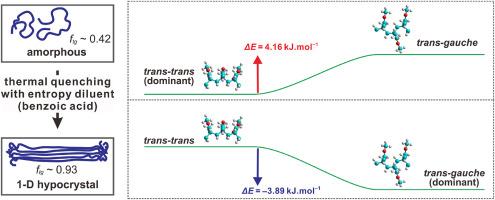
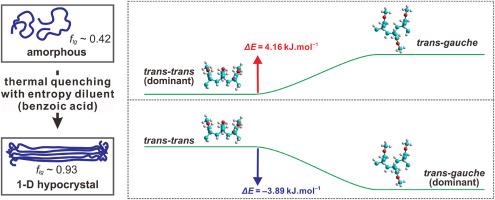
This study investigates the conformational structure of hypocrystalline poly(methyl methacrylate) (PMMA) films (hc-PMMAs) prepared via thermal quenching with benzoic acid (BA) as an entropy diluent. FT-IR spectroscopy revealed a significant increase in the trans-gauche (tg) conformation in hc-PMMAs compared to their solution-cast PMMA counterparts. The presence of BA stretched the polymer chains, promoting crystallization. Conformational energy calculations showed that the tg conformation became more stable than the trans-trans (tt) form, contrary to natural PMMA, due to chain stress from the quenching process. Thermal analysis demonstrated a unique tg plateau below the glass transition temperature (Tg), followed by relaxation to tt above Tg. These findings highlight the potential for manipulating polymer conformation and crystallinity using entropy diluents.
期刊介绍:
Polymer is an interdisciplinary journal dedicated to publishing innovative and significant advances in Polymer Physics, Chemistry and Technology. We welcome submissions on polymer hybrids, nanocomposites, characterisation and self-assembly. Polymer also publishes work on the technological application of polymers in energy and optoelectronics.
The main scope is covered but not limited to the following core areas:
Polymer Materials
Nanocomposites and hybrid nanomaterials
Polymer blends, films, fibres, networks and porous materials
Physical Characterization
Characterisation, modelling and simulation* of molecular and materials properties in bulk, solution, and thin films
Polymer Engineering
Advanced multiscale processing methods
Polymer Synthesis, Modification and Self-assembly
Including designer polymer architectures, mechanisms and kinetics, and supramolecular polymerization
Technological Applications
Polymers for energy generation and storage
Polymer membranes for separation technology
Polymers for opto- and microelectronics.




 京公网安备 11010802042870号
京ICP备2023020795号-1
京公网安备 11010802042870号
京ICP备2023020795号-1

 分享
分享
 求助内容:
求助内容: 应助结果提醒方式:
 扫码关注我们
