Arthur Lassus , Daniel Therriault , Basil D. Favis , Nick Virgilio
{"title":"Tailoring the morphology in partially and fully miscible mixtures of PEEK and PEI","authors":"Arthur Lassus , Daniel Therriault , Basil D. Favis , Nick Virgilio","doi":"10.1016/j.polymer.2025.128315","DOIUrl":null,"url":null,"abstract":"<div><div>Over the last three decades, the vast body of work related to the control of the morphology of multiphase polymers has concentrated on systems that are inherently immiscible. On the other hand, detailed morphological studies of phase separation in miscible blends have been limited by the highly unstable nature of the structures generated as a function of time and temperature. In this work, we present one basic polymer system, with a slight variation in chemical structure, that allows for a high level of morphological tailoring and control in the miscible to partially miscible region. Two close isomeric forms of polyetherimides (PEI) yield fundamentally different types of morphologies in polyetheretherketone (PEEK)/PEI melt-processed multiphase systems: a partially miscible, phase-separated microstructure for the barely studied PEEK/<em>para</em>-PEI (<em>p</em>-PEI) system, and the typically reported fully miscible PEEK/<em>meta</em>-PEI system (<em>m</em>-PEI). The PEEK/<em>p</em>-PEI system displays sub-μm, matrix/dispersed phase or co-continuous types of morphologies, with the latter quickly coarsening over tens of μm in length scale under quiescent annealing conditions due to the PEEK/<em>p</em>-PEI interfacial tension, which was measured by the breaking thread method at 0.14 mN/m, one of the lowest values ever reported for a polymer pair. On the other hand, for the PEEK/<em>m</em>-PEI system, controlling the thermal annealing temperature promotes PEEK recrystallization and the formation of a nanostructured PEI-rich phase. Considering both types of blends, it is then possible to control the morphological length scale of PEEK and PEI domains over nearly 4 orders of magnitude, from ≈5 nm to over 15 μm. This is the smallest domain size ever reported for co-continuous systems. The selective extraction of the PEI phase then results in porous PEEK monoliths with full pore interconnectivity, with an average pore size spanning the same considerable range – without any interfacial modifier or block copolymer.</div></div>","PeriodicalId":405,"journal":{"name":"Polymer","volume":"326 ","pages":"Article 128315"},"PeriodicalIF":4.5000,"publicationDate":"2025-05-09","publicationTypes":"Journal Article","fieldsOfStudy":null,"isOpenAccess":false,"openAccessPdf":"","citationCount":"0","resultStr":null,"platform":"Semanticscholar","paperid":null,"PeriodicalName":"Polymer","FirstCategoryId":"92","ListUrlMain":"https://www.sciencedirect.com/science/article/pii/S0032386125003015","RegionNum":2,"RegionCategory":"化学","ArticlePicture":[],"TitleCN":null,"AbstractTextCN":null,"PMCID":null,"EPubDate":"2025/3/27 0:00:00","PubModel":"Epub","JCR":"Q2","JCRName":"POLYMER SCIENCE","Score":null,"Total":0}
引用次数: 0
Abstract
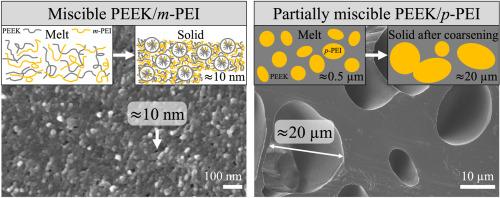
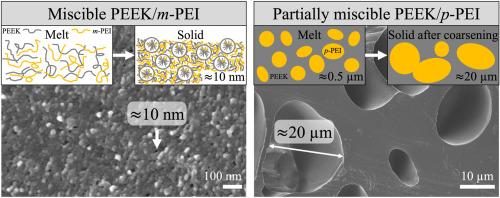
Over the last three decades, the vast body of work related to the control of the morphology of multiphase polymers has concentrated on systems that are inherently immiscible. On the other hand, detailed morphological studies of phase separation in miscible blends have been limited by the highly unstable nature of the structures generated as a function of time and temperature. In this work, we present one basic polymer system, with a slight variation in chemical structure, that allows for a high level of morphological tailoring and control in the miscible to partially miscible region. Two close isomeric forms of polyetherimides (PEI) yield fundamentally different types of morphologies in polyetheretherketone (PEEK)/PEI melt-processed multiphase systems: a partially miscible, phase-separated microstructure for the barely studied PEEK/para-PEI (p-PEI) system, and the typically reported fully miscible PEEK/meta-PEI system (m-PEI). The PEEK/p-PEI system displays sub-μm, matrix/dispersed phase or co-continuous types of morphologies, with the latter quickly coarsening over tens of μm in length scale under quiescent annealing conditions due to the PEEK/p-PEI interfacial tension, which was measured by the breaking thread method at 0.14 mN/m, one of the lowest values ever reported for a polymer pair. On the other hand, for the PEEK/m-PEI system, controlling the thermal annealing temperature promotes PEEK recrystallization and the formation of a nanostructured PEI-rich phase. Considering both types of blends, it is then possible to control the morphological length scale of PEEK and PEI domains over nearly 4 orders of magnitude, from ≈5 nm to over 15 μm. This is the smallest domain size ever reported for co-continuous systems. The selective extraction of the PEI phase then results in porous PEEK monoliths with full pore interconnectivity, with an average pore size spanning the same considerable range – without any interfacial modifier or block copolymer.
期刊介绍:
Polymer is an interdisciplinary journal dedicated to publishing innovative and significant advances in Polymer Physics, Chemistry and Technology. We welcome submissions on polymer hybrids, nanocomposites, characterisation and self-assembly. Polymer also publishes work on the technological application of polymers in energy and optoelectronics.
The main scope is covered but not limited to the following core areas:
Polymer Materials
Nanocomposites and hybrid nanomaterials
Polymer blends, films, fibres, networks and porous materials
Physical Characterization
Characterisation, modelling and simulation* of molecular and materials properties in bulk, solution, and thin films
Polymer Engineering
Advanced multiscale processing methods
Polymer Synthesis, Modification and Self-assembly
Including designer polymer architectures, mechanisms and kinetics, and supramolecular polymerization
Technological Applications
Polymers for energy generation and storage
Polymer membranes for separation technology
Polymers for opto- and microelectronics.



 京公网安备 11010802042870号
京ICP备2023020795号-1
京公网安备 11010802042870号
京ICP备2023020795号-1

 分享
分享
 求助内容:
求助内容: 应助结果提醒方式:
 扫码关注我们
