Laura Martinez Maestro, Miguel A. Antón, Eduardo Cabrera-Granado, Rosa Weigand, Javier Hernandez-Rueda
{"title":"Intrinsic Optical Response of Levitating Upconverting Single Particles","authors":"Laura Martinez Maestro, Miguel A. Antón, Eduardo Cabrera-Granado, Rosa Weigand, Javier Hernandez-Rueda","doi":"10.1021/acsphotonics.4c02024","DOIUrl":null,"url":null,"abstract":"Today, upconverting luminescent particles are routinely used as accurate and reliable probes to remotely measure the temperature of minute volumes of matter on the order of attoliters. Lanthanide-doped particles exhibit adaptability as optical nanothermometers within biological systems, aiding the understanding of cellular dynamics, pathology, and physiology. Herein, we investigate the intrinsic optical response of Er/Yb-doped single particles levitating in a vacuum and compare it with the collective response of ensembles of particles embedded in application-relevant wet and dry environments. We make use of a quadrupole Paul trap that employs a time-varying electric field to confine single Er/Yb-doped particles in a vacuum and a thermal bath module to study particles in the above-mentioned environments. Both subsystems use twin-excitation/detection setups that allow us to record luminescence spectra, covering 4 orders of magnitude in laser intensity (e.g., 10<sup>–1</sup>–10<sup>3</sup> W/cm<sup>2</sup> at 980 nm) and temperatures from 20 up to 200 °C. We revisit the well-established reliability of ratiometric measurements to accurately measure temperature. We find an almost perfect overlap of the experimental Boltzmann factor as a function of temperature for water, ethanol, and air–substrate environments, which is then used to retrieve the temperature of particles levitating in vacuum. We also explored the influence of the surrounding environment for increasing laser intensities by numerically and experimentally examining the balance among relevant emission bands. Our simulations qualitatively reproduce the experimentally measured luminescence in different environments, yielding a single model to simultaneously explain the laser intensity dependence of UV–NIR transitions for both the low and strong laser excitation regimes. Our findings hold great potential to expand the range of applicability of upconverting particles as dual sensors of temperature and laser intensity in different media relevant to biological and nanophotonic applications.","PeriodicalId":23,"journal":{"name":"ACS Photonics","volume":"72 1","pages":""},"PeriodicalIF":6.7000,"publicationDate":"2025-03-27","publicationTypes":"Journal Article","fieldsOfStudy":null,"isOpenAccess":false,"openAccessPdf":"","citationCount":"0","resultStr":null,"platform":"Semanticscholar","paperid":null,"PeriodicalName":"ACS Photonics","FirstCategoryId":"101","ListUrlMain":"https://doi.org/10.1021/acsphotonics.4c02024","RegionNum":1,"RegionCategory":"物理与天体物理","ArticlePicture":[],"TitleCN":null,"AbstractTextCN":null,"PMCID":null,"EPubDate":"","PubModel":"","JCR":"Q1","JCRName":"MATERIALS SCIENCE, MULTIDISCIPLINARY","Score":null,"Total":0}
引用次数: 0
Abstract
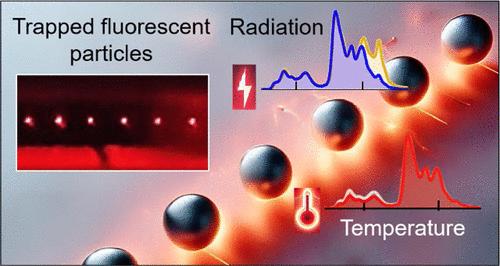
Today, upconverting luminescent particles are routinely used as accurate and reliable probes to remotely measure the temperature of minute volumes of matter on the order of attoliters. Lanthanide-doped particles exhibit adaptability as optical nanothermometers within biological systems, aiding the understanding of cellular dynamics, pathology, and physiology. Herein, we investigate the intrinsic optical response of Er/Yb-doped single particles levitating in a vacuum and compare it with the collective response of ensembles of particles embedded in application-relevant wet and dry environments. We make use of a quadrupole Paul trap that employs a time-varying electric field to confine single Er/Yb-doped particles in a vacuum and a thermal bath module to study particles in the above-mentioned environments. Both subsystems use twin-excitation/detection setups that allow us to record luminescence spectra, covering 4 orders of magnitude in laser intensity (e.g., 10–1–103 W/cm2 at 980 nm) and temperatures from 20 up to 200 °C. We revisit the well-established reliability of ratiometric measurements to accurately measure temperature. We find an almost perfect overlap of the experimental Boltzmann factor as a function of temperature for water, ethanol, and air–substrate environments, which is then used to retrieve the temperature of particles levitating in vacuum. We also explored the influence of the surrounding environment for increasing laser intensities by numerically and experimentally examining the balance among relevant emission bands. Our simulations qualitatively reproduce the experimentally measured luminescence in different environments, yielding a single model to simultaneously explain the laser intensity dependence of UV–NIR transitions for both the low and strong laser excitation regimes. Our findings hold great potential to expand the range of applicability of upconverting particles as dual sensors of temperature and laser intensity in different media relevant to biological and nanophotonic applications.
期刊介绍:
Published as soon as accepted and summarized in monthly issues, ACS Photonics will publish Research Articles, Letters, Perspectives, and Reviews, to encompass the full scope of published research in this field.




 京公网安备 11010802042870号
京ICP备2023020795号-1
京公网安备 11010802042870号
京ICP备2023020795号-1

 分享
分享
 求助内容:
求助内容: 应助结果提醒方式:
 扫码关注我们
