Jie Ma, Youshudi Xie, Fengyun Tian, Mei Chen, Xingrong Zhou, Changli Yang, Tian Deng, Houhong Xiao, Xue Dong, Dingli Chen, Yanfen Yang, Xinlong Dai, Tao Xia
{"title":"Plant Tannase: Evolutionary and Functional Divergence Features","authors":"Jie Ma, Youshudi Xie, Fengyun Tian, Mei Chen, Xingrong Zhou, Changli Yang, Tian Deng, Houhong Xiao, Xue Dong, Dingli Chen, Yanfen Yang, Xinlong Dai, Tao Xia","doi":"10.1021/acs.jafc.4c12975","DOIUrl":null,"url":null,"abstract":"In plants, α/β-hydrolase regulates the hydrolysis of ester compounds, enriching the types and functions of specialized metabolites. In this study, three genes─<i>CsCSE</i>, <i>CsCXE3</i>, and <i>CsTA</i>─which encode caffeoyl shikimate esterase (CSE), carboxylesterase (CXE), and tannase (TA), respectively, were isolated from the tea plant genome through multiomics correlation analysis. Evolutionary analysis showed that CSE and CXE were ancient, whereas TA emerged in core eudicots approximately 120 million years ago. Enzyme activity assays revealed that CsCSE and CsCXE3 catalyze phenolic acid and acetate ester hydrolysis, respectively. Interestingly, CsTA not only has the catalytic function of CsCSE and CsCXE3 but also catalyzes the hydrolysis of galloylated catechin, hydrolyzable tannin, and hormone ester. Overall, CsTA is a newly derived α/β-hydrolase with evolutionary and functional divergence features. This study expands our understanding of the physiological significance of plant TA and provides insights into the potential role of <i>CsTA</i> in the complex metabolic processes of tea plants.","PeriodicalId":41,"journal":{"name":"Journal of Agricultural and Food Chemistry","volume":"10 1","pages":""},"PeriodicalIF":6.2000,"publicationDate":"2025-03-27","publicationTypes":"Journal Article","fieldsOfStudy":null,"isOpenAccess":false,"openAccessPdf":"","citationCount":"0","resultStr":null,"platform":"Semanticscholar","paperid":null,"PeriodicalName":"Journal of Agricultural and Food Chemistry","FirstCategoryId":"97","ListUrlMain":"https://doi.org/10.1021/acs.jafc.4c12975","RegionNum":1,"RegionCategory":"农林科学","ArticlePicture":[],"TitleCN":null,"AbstractTextCN":null,"PMCID":null,"EPubDate":"","PubModel":"","JCR":"Q1","JCRName":"AGRICULTURE, MULTIDISCIPLINARY","Score":null,"Total":0}
引用次数: 0
Abstract
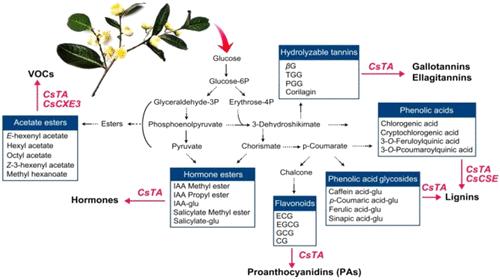
In plants, α/β-hydrolase regulates the hydrolysis of ester compounds, enriching the types and functions of specialized metabolites. In this study, three genes─CsCSE, CsCXE3, and CsTA─which encode caffeoyl shikimate esterase (CSE), carboxylesterase (CXE), and tannase (TA), respectively, were isolated from the tea plant genome through multiomics correlation analysis. Evolutionary analysis showed that CSE and CXE were ancient, whereas TA emerged in core eudicots approximately 120 million years ago. Enzyme activity assays revealed that CsCSE and CsCXE3 catalyze phenolic acid and acetate ester hydrolysis, respectively. Interestingly, CsTA not only has the catalytic function of CsCSE and CsCXE3 but also catalyzes the hydrolysis of galloylated catechin, hydrolyzable tannin, and hormone ester. Overall, CsTA is a newly derived α/β-hydrolase with evolutionary and functional divergence features. This study expands our understanding of the physiological significance of plant TA and provides insights into the potential role of CsTA in the complex metabolic processes of tea plants.
期刊介绍:
The Journal of Agricultural and Food Chemistry publishes high-quality, cutting edge original research representing complete studies and research advances dealing with the chemistry and biochemistry of agriculture and food. The Journal also encourages papers with chemistry and/or biochemistry as a major component combined with biological/sensory/nutritional/toxicological evaluation related to agriculture and/or food.



 京公网安备 11010802042870号
京ICP备2023020795号-1
京公网安备 11010802042870号
京ICP备2023020795号-1

 分享
分享
 求助内容:
求助内容: 应助结果提醒方式:
 扫码关注我们
