Suiqing Zhou , Liren Zhang , Yue You , Kai Yu , Xiaofeng Tie , Yun Gao , Yining Chen , Feifan Yao , Ruizhi Zhang , Xiaopei Hao , Chunyao Fang , Xiangdong Li , Qing Li , Xuehao Wang
{"title":"eIF3f promotes tumour malignancy by remodelling fatty acid biosynthesis in hepatocellular carcinoma","authors":"Suiqing Zhou , Liren Zhang , Yue You , Kai Yu , Xiaofeng Tie , Yun Gao , Yining Chen , Feifan Yao , Ruizhi Zhang , Xiaopei Hao , Chunyao Fang , Xiangdong Li , Qing Li , Xuehao Wang","doi":"10.1016/j.jhep.2025.02.045","DOIUrl":null,"url":null,"abstract":"<div><h3>Background & Aims</h3><div>Fatty acid metabolism is closely associated with hepatocellular carcinoma (HCC). Elucidating the molecules that influence fatty acid metabolism in HCC is important for developing precision therapies. However, uncovering the precise molecular mechanisms underlying changes in fatty acid metabolism in tumour cells is challenging. In this study, we aimed to determine the characteristics of fatty acid metabolism in HCC.</div></div><div><h3>Methods</h3><div><span>We employed organoid models, single-cell RNA sequencing<span><span><span><span>, and spatial transcriptomics to identify key genes involved in tumour fatty acid metabolism. </span>Metabolomics, </span>proteomics, </span>metabolic flux analysis, and </span></span>transmission electron microscopy<span><span> were utilized to evaluate this metabolic process. Tumour malignancy was characterized using multi-species models. Changes in the immune microenvironment were analysed by time-of-flight mass cytometry and multiplexed immunohistochemistry. </span>Gene knockdown<span> targeting the liver was achieved using lipid nanoparticles.</span></span></div></div><div><h3>Results</h3><div><span><span><span><span><span>Eukaryotic translation initiation factor 3 subunit f (eIF3f) is upregulated in HCC tissues and is associated with poor prognosis. eIF3f directly interacted with and stabilised long chain </span>acyl CoA synthetase 4 (ACSL4) through K48-linked </span>deubiquitination, promoting </span>fatty acid biosynthesis and malignancy. The increased </span>fatty acid levels<span> in the tumour microenvironment<span> indirectly reduced CD8</span></span></span><sup>+</sup><span> T-cell infiltration. In addition, phosphorylated eIF3f enhanced the interaction between eIF3f and ACSL4.</span></div></div><div><h3>Conclusions</h3><div>Targeting the eIF3f-ACSL4-fatty acid biosynthesis axis could decelerate the progression of HCC and enhance anti-programmed cell death-1 efficacy, implicating eIF3f as a potential target for precision therapy in HCC.</div></div><div><h3>Impact and implications</h3><div>Fatty acid metabolism is closely associated with hepatocellular carcinoma (HCC), yet the underlying mechanisms involved remain unclear. Here, we found that eIF3f is upregulated in HCC and is associated with poor prognosis. eIF3f interacts with and stabilizes ACSL4, thereby promoting fatty acid biosynthesis. Additionally, increased fatty acid levels reduce CD8<sup>+</sup> T-cell infiltration and activation. These findings are of significant importance for clinicians and researchers in the field of HCC treatment, as eIF3f inhibition combined with anti-PD-1 therapy significantly improved anti-tumour efficacy in a mouse model and could offer therapeutic benefits for patients. These findings have practical implications, as eIF3f could serve as a novel therapeutic target in HCC. However, further clinical studies are needed to confirm the efficacy of eIF3f targeting in human patients.</div></div>","PeriodicalId":15888,"journal":{"name":"Journal of Hepatology","volume":"83 3","pages":"Pages 712-728"},"PeriodicalIF":33.0000,"publicationDate":"2025-03-26","publicationTypes":"Journal Article","fieldsOfStudy":null,"isOpenAccess":false,"openAccessPdf":"","citationCount":"0","resultStr":null,"platform":"Semanticscholar","paperid":null,"PeriodicalName":"Journal of Hepatology","FirstCategoryId":"3","ListUrlMain":"https://www.sciencedirect.com/science/article/pii/S0168827825002065","RegionNum":1,"RegionCategory":"医学","ArticlePicture":[],"TitleCN":null,"AbstractTextCN":null,"PMCID":null,"EPubDate":"","PubModel":"","JCR":"Q1","JCRName":"GASTROENTEROLOGY & HEPATOLOGY","Score":null,"Total":0}
引用次数: 0
Abstract
Background & Aims
Fatty acid metabolism is closely associated with hepatocellular carcinoma (HCC). Elucidating the molecules that influence fatty acid metabolism in HCC is important for developing precision therapies. However, uncovering the precise molecular mechanisms underlying changes in fatty acid metabolism in tumour cells is challenging. In this study, we aimed to determine the characteristics of fatty acid metabolism in HCC.
Methods
We employed organoid models, single-cell RNA sequencing, and spatial transcriptomics to identify key genes involved in tumour fatty acid metabolism. Metabolomics, proteomics, metabolic flux analysis, and transmission electron microscopy were utilized to evaluate this metabolic process. Tumour malignancy was characterized using multi-species models. Changes in the immune microenvironment were analysed by time-of-flight mass cytometry and multiplexed immunohistochemistry. Gene knockdown targeting the liver was achieved using lipid nanoparticles.
Results
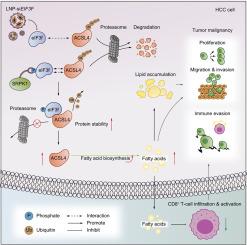
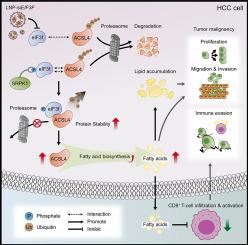
Eukaryotic translation initiation factor 3 subunit f (eIF3f) is upregulated in HCC tissues and is associated with poor prognosis. eIF3f directly interacted with and stabilised long chain acyl CoA synthetase 4 (ACSL4) through K48-linked deubiquitination, promoting fatty acid biosynthesis and malignancy. The increased fatty acid levels in the tumour microenvironment indirectly reduced CD8+ T-cell infiltration. In addition, phosphorylated eIF3f enhanced the interaction between eIF3f and ACSL4.
Conclusions
Targeting the eIF3f-ACSL4-fatty acid biosynthesis axis could decelerate the progression of HCC and enhance anti-programmed cell death-1 efficacy, implicating eIF3f as a potential target for precision therapy in HCC.
Impact and implications
Fatty acid metabolism is closely associated with hepatocellular carcinoma (HCC), yet the underlying mechanisms involved remain unclear. Here, we found that eIF3f is upregulated in HCC and is associated with poor prognosis. eIF3f interacts with and stabilizes ACSL4, thereby promoting fatty acid biosynthesis. Additionally, increased fatty acid levels reduce CD8+ T-cell infiltration and activation. These findings are of significant importance for clinicians and researchers in the field of HCC treatment, as eIF3f inhibition combined with anti-PD-1 therapy significantly improved anti-tumour efficacy in a mouse model and could offer therapeutic benefits for patients. These findings have practical implications, as eIF3f could serve as a novel therapeutic target in HCC. However, further clinical studies are needed to confirm the efficacy of eIF3f targeting in human patients.
期刊介绍:
The Journal of Hepatology is the official publication of the European Association for the Study of the Liver (EASL). It is dedicated to presenting clinical and basic research in the field of hepatology through original papers, reviews, case reports, and letters to the Editor. The Journal is published in English and may consider supplements that pass an editorial review.



 京公网安备 11010802042870号
京ICP备2023020795号-1
京公网安备 11010802042870号
京ICP备2023020795号-1

 分享
分享
 求助内容:
求助内容: 应助结果提醒方式:
 扫码关注我们
