Changhoon Yoo , Makoto Ueno , Heinz-Josef Klümpen , Robin Kate Kelley , Arndt Vogel , Junji Furuse , Zhenggang Ren , Thomas Yau , Stephen Lam Chan , Masato Ozaka , Sang Cheul Oh , Shanzhi Gu , Joon Oh Park , Juan W. Valle , Julien Edeline , Jong Gwang Kim , Shital Kamble , Josephine M. Norquist , Li Yu , Usha Malhotra , Richard S. Finn
{"title":"Health-related quality of life in participants with advanced biliary tract cancer from the randomized phase III KEYNOTE-966 study","authors":"Changhoon Yoo , Makoto Ueno , Heinz-Josef Klümpen , Robin Kate Kelley , Arndt Vogel , Junji Furuse , Zhenggang Ren , Thomas Yau , Stephen Lam Chan , Masato Ozaka , Sang Cheul Oh , Shanzhi Gu , Joon Oh Park , Juan W. Valle , Julien Edeline , Jong Gwang Kim , Shital Kamble , Josephine M. Norquist , Li Yu , Usha Malhotra , Richard S. Finn","doi":"10.1016/j.jhep.2025.03.019","DOIUrl":null,"url":null,"abstract":"<div><h3>Background & Aims</h3><div><span><span>In the randomized, double-blind, phase III KEYNOTE-966 trial, the addition of pembrolizumab<span> to gemcitabine<span> and cisplatin (GemCis) led to a significant improvement in </span></span></span>overall survival </span><em>vs</em><span><span>. GemCis alone for the first-line treatment of advanced biliary tract cancer (BTC). Herein, we present the prespecified health-related </span>quality of life (HRQoL) outcomes from KEYNOTE-966.</span></div></div><div><h3>Methods</h3><div>HRQoL was assessed using the EORTC Core Quality of Life Questionnaire (QLQ-C30), EORTC QLQ-BIL21, and EQ-5D-5L questionnaires. Data from the latest time point with ≥60% completion and ≥80% compliance (week 18) were compared to baseline. Least squares<span> means for change from baseline to week 18 were compared using a constrained longitudinal analysis model in six prespecified domains: QLQ-C30 global health status/quality of life, physical functioning, and role functioning; QLQ-BIL21 pain and jaundice scores, and EQ-5D-5L visual analogue score. The analysis population was all treated participants with ≥1 completed HRQoL assessment<span>. Between-arm difference in time to confirmed deterioration was assessed using a stratified Cox proportional hazards model with randomization stratification factors.</span></span></div></div><div><h3>Results</h3><div><span>In KEYNOTE-966, 1,069 participants were randomized (533 to the GemCis+pembrolizumab arm and 536 to the GemCis+placebo arm). Questionnaire compliance was >87% from baseline to week 18 in both arms. Least squares means changes from baseline to week 18 were similar between arms for all prespecified domains. Time to confirmed deterioration estimates were also similar between arms, including for global health status/quality of life (median not reached [NR] in the pembrolizumab arm </span><em>vs</em>. 21.2 months in the placebo arm; hazard ratio [HR] 0.86, 95% CI 0.70-1.07); jaundice (NR <em>vs.</em> NR; HR 1.20, 95% CI 0.94-1.54), and pain (NR <em>vs</em>. NR; HR 0.79, 95% CI 0.59-1.05).</div></div><div><h3>Conclusion</h3><div>HRQoL was maintained after adding pembrolizumab to GemCis, further supporting this regimen as a first-line treatment option for advanced BTC.</div></div><div><h3>Impact and implications</h3><div>Biliary tract cancer (BTC) is often diagnosed at late stages because most patients do not present with disease-specific symptoms. Compared with the general population, patients with advanced BTC report worse physical, emotional, and functional well-being. In KEYNOTE-966, adding the PD-1 (programmed cell death protein 1) inhibitor pembrolizumab to gemcitabine<span> and cisplatin as first-line therapy for participants with advanced BTC produced a statistically significant and clinically meaningful improvement in overall survival. The prespecified patient-reported outcome results from KEYNOTE-966 presented herein demonstrated that health-related quality of life was maintained after adding pembrolizumab to gemcitabine and cisplatin, further supporting this regimen as a first-line treatment option for advanced BTC.</span></div></div><div><h3>Clinical trial registration</h3><div>NCT04924062.</div></div>","PeriodicalId":15888,"journal":{"name":"Journal of Hepatology","volume":"83 3","pages":"Pages 692-700"},"PeriodicalIF":33.0000,"publicationDate":"2025-09-01","publicationTypes":"Journal Article","fieldsOfStudy":null,"isOpenAccess":false,"openAccessPdf":"","citationCount":"0","resultStr":null,"platform":"Semanticscholar","paperid":null,"PeriodicalName":"Journal of Hepatology","FirstCategoryId":"3","ListUrlMain":"https://www.sciencedirect.com/science/article/pii/S0168827825002077","RegionNum":1,"RegionCategory":"医学","ArticlePicture":[],"TitleCN":null,"AbstractTextCN":null,"PMCID":null,"EPubDate":"2025/3/27 0:00:00","PubModel":"Epub","JCR":"Q1","JCRName":"GASTROENTEROLOGY & HEPATOLOGY","Score":null,"Total":0}
引用次数: 0
Abstract
Background & Aims
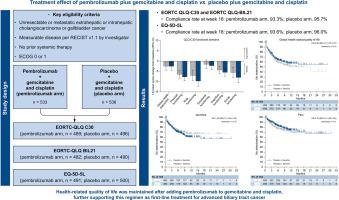
In the randomized, double-blind, phase III KEYNOTE-966 trial, the addition of pembrolizumab to gemcitabine and cisplatin (GemCis) led to a significant improvement in overall survival vs. GemCis alone for the first-line treatment of advanced biliary tract cancer (BTC). Herein, we present the prespecified health-related quality of life (HRQoL) outcomes from KEYNOTE-966.
Methods
HRQoL was assessed using the EORTC Core Quality of Life Questionnaire (QLQ-C30), EORTC QLQ-BIL21, and EQ-5D-5L questionnaires. Data from the latest time point with ≥60% completion and ≥80% compliance (week 18) were compared to baseline. Least squares means for change from baseline to week 18 were compared using a constrained longitudinal analysis model in six prespecified domains: QLQ-C30 global health status/quality of life, physical functioning, and role functioning; QLQ-BIL21 pain and jaundice scores, and EQ-5D-5L visual analogue score. The analysis population was all treated participants with ≥1 completed HRQoL assessment. Between-arm difference in time to confirmed deterioration was assessed using a stratified Cox proportional hazards model with randomization stratification factors.
Results
In KEYNOTE-966, 1,069 participants were randomized (533 to the GemCis+pembrolizumab arm and 536 to the GemCis+placebo arm). Questionnaire compliance was >87% from baseline to week 18 in both arms. Least squares means changes from baseline to week 18 were similar between arms for all prespecified domains. Time to confirmed deterioration estimates were also similar between arms, including for global health status/quality of life (median not reached [NR] in the pembrolizumab arm vs. 21.2 months in the placebo arm; hazard ratio [HR] 0.86, 95% CI 0.70-1.07); jaundice (NR vs. NR; HR 1.20, 95% CI 0.94-1.54), and pain (NR vs. NR; HR 0.79, 95% CI 0.59-1.05).
Conclusion
HRQoL was maintained after adding pembrolizumab to GemCis, further supporting this regimen as a first-line treatment option for advanced BTC.
Impact and implications
Biliary tract cancer (BTC) is often diagnosed at late stages because most patients do not present with disease-specific symptoms. Compared with the general population, patients with advanced BTC report worse physical, emotional, and functional well-being. In KEYNOTE-966, adding the PD-1 (programmed cell death protein 1) inhibitor pembrolizumab to gemcitabine and cisplatin as first-line therapy for participants with advanced BTC produced a statistically significant and clinically meaningful improvement in overall survival. The prespecified patient-reported outcome results from KEYNOTE-966 presented herein demonstrated that health-related quality of life was maintained after adding pembrolizumab to gemcitabine and cisplatin, further supporting this regimen as a first-line treatment option for advanced BTC.
期刊介绍:
The Journal of Hepatology is the official publication of the European Association for the Study of the Liver (EASL). It is dedicated to presenting clinical and basic research in the field of hepatology through original papers, reviews, case reports, and letters to the Editor. The Journal is published in English and may consider supplements that pass an editorial review.





 京公网安备 11010802042870号
京ICP备2023020795号-1
京公网安备 11010802042870号
京ICP备2023020795号-1

 分享
分享
 求助内容:
求助内容: 应助结果提醒方式:
 扫码关注我们
