Influence of Silver Doping and Anodization Current Density on Aluminum Surface Properties and Surface Adhesion of Staphylococcus aureus and Escherichia coli
Mustafa Erbakan, Muharrem Taşdemir, Fatih Şenaslan, Oğuz Yunus Sarıbıyık
{"title":"Influence of Silver Doping and Anodization Current Density on Aluminum Surface Properties and Surface Adhesion of Staphylococcus aureus and Escherichia coli","authors":"Mustafa Erbakan, Muharrem Taşdemir, Fatih Şenaslan, Oğuz Yunus Sarıbıyık","doi":"10.1021/acs.langmuir.5c00698","DOIUrl":null,"url":null,"abstract":"In this study, we investigated the influence of crystal structure, topography, and elemental composition of aluminum oxide surfaces on bacterial adhesion. The structural properties of the surfaces were systematically controlled by varying the current density (1.5, 2.0, and 2.5 A/dm<sup>2</sup>) and silver doping during the anodization process. The resulting changes in structural and morphological properties were examined by using X-ray diffraction (XRD), X-ray photoelectron spectroscopy (XPS), field emission scanning electron microscopy (FE-SEM), contact angle measurements, and profilometry. Using FE-SEM analysis, we evaluated the adhesion of model bacteria, <i>Escherichia coli</i> and <i>Staphylococcus aureus</i>, to surfaces exhibiting diverse morphologies and elemental compositions. The surface roughness and crystal size of the aluminum oxide increased proportionally with the applied current density and silver doping. According to the XRD results, the slip plane crystal structure of (311) increased proportionally to the current density but decreased with silver doping. Specifically, while stepped atomic alignment of (311) planes facilitates bacterial attachment, smoother (200) planes reduce the adhered bacteria population. Further analysis via XPS revealed that the oxide crystal structure of undoped surfaces shifted from the tetrahedral to octahedral form with increasing current density, while silver-doped surfaces exhibited the opposite trend. Additionally, increasing current density during the preparation of silver-doped surfaces diminished the ratio of ionic silver to metallic silver, suggesting a lowered propensity for bacterial adhesion. <i>S. aureus</i> adhesion to undoped surfaces increased 4.46-fold for surfaces prepared at 2.5 A/dm<sup>2</sup> compared to that at 1.5 A/dm<sup>2</sup>. Moreover, <i>E. coli</i> adhesion was completely inhibited on silver-doped surfaces anodized at 1.5 A/dm<sup>2</sup>. Reducing the surface roughness and incorporating silver during the anodization of aluminum surfaces decrease the number of bacteria adhering to aluminum oxide surfaces.","PeriodicalId":50,"journal":{"name":"Langmuir","volume":"3 1","pages":""},"PeriodicalIF":3.9000,"publicationDate":"2025-03-27","publicationTypes":"Journal Article","fieldsOfStudy":null,"isOpenAccess":false,"openAccessPdf":"","citationCount":"0","resultStr":null,"platform":"Semanticscholar","paperid":null,"PeriodicalName":"Langmuir","FirstCategoryId":"92","ListUrlMain":"https://doi.org/10.1021/acs.langmuir.5c00698","RegionNum":2,"RegionCategory":"化学","ArticlePicture":[],"TitleCN":null,"AbstractTextCN":null,"PMCID":null,"EPubDate":"","PubModel":"","JCR":"Q2","JCRName":"CHEMISTRY, MULTIDISCIPLINARY","Score":null,"Total":0}
引用次数: 0
Abstract
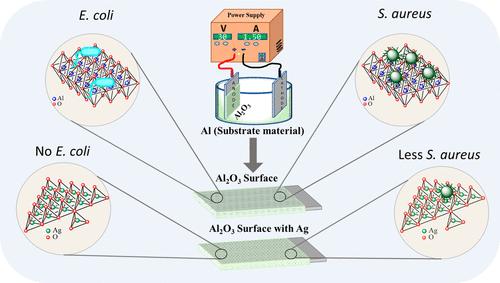
In this study, we investigated the influence of crystal structure, topography, and elemental composition of aluminum oxide surfaces on bacterial adhesion. The structural properties of the surfaces were systematically controlled by varying the current density (1.5, 2.0, and 2.5 A/dm2) and silver doping during the anodization process. The resulting changes in structural and morphological properties were examined by using X-ray diffraction (XRD), X-ray photoelectron spectroscopy (XPS), field emission scanning electron microscopy (FE-SEM), contact angle measurements, and profilometry. Using FE-SEM analysis, we evaluated the adhesion of model bacteria, Escherichia coli and Staphylococcus aureus, to surfaces exhibiting diverse morphologies and elemental compositions. The surface roughness and crystal size of the aluminum oxide increased proportionally with the applied current density and silver doping. According to the XRD results, the slip plane crystal structure of (311) increased proportionally to the current density but decreased with silver doping. Specifically, while stepped atomic alignment of (311) planes facilitates bacterial attachment, smoother (200) planes reduce the adhered bacteria population. Further analysis via XPS revealed that the oxide crystal structure of undoped surfaces shifted from the tetrahedral to octahedral form with increasing current density, while silver-doped surfaces exhibited the opposite trend. Additionally, increasing current density during the preparation of silver-doped surfaces diminished the ratio of ionic silver to metallic silver, suggesting a lowered propensity for bacterial adhesion. S. aureus adhesion to undoped surfaces increased 4.46-fold for surfaces prepared at 2.5 A/dm2 compared to that at 1.5 A/dm2. Moreover, E. coli adhesion was completely inhibited on silver-doped surfaces anodized at 1.5 A/dm2. Reducing the surface roughness and incorporating silver during the anodization of aluminum surfaces decrease the number of bacteria adhering to aluminum oxide surfaces.
期刊介绍:
Langmuir is an interdisciplinary journal publishing articles in the following subject categories:
Colloids: surfactants and self-assembly, dispersions, emulsions, foams
Interfaces: adsorption, reactions, films, forces
Biological Interfaces: biocolloids, biomolecular and biomimetic materials
Materials: nano- and mesostructured materials, polymers, gels, liquid crystals
Electrochemistry: interfacial charge transfer, charge transport, electrocatalysis, electrokinetic phenomena, bioelectrochemistry
Devices and Applications: sensors, fluidics, patterning, catalysis, photonic crystals
However, when high-impact, original work is submitted that does not fit within the above categories, decisions to accept or decline such papers will be based on one criteria: What Would Irving Do?
Langmuir ranks #2 in citations out of 136 journals in the category of Physical Chemistry with 113,157 total citations. The journal received an Impact Factor of 4.384*.
This journal is also indexed in the categories of Materials Science (ranked #1) and Multidisciplinary Chemistry (ranked #5).



 京公网安备 11010802042870号
京ICP备2023020795号-1
京公网安备 11010802042870号
京ICP备2023020795号-1

 分享
分享
 求助内容:
求助内容: 应助结果提醒方式:
 扫码关注我们
