Rao Tao , Hui Zheng , Zhi Hu , Qihui Wang , Qinyuan Tang , Qiucheng Fu , Jian Xiang , Hongfei Zhang , Wentian Wang , Yepeng Yang
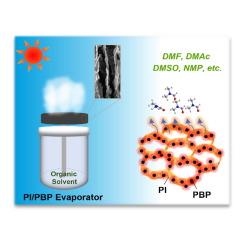
{"title":"Efficient solar-driven interfacial evaporation of high-boiling organic solvents over arylamine-based conjugated microporous polymer/polyimide aerogels","authors":"Rao Tao , Hui Zheng , Zhi Hu , Qihui Wang , Qinyuan Tang , Qiucheng Fu , Jian Xiang , Hongfei Zhang , Wentian Wang , Yepeng Yang","doi":"10.1016/j.seppur.2025.132702","DOIUrl":null,"url":null,"abstract":"<div><div>Herein, a promising solar-driven interfacial evaporation technology was developed for the efficient separation of high-boiling organic solvents. Three novel arylamine-based conjugated microporous polymer/polyimide aerogels, PI/PBP-Tr, PI/PBP-Te, and PI/PBP-He, were successfully synthesized through directional freezing technology, with a low thermal conductivity of 0.037, 0.035, and 0.034 W·m<sup>−1</sup>·k<sup>−1</sup>. The as-prepared PI/PBP aerogels exhibited remarkable solar-driven evaporation capabilities in high-boiling solvents including <em>N</em>, <em>N</em>-dimethylformamide (DMF), <em>N</em>, <em>N</em>-dimethylacetamide (DMAc), dimethyl sulfoxide (DMSO), and <em>N</em>-methylpyrrolidone (NMP). Under 1 sun illumination, the PI/PBP-Tr, PI/PBP-Te, and PI/PBP-He evaporators achieved high evaporation rates of 2.47, 2.56, and 2.65 kg·m<sup>−2</sup>·h<sup>−1</sup> for DMF, respectively. PI/PBP-He evaporator had evaporation rates of 1.63, 1.02, and 0.54 kg·m<sup>−2</sup>·h<sup>−1</sup> for DMAc, DMSO, and NMP, respectively. Furthermore, the PI/PBP-He evaporator exhibited exceptional purification performance, achieving retention rates of over 99 % for dye molecules such as basic fuchsin, rhodamine B, and methyl orange.</div></div>","PeriodicalId":427,"journal":{"name":"Separation and Purification Technology","volume":"365 ","pages":"Article 132702"},"PeriodicalIF":9.0000,"publicationDate":"2025-03-26","publicationTypes":"Journal Article","fieldsOfStudy":null,"isOpenAccess":false,"openAccessPdf":"","citationCount":"0","resultStr":null,"platform":"Semanticscholar","paperid":null,"PeriodicalName":"Separation and Purification Technology","FirstCategoryId":"5","ListUrlMain":"https://www.sciencedirect.com/science/article/pii/S1383586625012997","RegionNum":1,"RegionCategory":"工程技术","ArticlePicture":[],"TitleCN":null,"AbstractTextCN":null,"PMCID":null,"EPubDate":"","PubModel":"","JCR":"Q1","JCRName":"ENGINEERING, CHEMICAL","Score":null,"Total":0}
引用次数: 0
Abstract
Herein, a promising solar-driven interfacial evaporation technology was developed for the efficient separation of high-boiling organic solvents. Three novel arylamine-based conjugated microporous polymer/polyimide aerogels, PI/PBP-Tr, PI/PBP-Te, and PI/PBP-He, were successfully synthesized through directional freezing technology, with a low thermal conductivity of 0.037, 0.035, and 0.034 W·m−1·k−1. The as-prepared PI/PBP aerogels exhibited remarkable solar-driven evaporation capabilities in high-boiling solvents including N, N-dimethylformamide (DMF), N, N-dimethylacetamide (DMAc), dimethyl sulfoxide (DMSO), and N-methylpyrrolidone (NMP). Under 1 sun illumination, the PI/PBP-Tr, PI/PBP-Te, and PI/PBP-He evaporators achieved high evaporation rates of 2.47, 2.56, and 2.65 kg·m−2·h−1 for DMF, respectively. PI/PBP-He evaporator had evaporation rates of 1.63, 1.02, and 0.54 kg·m−2·h−1 for DMAc, DMSO, and NMP, respectively. Furthermore, the PI/PBP-He evaporator exhibited exceptional purification performance, achieving retention rates of over 99 % for dye molecules such as basic fuchsin, rhodamine B, and methyl orange.
期刊介绍:
Separation and Purification Technology is a premier journal committed to sharing innovative methods for separation and purification in chemical and environmental engineering, encompassing both homogeneous solutions and heterogeneous mixtures. Our scope includes the separation and/or purification of liquids, vapors, and gases, as well as carbon capture and separation techniques. However, it's important to note that methods solely intended for analytical purposes are not within the scope of the journal. Additionally, disciplines such as soil science, polymer science, and metallurgy fall outside the purview of Separation and Purification Technology. Join us in advancing the field of separation and purification methods for sustainable solutions in chemical and environmental engineering.




 京公网安备 11010802042870号
京ICP备2023020795号-1
京公网安备 11010802042870号
京ICP备2023020795号-1

 分享
分享
 求助内容:
求助内容: 应助结果提醒方式:
 扫码关注我们
