Mohammadreza Farrokhnia, Bahareh Babamiri, Mehdi Mohammadi, Amir Sanati Nezhad
{"title":"MIP-Chip: Integrated Microfluidic Plasma Separation and Redox-Enhanced Molecularly Imprinted Polymer Succinate Sensor for Whole Blood Metabolite Analysis","authors":"Mohammadreza Farrokhnia, Bahareh Babamiri, Mehdi Mohammadi, Amir Sanati Nezhad","doi":"10.1021/acssensors.5c00355","DOIUrl":null,"url":null,"abstract":"The precise quantification of metabolites in bodily fluids is essential for advancing digital health monitoring and clinical diagnostics. Among these fluids, whole blood stands out as a valuable source of predictive metabolite biomarkers, providing critical insights into disease diagnosis and progression. However, traditional blood testing methods often require expensive instrumentation and specialized training, primarily due to the need for plasma extraction to remove interfering blood cells. This study addresses these limitations by introducing a novel, sensitive, rapid, reagent-free, and cost-effective capillary microfluidic-integrated molecularly imprinted polymer (MIP) sensor (MIP-Chip) designed for metabolite detection in whole blood. The MIP-Chip integrates two key components: (1) a highly efficient plasma separation module capable of extracting plasma from whole blood (∼95% efficiency) without requiring sample pretreatment or external active forces and (2) an electrochemical MIP sensor employing an ultrasensitive electrode with on-electrode Prussian Blue nanoparticles (PB NPs) as embedded redox probes for sensitive and specific metabolite detection in the extracted plasma. Using this platform, we successfully quantified succinate, a critical metabolite, across a wide linear concentration range (50 nM–250 μM) with a limit of detection of 5 nM. The device processed 120 μL of whole blood, delivering 8 μL of plasma, and completed the entire workflow-from sample introduction to biomarker detection within 25 min. The MIP-Chip demonstrated exceptional performance, including self-powered assay automation, high specificity for succinate quantification in whole blood, excellent reproducibility, and long-term stability of the MIP-based sensor. These features establish the MIP-Chip as a powerful analytical platform for point-of-care diagnostics, offering a significant step forward in clinical metabolite detection and digital health monitoring.","PeriodicalId":24,"journal":{"name":"ACS Sensors","volume":"30 1","pages":""},"PeriodicalIF":9.1000,"publicationDate":"2025-03-27","publicationTypes":"Journal Article","fieldsOfStudy":null,"isOpenAccess":false,"openAccessPdf":"","citationCount":"0","resultStr":null,"platform":"Semanticscholar","paperid":null,"PeriodicalName":"ACS Sensors","FirstCategoryId":"92","ListUrlMain":"https://doi.org/10.1021/acssensors.5c00355","RegionNum":1,"RegionCategory":"化学","ArticlePicture":[],"TitleCN":null,"AbstractTextCN":null,"PMCID":null,"EPubDate":"","PubModel":"","JCR":"Q1","JCRName":"CHEMISTRY, ANALYTICAL","Score":null,"Total":0}
引用次数: 0
Abstract
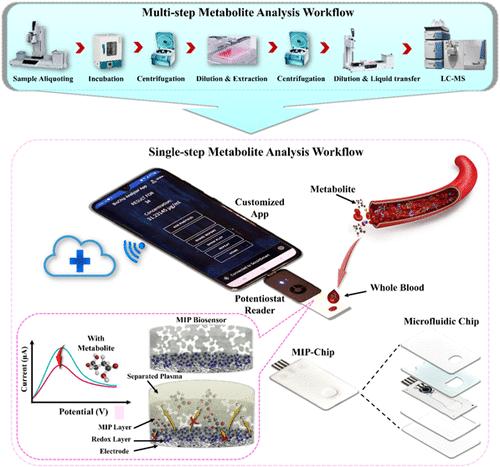
The precise quantification of metabolites in bodily fluids is essential for advancing digital health monitoring and clinical diagnostics. Among these fluids, whole blood stands out as a valuable source of predictive metabolite biomarkers, providing critical insights into disease diagnosis and progression. However, traditional blood testing methods often require expensive instrumentation and specialized training, primarily due to the need for plasma extraction to remove interfering blood cells. This study addresses these limitations by introducing a novel, sensitive, rapid, reagent-free, and cost-effective capillary microfluidic-integrated molecularly imprinted polymer (MIP) sensor (MIP-Chip) designed for metabolite detection in whole blood. The MIP-Chip integrates two key components: (1) a highly efficient plasma separation module capable of extracting plasma from whole blood (∼95% efficiency) without requiring sample pretreatment or external active forces and (2) an electrochemical MIP sensor employing an ultrasensitive electrode with on-electrode Prussian Blue nanoparticles (PB NPs) as embedded redox probes for sensitive and specific metabolite detection in the extracted plasma. Using this platform, we successfully quantified succinate, a critical metabolite, across a wide linear concentration range (50 nM–250 μM) with a limit of detection of 5 nM. The device processed 120 μL of whole blood, delivering 8 μL of plasma, and completed the entire workflow-from sample introduction to biomarker detection within 25 min. The MIP-Chip demonstrated exceptional performance, including self-powered assay automation, high specificity for succinate quantification in whole blood, excellent reproducibility, and long-term stability of the MIP-based sensor. These features establish the MIP-Chip as a powerful analytical platform for point-of-care diagnostics, offering a significant step forward in clinical metabolite detection and digital health monitoring.
期刊介绍:
ACS Sensors is a peer-reviewed research journal that focuses on the dissemination of new and original knowledge in the field of sensor science, particularly those that selectively sense chemical or biological species or processes. The journal covers a broad range of topics, including but not limited to biosensors, chemical sensors, gas sensors, intracellular sensors, single molecule sensors, cell chips, and microfluidic devices. It aims to publish articles that address conceptual advances in sensing technology applicable to various types of analytes or application papers that report on the use of existing sensing concepts in new ways or for new analytes.



 京公网安备 11010802042870号
京ICP备2023020795号-1
京公网安备 11010802042870号
京ICP备2023020795号-1

 分享
分享
 求助内容:
求助内容: 应助结果提醒方式:
 扫码关注我们
