{"title":"N-Type Silver Selenide Thermoelectric Cotton Thread for Antibacterial and Versatile Textile Electronics","authors":"Xiaolong Sun, Yue Hou, Zheng Zhu, Qianfeng Ding, Wenjie Zhou, Zhanglong Xia, Sijia Yan, Yong Liu, Qingqing He, Yang Yang, Ziyu Wang","doi":"10.1021/acssensors.4c03417","DOIUrl":null,"url":null,"abstract":"Thermoelectric textiles have garnered significant attention in energy harvesting and temperature sensing due to their comfort and reliable long-term power generation capabilities. However, existing thermoelectric textiles rarely realize antibacterial, high output performance, and sensing capabilities simultaneously. Here, we present a facile and scalable method for fabricating n-type silver selenide (Ag<sub>2</sub>Se) cotton threads with exceptional antibacterial, high power output, and advanced sensing capabilities. The Ag–Ag<sub>2</sub>Se segmented structures are prepared using the segmented selenization method. Subsequently, a thermoelectric textile consisting of 50 pairs of p–n legs is fabricated, which can generate a power density of 500 μW m<sup>–2</sup> at a temperature difference of 30 K, and it can provide an output voltage of 24.7 mV when worn on the arm at room temperature. The textile-based sensor exhibits temperature detection (0.7 K) and a response time (2.49 s). Integrating Ag<sub>2</sub>Se cotton threads onto textiles enables the utilization of multipixel touchpads for writing and communication. Additionally, these sensors can be incorporated into gloves to accurately detect the surrounding objects’ temperatures. This thermoelectric cotton thread not only facilitates energy harvesting but also establishes a solid foundation for widespread application in multifunctional textile electronics.","PeriodicalId":24,"journal":{"name":"ACS Sensors","volume":"50 1","pages":""},"PeriodicalIF":9.1000,"publicationDate":"2025-03-26","publicationTypes":"Journal Article","fieldsOfStudy":null,"isOpenAccess":false,"openAccessPdf":"","citationCount":"0","resultStr":null,"platform":"Semanticscholar","paperid":null,"PeriodicalName":"ACS Sensors","FirstCategoryId":"92","ListUrlMain":"https://doi.org/10.1021/acssensors.4c03417","RegionNum":1,"RegionCategory":"化学","ArticlePicture":[],"TitleCN":null,"AbstractTextCN":null,"PMCID":null,"EPubDate":"","PubModel":"","JCR":"Q1","JCRName":"CHEMISTRY, ANALYTICAL","Score":null,"Total":0}
引用次数: 0
Abstract
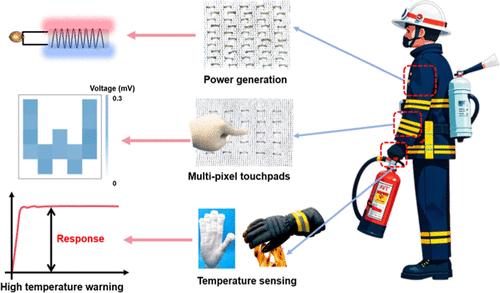
Thermoelectric textiles have garnered significant attention in energy harvesting and temperature sensing due to their comfort and reliable long-term power generation capabilities. However, existing thermoelectric textiles rarely realize antibacterial, high output performance, and sensing capabilities simultaneously. Here, we present a facile and scalable method for fabricating n-type silver selenide (Ag2Se) cotton threads with exceptional antibacterial, high power output, and advanced sensing capabilities. The Ag–Ag2Se segmented structures are prepared using the segmented selenization method. Subsequently, a thermoelectric textile consisting of 50 pairs of p–n legs is fabricated, which can generate a power density of 500 μW m–2 at a temperature difference of 30 K, and it can provide an output voltage of 24.7 mV when worn on the arm at room temperature. The textile-based sensor exhibits temperature detection (0.7 K) and a response time (2.49 s). Integrating Ag2Se cotton threads onto textiles enables the utilization of multipixel touchpads for writing and communication. Additionally, these sensors can be incorporated into gloves to accurately detect the surrounding objects’ temperatures. This thermoelectric cotton thread not only facilitates energy harvesting but also establishes a solid foundation for widespread application in multifunctional textile electronics.
期刊介绍:
ACS Sensors is a peer-reviewed research journal that focuses on the dissemination of new and original knowledge in the field of sensor science, particularly those that selectively sense chemical or biological species or processes. The journal covers a broad range of topics, including but not limited to biosensors, chemical sensors, gas sensors, intracellular sensors, single molecule sensors, cell chips, and microfluidic devices. It aims to publish articles that address conceptual advances in sensing technology applicable to various types of analytes or application papers that report on the use of existing sensing concepts in new ways or for new analytes.



 京公网安备 11010802042870号
京ICP备2023020795号-1
京公网安备 11010802042870号
京ICP备2023020795号-1

 分享
分享
 求助内容:
求助内容: 应助结果提醒方式:
 扫码关注我们
