Brandon R. Hill, Colin A. Cooke, Alberto V. Reyes, Murray K. Gingras
{"title":"Geology and Geomorphology Drive Polycyclic Aromatic Compound Concentrations and Composition in Rivers Draining the Alberta Oil Sands","authors":"Brandon R. Hill, Colin A. Cooke, Alberto V. Reyes, Murray K. Gingras","doi":"10.1021/acs.est.5c02074","DOIUrl":null,"url":null,"abstract":"Large-scale open-pit bitumen mining operations in Alberta, Canada, have raised concerns about contaminant releases to downstream ecosystems and communities. Among the contaminants of concern are polycyclic aromatic compounds (PACs), a toxic group of organic pollutants prevalent at high concentrations in bitumen. Here, we quantify PAC concentrations, loads, and yields in four rivers draining watersheds impacted by mining. These rivers also actively erode and incise the bitumen-bearing McMurray Formation, which has complicated previous attempts to distinguish natural from anthropogenic inputs. We collected 998 water quality samples from locations both upstream and downstream of mining, analyzed them for a broad suite of 48 unsubstituted and alkylated PAC homologues, and compared their compositional fingerprints to potential natural and anthropogenic sources. Erosion of bituminous outcrops, rather than industrial pollution, is the main driver behind PAC input and riverine transport, as supported by (i) discrepancies in loads and yields among watersheds with varying levels of industrial development, (ii) responses to hydrologic changes with respect to the distribution of mapped outcrops, and (iii) shifts in PAC relative abundances. This study presents evidence that PAC concentrations are primarily controlled by the presence of eroding bitumen-rich outcrops in conjunction with hydrographic profiles, rather than industrial impacts.","PeriodicalId":36,"journal":{"name":"环境科学与技术","volume":"19 1","pages":""},"PeriodicalIF":11.3000,"publicationDate":"2025-03-27","publicationTypes":"Journal Article","fieldsOfStudy":null,"isOpenAccess":false,"openAccessPdf":"","citationCount":"0","resultStr":null,"platform":"Semanticscholar","paperid":null,"PeriodicalName":"环境科学与技术","FirstCategoryId":"1","ListUrlMain":"https://doi.org/10.1021/acs.est.5c02074","RegionNum":1,"RegionCategory":"环境科学与生态学","ArticlePicture":[],"TitleCN":null,"AbstractTextCN":null,"PMCID":null,"EPubDate":"","PubModel":"","JCR":"Q1","JCRName":"ENGINEERING, ENVIRONMENTAL","Score":null,"Total":0}
引用次数: 0
Abstract
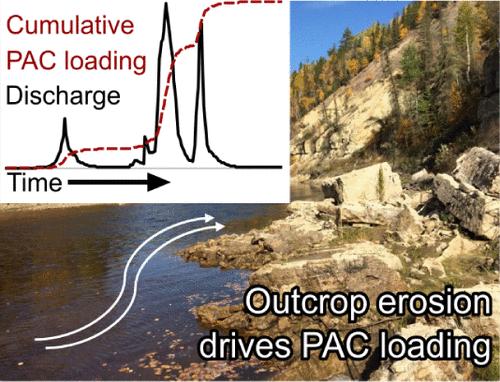
Large-scale open-pit bitumen mining operations in Alberta, Canada, have raised concerns about contaminant releases to downstream ecosystems and communities. Among the contaminants of concern are polycyclic aromatic compounds (PACs), a toxic group of organic pollutants prevalent at high concentrations in bitumen. Here, we quantify PAC concentrations, loads, and yields in four rivers draining watersheds impacted by mining. These rivers also actively erode and incise the bitumen-bearing McMurray Formation, which has complicated previous attempts to distinguish natural from anthropogenic inputs. We collected 998 water quality samples from locations both upstream and downstream of mining, analyzed them for a broad suite of 48 unsubstituted and alkylated PAC homologues, and compared their compositional fingerprints to potential natural and anthropogenic sources. Erosion of bituminous outcrops, rather than industrial pollution, is the main driver behind PAC input and riverine transport, as supported by (i) discrepancies in loads and yields among watersheds with varying levels of industrial development, (ii) responses to hydrologic changes with respect to the distribution of mapped outcrops, and (iii) shifts in PAC relative abundances. This study presents evidence that PAC concentrations are primarily controlled by the presence of eroding bitumen-rich outcrops in conjunction with hydrographic profiles, rather than industrial impacts.
期刊介绍:
Environmental Science & Technology (ES&T) is a co-sponsored academic and technical magazine by the Hubei Provincial Environmental Protection Bureau and the Hubei Provincial Academy of Environmental Sciences.
Environmental Science & Technology (ES&T) holds the status of Chinese core journals, scientific papers source journals of China, Chinese Science Citation Database source journals, and Chinese Academic Journal Comprehensive Evaluation Database source journals. This publication focuses on the academic field of environmental protection, featuring articles related to environmental protection and technical advancements.



 京公网安备 11010802042870号
京ICP备2023020795号-1
京公网安备 11010802042870号
京ICP备2023020795号-1

 分享
分享
 求助内容:
求助内容: 应助结果提醒方式:
 扫码关注我们
