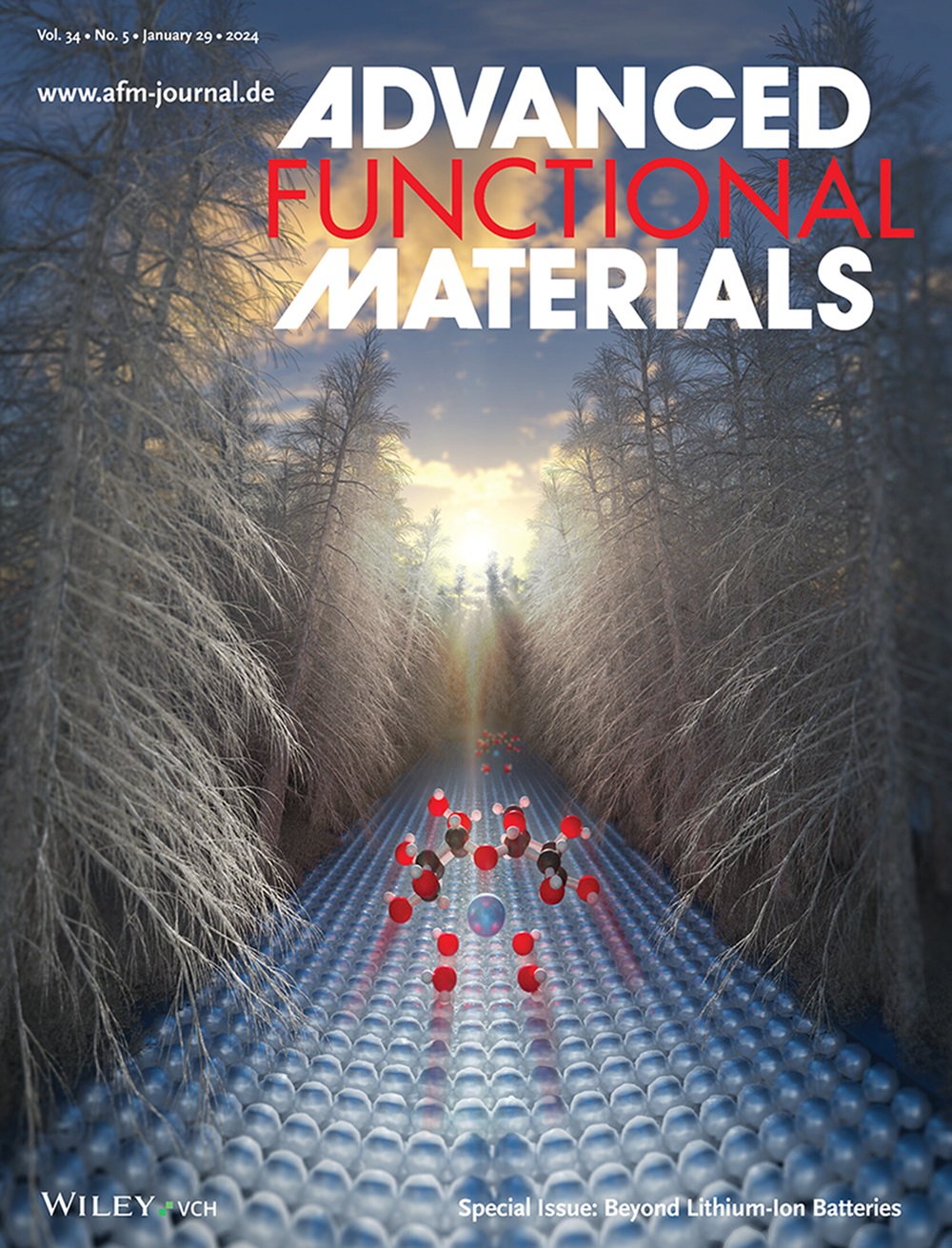
Hydrophobic Deep Eutectic Solvent (DES) Design Enables Optimally Hydrated DES-in-Water Electrolytes for High-Performance Bromine Redox-Enhanced Energy Storage Systems
Tae Pyeong Eom, Gunwoo Lee, Young Hun Cho, Younjee Lim, Seung Joon Yoo
{"title":"Hydrophobic Deep Eutectic Solvent (DES) Design Enables Optimally Hydrated DES-in-Water Electrolytes for High-Performance Bromine Redox-Enhanced Energy Storage Systems","authors":"Tae Pyeong Eom, Gunwoo Lee, Young Hun Cho, Younjee Lim, Seung Joon Yoo","doi":"10.1002/adfm.202424243","DOIUrl":null,"url":null,"abstract":"<p>Supercapacitors are renowned for rapid charging, high power density, and long lifespan, yet their practical applications are limited by low energy densities. Redox-enhanced electrochemical capacitors (redox ECs) address this limitation by incorporating redox-active electrolytes, enabling Faradaic charge storage. Bromide is a promising catholyte due to its high reduction potential, excellent solubility, and low cost. However, the generation of corrosive Br<sub>2</sub> and the cross-diffusion of soluble polybromides result in suboptimal cell efficiency including severe self-discharge and reduced cycle life. Although solid complexing agents have been used to suppress polybromides' cross-diffusion, this approach necessitates water, which inherently limits electrochemical and thermal stability. Here, a hydrated deep eutectic solvent (HDES) electrolyte is developed by combining tetrabutylammonium bromide (TBAB) with ethylene glycol. This HDES system effectively utilizes the multifunctional roles of TBAB: the bromide anion functions as a catholyte, while the TBA cation suppresses polybromides' cross-diffusion as a built-in solid complexing agent. Critically, unlike previous studies that focus on minimally hydrated DESs, this system leverages the hydrophobic effect of TBAB to accommodate higher water content, addressing challenges inherent to DESs while maintaining superior electrochemical and thermal stability. The optimized HDES-50 electrolyte, containing 50 wt.% water, provides a robust and efficient solution for advanced redox ECs.</p>","PeriodicalId":112,"journal":{"name":"Advanced Functional Materials","volume":"35 32","pages":""},"PeriodicalIF":19.0000,"publicationDate":"2025-03-27","publicationTypes":"Journal Article","fieldsOfStudy":null,"isOpenAccess":false,"openAccessPdf":"https://advanced.onlinelibrary.wiley.com/doi/epdf/10.1002/adfm.202424243","citationCount":"0","resultStr":null,"platform":"Semanticscholar","paperid":null,"PeriodicalName":"Advanced Functional Materials","FirstCategoryId":"88","ListUrlMain":"https://advanced.onlinelibrary.wiley.com/doi/10.1002/adfm.202424243","RegionNum":1,"RegionCategory":"材料科学","ArticlePicture":[],"TitleCN":null,"AbstractTextCN":null,"PMCID":null,"EPubDate":"","PubModel":"","JCR":"Q1","JCRName":"CHEMISTRY, MULTIDISCIPLINARY","Score":null,"Total":0}
引用次数: 0
Abstract
Supercapacitors are renowned for rapid charging, high power density, and long lifespan, yet their practical applications are limited by low energy densities. Redox-enhanced electrochemical capacitors (redox ECs) address this limitation by incorporating redox-active electrolytes, enabling Faradaic charge storage. Bromide is a promising catholyte due to its high reduction potential, excellent solubility, and low cost. However, the generation of corrosive Br2 and the cross-diffusion of soluble polybromides result in suboptimal cell efficiency including severe self-discharge and reduced cycle life. Although solid complexing agents have been used to suppress polybromides' cross-diffusion, this approach necessitates water, which inherently limits electrochemical and thermal stability. Here, a hydrated deep eutectic solvent (HDES) electrolyte is developed by combining tetrabutylammonium bromide (TBAB) with ethylene glycol. This HDES system effectively utilizes the multifunctional roles of TBAB: the bromide anion functions as a catholyte, while the TBA cation suppresses polybromides' cross-diffusion as a built-in solid complexing agent. Critically, unlike previous studies that focus on minimally hydrated DESs, this system leverages the hydrophobic effect of TBAB to accommodate higher water content, addressing challenges inherent to DESs while maintaining superior electrochemical and thermal stability. The optimized HDES-50 electrolyte, containing 50 wt.% water, provides a robust and efficient solution for advanced redox ECs.
期刊介绍:
Firmly established as a top-tier materials science journal, Advanced Functional Materials reports breakthrough research in all aspects of materials science, including nanotechnology, chemistry, physics, and biology every week.
Advanced Functional Materials is known for its rapid and fair peer review, quality content, and high impact, making it the first choice of the international materials science community.





 京公网安备 11010802042870号
京ICP备2023020795号-1
京公网安备 11010802042870号
京ICP备2023020795号-1

 分享
分享
 求助内容:
求助内容: 应助结果提醒方式:
 扫码关注我们
