{"title":"Effect of europium doping on structural, optical and fluorescence lifetime studies of CuS nanostructures","authors":"B. Sree Sesha Sudha Gayatri, N. Madhusudhana Rao","doi":"10.1016/j.optmat.2025.116982","DOIUrl":null,"url":null,"abstract":"<div><div>The purpose of the current study was to examine the impact of varying concentrations of Europium (Eu) atoms on the physical properties of copper sulphide (CuS) nanostructures designed for optical and fluorescence studies. CuS nanostructures were grown using the hydrothermal method and subsequently evaluated their structural, optical, and morphological characteristics. Nanostructures of CuS doped with Eu at levels of 0, 1, 3, 5, and 7 at. % were synthesised. For the purpose of analysing their properties, various characterisation instruments like X-ray diffraction (XRD), Raman, X-ray photoelectron spectroscopy (XPS), UV–Vis, photoluminescence, and FESEM were utilised. Chemical states were analysed using XPS. The XRD analysis of CuS revealed its hexagonal structure in the covellite phase and samples doped with Eu showed an increment in crystallite size. Eu-doped CuS nanostructures exhibit bandgap increment with the introduction of doping. FESEM analysis reveals the formation of flower-like structures resembling spheres, while lower magnification identifies the presence of nanoflakes. Room-temperature photoluminescence analysis was performed utilising a fluorescence spectrophotometer, revealing orange-red emission peaks at an excitation wavelength of 350 nm. The colour-correlation temperature (CCT) and colour index of extinction (CIE) values of the synthesised samples indicate significant potential for application in display technology. The analysis of fluorescence lifetime and decay in CuS nanostructures doped with Eu was validated through fluorescence lifetime measurements, indicating that the Eu dopant serves as a fluorescence-enhancing agent. Their unique luminescent properties, particularly the strong red emission, suggest potential applications in red-emitting phosphors, white LEDs, high-energy batteries, and supercapacitors.</div></div>","PeriodicalId":19564,"journal":{"name":"Optical Materials","volume":"163 ","pages":"Article 116982"},"PeriodicalIF":4.2000,"publicationDate":"2025-06-01","publicationTypes":"Journal Article","fieldsOfStudy":null,"isOpenAccess":false,"openAccessPdf":"","citationCount":"0","resultStr":null,"platform":"Semanticscholar","paperid":null,"PeriodicalName":"Optical Materials","FirstCategoryId":"88","ListUrlMain":"https://www.sciencedirect.com/science/article/pii/S0925346725003428","RegionNum":3,"RegionCategory":"材料科学","ArticlePicture":[],"TitleCN":null,"AbstractTextCN":null,"PMCID":null,"EPubDate":"2025/3/24 0:00:00","PubModel":"Epub","JCR":"Q2","JCRName":"MATERIALS SCIENCE, MULTIDISCIPLINARY","Score":null,"Total":0}
引用次数: 0
Abstract
The purpose of the current study was to examine the impact of varying concentrations of Europium (Eu) atoms on the physical properties of copper sulphide (CuS) nanostructures designed for optical and fluorescence studies. CuS nanostructures were grown using the hydrothermal method and subsequently evaluated their structural, optical, and morphological characteristics. Nanostructures of CuS doped with Eu at levels of 0, 1, 3, 5, and 7 at. % were synthesised. For the purpose of analysing their properties, various characterisation instruments like X-ray diffraction (XRD), Raman, X-ray photoelectron spectroscopy (XPS), UV–Vis, photoluminescence, and FESEM were utilised. Chemical states were analysed using XPS. The XRD analysis of CuS revealed its hexagonal structure in the covellite phase and samples doped with Eu showed an increment in crystallite size. Eu-doped CuS nanostructures exhibit bandgap increment with the introduction of doping. FESEM analysis reveals the formation of flower-like structures resembling spheres, while lower magnification identifies the presence of nanoflakes. Room-temperature photoluminescence analysis was performed utilising a fluorescence spectrophotometer, revealing orange-red emission peaks at an excitation wavelength of 350 nm. The colour-correlation temperature (CCT) and colour index of extinction (CIE) values of the synthesised samples indicate significant potential for application in display technology. The analysis of fluorescence lifetime and decay in CuS nanostructures doped with Eu was validated through fluorescence lifetime measurements, indicating that the Eu dopant serves as a fluorescence-enhancing agent. Their unique luminescent properties, particularly the strong red emission, suggest potential applications in red-emitting phosphors, white LEDs, high-energy batteries, and supercapacitors.
期刊介绍:
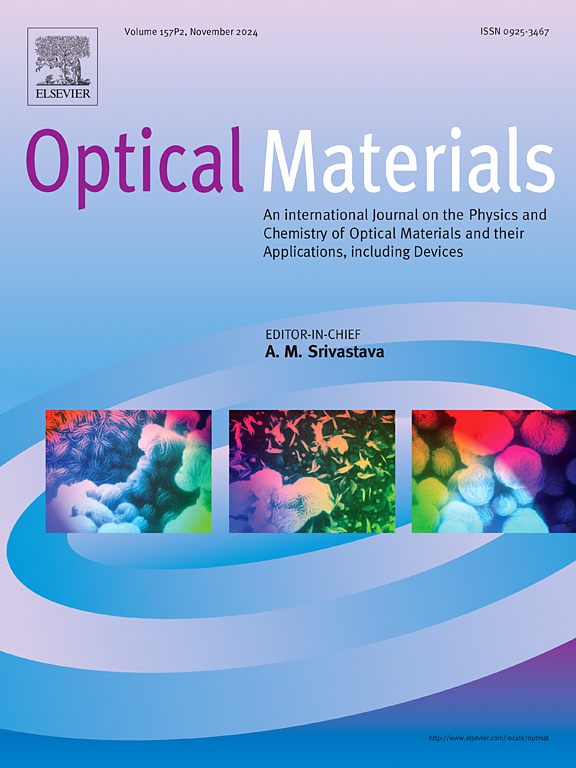
Optical Materials has an open access mirror journal Optical Materials: X, sharing the same aims and scope, editorial team, submission system and rigorous peer review.
The purpose of Optical Materials is to provide a means of communication and technology transfer between researchers who are interested in materials for potential device applications. The journal publishes original papers and review articles on the design, synthesis, characterisation and applications of optical materials.
OPTICAL MATERIALS focuses on:
• Optical Properties of Material Systems;
• The Materials Aspects of Optical Phenomena;
• The Materials Aspects of Devices and Applications.
Authors can submit separate research elements describing their data to Data in Brief and methods to Methods X.




 京公网安备 11010802042870号
京ICP备2023020795号-1
京公网安备 11010802042870号
京ICP备2023020795号-1

 分享
分享
 求助内容:
求助内容: 应助结果提醒方式:
 扫码关注我们
