{"title":"The effect of ionic bond on anion exchange membrane: Enhanced hydrophilicity and structural rearrangement of blending membrane","authors":"Kyu Ha Lee , Ji Young Chu","doi":"10.1016/j.fuel.2025.135169","DOIUrl":null,"url":null,"abstract":"<div><div>For the commercialization of anion exchange membrane fuel cells (AEMFCs), the anion exchange membrane (AEM), which is a key component of AEMFCs, requires not only excellent ion conductivity but also high alkaline stability. Therefore, in this study, a hybrid membrane composed of quaternized poly(phenylene oxide) (QPPO) with a dense ion sites and polyvinyl alcohol (PVA), known for its superior chemical and mechanical properties, is prepared. The QPPO<sub>x</sub>-PVA<sub>y</sub> AEMs (where x and y represent the weight ratio of QPPO and PVA) forms hydrogen bonds or electrostatic interactions through a dehydration reaction between the quaternary ammonium group of QPPO and the hydroxyl group of PVA. This network bonding, resulting in enhanced hydrophilicity and structural rearrangement, improves the dimensional and chemical stability of the membrane. Among the prepared AEMs, QPPO<sub>85</sub>-PVA<sub>15</sub> AEM exhibits high ionic conductivity of 79.8 mS cm<sup>−1</sup> at 80 °C under 100 % RH, a low dimensional change, and appropriate mechanical strength. In addition, ion conductivity of QPPO<sub>85</sub>-PVA<sub>15</sub> AEM retains 86.3 % of its initial ion conductivity after 1000 h in 2 M NaOH conditions. Thus, overall results demonstrate that the appropriate incorporation of PVA is effective in producing AEMs with excellent dimensional stability and high performance.</div></div>","PeriodicalId":325,"journal":{"name":"Fuel","volume":"395 ","pages":"Article 135169"},"PeriodicalIF":7.5000,"publicationDate":"2025-09-01","publicationTypes":"Journal Article","fieldsOfStudy":null,"isOpenAccess":false,"openAccessPdf":"","citationCount":"0","resultStr":null,"platform":"Semanticscholar","paperid":null,"PeriodicalName":"Fuel","FirstCategoryId":"5","ListUrlMain":"https://www.sciencedirect.com/science/article/pii/S0016236125008944","RegionNum":1,"RegionCategory":"工程技术","ArticlePicture":[],"TitleCN":null,"AbstractTextCN":null,"PMCID":null,"EPubDate":"2025/3/27 0:00:00","PubModel":"Epub","JCR":"Q2","JCRName":"ENERGY & FUELS","Score":null,"Total":0}
引用次数: 0
Abstract
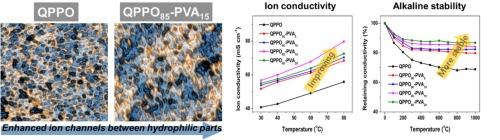
For the commercialization of anion exchange membrane fuel cells (AEMFCs), the anion exchange membrane (AEM), which is a key component of AEMFCs, requires not only excellent ion conductivity but also high alkaline stability. Therefore, in this study, a hybrid membrane composed of quaternized poly(phenylene oxide) (QPPO) with a dense ion sites and polyvinyl alcohol (PVA), known for its superior chemical and mechanical properties, is prepared. The QPPOx-PVAy AEMs (where x and y represent the weight ratio of QPPO and PVA) forms hydrogen bonds or electrostatic interactions through a dehydration reaction between the quaternary ammonium group of QPPO and the hydroxyl group of PVA. This network bonding, resulting in enhanced hydrophilicity and structural rearrangement, improves the dimensional and chemical stability of the membrane. Among the prepared AEMs, QPPO85-PVA15 AEM exhibits high ionic conductivity of 79.8 mS cm−1 at 80 °C under 100 % RH, a low dimensional change, and appropriate mechanical strength. In addition, ion conductivity of QPPO85-PVA15 AEM retains 86.3 % of its initial ion conductivity after 1000 h in 2 M NaOH conditions. Thus, overall results demonstrate that the appropriate incorporation of PVA is effective in producing AEMs with excellent dimensional stability and high performance.
期刊介绍:
The exploration of energy sources remains a critical matter of study. For the past nine decades, fuel has consistently held the forefront in primary research efforts within the field of energy science. This area of investigation encompasses a wide range of subjects, with a particular emphasis on emerging concerns like environmental factors and pollution.



 京公网安备 11010802042870号
京ICP备2023020795号-1
京公网安备 11010802042870号
京ICP备2023020795号-1

 分享
分享
 求助内容:
求助内容: 应助结果提醒方式:
 扫码关注我们
