Catalytic pyrolysis of polyethylene over bimetallic-modified ZSM-5: Role of alkaline sites on structure regulation, thermal behavior and aromatics production
Huiyu Liu , Ying Qiu , Rui Shan , Jun Zhang , Haoran Yuan , Yong Chen
{"title":"Catalytic pyrolysis of polyethylene over bimetallic-modified ZSM-5: Role of alkaline sites on structure regulation, thermal behavior and aromatics production","authors":"Huiyu Liu , Ying Qiu , Rui Shan , Jun Zhang , Haoran Yuan , Yong Chen","doi":"10.1016/j.fuel.2025.135180","DOIUrl":null,"url":null,"abstract":"<div><div>Catalytic fast pyrolysis (CFP) using bimetallic modified ZSM-5 enables efficient upcycling of polyethylene (PE). The present study demonstrates that alkaline sites significantly enhanced the mass transfer capacity of catalysts through generating fragmented structures, thus contributing to the selective regulation of thermal decomposition behavior of PE. Specifically, CuZn/ZSM-5 reduced decomposition temperature range by > 100 °C <em>via</em> enhanced chain-cracking and product transport. The synergistic effects of Cu<sup>0</sup> and alkaline sites derived from Zn species facilitated the cleavage of C–C bonds under a high heating rate, thereby accelerating the formation of olefin intermediates as well as promoting the aromatization within ZSM-5 channels. CuZn/ZSM-5 optimally combined highly dispersed metal sites, abundant strong alkaline sites, moderate acidic sites, and reinforced diffusion capacity, boosting low-temperature aromatics selectivity by 29.7 %, particularly for monocyclic aromatic hydrocarbons (MAHs). Despite the highest alkalinity of CuMg/ZSM-5, the permanent loss of weak alkaline sites at high temperatures resulted in weak capacity for aromatization. In addition, the plausible pathway for fast pyrolysis of PE into aromatics over CuZn/ZSM-5 was proposed.</div></div>","PeriodicalId":325,"journal":{"name":"Fuel","volume":"395 ","pages":"Article 135180"},"PeriodicalIF":7.5000,"publicationDate":"2025-09-01","publicationTypes":"Journal Article","fieldsOfStudy":null,"isOpenAccess":false,"openAccessPdf":"","citationCount":"0","resultStr":null,"platform":"Semanticscholar","paperid":null,"PeriodicalName":"Fuel","FirstCategoryId":"5","ListUrlMain":"https://www.sciencedirect.com/science/article/pii/S0016236125009056","RegionNum":1,"RegionCategory":"工程技术","ArticlePicture":[],"TitleCN":null,"AbstractTextCN":null,"PMCID":null,"EPubDate":"2025/3/27 0:00:00","PubModel":"Epub","JCR":"Q2","JCRName":"ENERGY & FUELS","Score":null,"Total":0}
引用次数: 0
Abstract
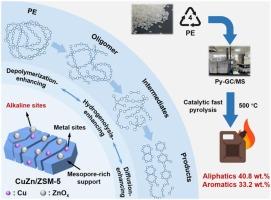
Catalytic fast pyrolysis (CFP) using bimetallic modified ZSM-5 enables efficient upcycling of polyethylene (PE). The present study demonstrates that alkaline sites significantly enhanced the mass transfer capacity of catalysts through generating fragmented structures, thus contributing to the selective regulation of thermal decomposition behavior of PE. Specifically, CuZn/ZSM-5 reduced decomposition temperature range by > 100 °C via enhanced chain-cracking and product transport. The synergistic effects of Cu0 and alkaline sites derived from Zn species facilitated the cleavage of C–C bonds under a high heating rate, thereby accelerating the formation of olefin intermediates as well as promoting the aromatization within ZSM-5 channels. CuZn/ZSM-5 optimally combined highly dispersed metal sites, abundant strong alkaline sites, moderate acidic sites, and reinforced diffusion capacity, boosting low-temperature aromatics selectivity by 29.7 %, particularly for monocyclic aromatic hydrocarbons (MAHs). Despite the highest alkalinity of CuMg/ZSM-5, the permanent loss of weak alkaline sites at high temperatures resulted in weak capacity for aromatization. In addition, the plausible pathway for fast pyrolysis of PE into aromatics over CuZn/ZSM-5 was proposed.
期刊介绍:
The exploration of energy sources remains a critical matter of study. For the past nine decades, fuel has consistently held the forefront in primary research efforts within the field of energy science. This area of investigation encompasses a wide range of subjects, with a particular emphasis on emerging concerns like environmental factors and pollution.



 京公网安备 11010802042870号
京ICP备2023020795号-1
京公网安备 11010802042870号
京ICP备2023020795号-1

 分享
分享
 求助内容:
求助内容: 应助结果提醒方式:
 扫码关注我们
