J. Čespiva , D. Kupka , J. Ryšavý , L. Niedzwiecki , W.-H. Chen , M. Jackowski , C.-C. Wang , J.-K. Kuo , A. Trusek , C.-C. Cormos , T. Ochodek
{"title":"Life cycle assessment of solid recovered fuel (SRF) for energy sector in declining coal region: Environmental burden of SRF production","authors":"J. Čespiva , D. Kupka , J. Ryšavý , L. Niedzwiecki , W.-H. Chen , M. Jackowski , C.-C. Wang , J.-K. Kuo , A. Trusek , C.-C. Cormos , T. Ochodek","doi":"10.1016/j.ecmx.2025.100989","DOIUrl":null,"url":null,"abstract":"<div><div>This study provides a comprehensive insight into solid recovered fuel (SRF) production and its potential as a coal supplement in the post-coal region of Moravia-Silesia, Czech Republic. Such studies on waste-to-energy (WtE) applications are often lacking, particularly at critical moments when decisions about regional energy strategies are being made. As a result, viable and less environmentally harmful pathways stand outside consideration.</div><div>In this study, SRF production is investigated using life cycle assessment (LCA), applying the Product Environmental Footprint (PEF) methodology with data from EF 3.0, ELCD and Ecoinvent 3.8. A scenario analysis was also conducted on transport modes and distances. The initial region-oriented scheme of the LCA study included the following steps: separation of waste material, transport to a processing plant, SRF production, and transport to an energy facility. The results present the overall environmental burden associated with SRF production. The most significant impact is observed in “climate change” indicator, accounting for 78 % of the total impact. The primary contributors to the impact are plastics (77.2 %), wood (13.5 %), coal (3.1 %), and transport (2.1 %). The scenario analysis, covering transport distances of 200–400 km, clearly demonstrated that rail transport is a more environmentally friendly option compared to road transport, with minimal sensitivity to variations in distance within the evaluated range. This study uncovers unique insights into alternative SRF production and evaluates its environmental burden through available interpretations.</div></div>","PeriodicalId":37131,"journal":{"name":"Energy Conversion and Management-X","volume":"26 ","pages":"Article 100989"},"PeriodicalIF":7.6000,"publicationDate":"2025-04-01","publicationTypes":"Journal Article","fieldsOfStudy":null,"isOpenAccess":false,"openAccessPdf":"","citationCount":"0","resultStr":null,"platform":"Semanticscholar","paperid":null,"PeriodicalName":"Energy Conversion and Management-X","FirstCategoryId":"1085","ListUrlMain":"https://www.sciencedirect.com/science/article/pii/S2590174525001217","RegionNum":0,"RegionCategory":null,"ArticlePicture":[],"TitleCN":null,"AbstractTextCN":null,"PMCID":null,"EPubDate":"2025/3/25 0:00:00","PubModel":"Epub","JCR":"Q1","JCRName":"ENERGY & FUELS","Score":null,"Total":0}
引用次数: 0
Abstract
This study provides a comprehensive insight into solid recovered fuel (SRF) production and its potential as a coal supplement in the post-coal region of Moravia-Silesia, Czech Republic. Such studies on waste-to-energy (WtE) applications are often lacking, particularly at critical moments when decisions about regional energy strategies are being made. As a result, viable and less environmentally harmful pathways stand outside consideration.
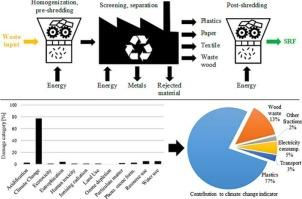
In this study, SRF production is investigated using life cycle assessment (LCA), applying the Product Environmental Footprint (PEF) methodology with data from EF 3.0, ELCD and Ecoinvent 3.8. A scenario analysis was also conducted on transport modes and distances. The initial region-oriented scheme of the LCA study included the following steps: separation of waste material, transport to a processing plant, SRF production, and transport to an energy facility. The results present the overall environmental burden associated with SRF production. The most significant impact is observed in “climate change” indicator, accounting for 78 % of the total impact. The primary contributors to the impact are plastics (77.2 %), wood (13.5 %), coal (3.1 %), and transport (2.1 %). The scenario analysis, covering transport distances of 200–400 km, clearly demonstrated that rail transport is a more environmentally friendly option compared to road transport, with minimal sensitivity to variations in distance within the evaluated range. This study uncovers unique insights into alternative SRF production and evaluates its environmental burden through available interpretations.
期刊介绍:
Energy Conversion and Management: X is the open access extension of the reputable journal Energy Conversion and Management, serving as a platform for interdisciplinary research on a wide array of critical energy subjects. The journal is dedicated to publishing original contributions and in-depth technical review articles that present groundbreaking research on topics spanning energy generation, utilization, conversion, storage, transmission, conservation, management, and sustainability.
The scope of Energy Conversion and Management: X encompasses various forms of energy, including mechanical, thermal, nuclear, chemical, electromagnetic, magnetic, and electric energy. It addresses all known energy resources, highlighting both conventional sources like fossil fuels and nuclear power, as well as renewable resources such as solar, biomass, hydro, wind, geothermal, and ocean energy.



 京公网安备 11010802042870号
京ICP备2023020795号-1
京公网安备 11010802042870号
京ICP备2023020795号-1

 分享
分享
 求助内容:
求助内容: 应助结果提醒方式:
 扫码关注我们
