Optimization for achieving robust metallurgical bonding interfaces in the integrated laser additive manufacturing of extremely property-mismatched materials
Chao Wei , Zhuang Zhao , Chao Wang , Qingfeng Yin , Xianfeng Shen , Jialin Yang , Guowei Wang , Yu Qin , Jingang Tang , Guomin Le , Yang Yang
{"title":"Optimization for achieving robust metallurgical bonding interfaces in the integrated laser additive manufacturing of extremely property-mismatched materials","authors":"Chao Wei , Zhuang Zhao , Chao Wang , Qingfeng Yin , Xianfeng Shen , Jialin Yang , Guowei Wang , Yu Qin , Jingang Tang , Guomin Le , Yang Yang","doi":"10.1016/j.matchar.2025.114975","DOIUrl":null,"url":null,"abstract":"<div><div>High-strength bonded interfaces of additive manufacturing (AM) multi-material structures are usually obtained through extensive trial-and-error experiments, leading to increased manufacturing costs. In this study, a three-way optimization method is proposed based on thermodynamic calculations, which combines joining methods, deposition strategies, and post-heat treatment to achieve robust metallurgical bonding interfaces in the integrated laser additive manufacturing of extremely property-mismatched materials. The integrated forming of ultra-high strength steel (UHSS) and Ti6Al4V (TC4) was achieved with Ni-Cr-V interlayers via laser-directed energy deposition (LDED). The introduction of Ni-Cr-V interlayers emerged as a pivotal solution for addressing material compatibility between UHSS and TC4. By optimizing deposition strategies, high-quality UHSS-Ni, Ni<img>Cr, Cr<img>V, and V-TC4 bonded interfaces were obtained without cracks or intermetallics. Furthermore, a customized post-heat treatment significantly enhanced the performance of LDED UHSS-Ni-Cr-V-TC4 sample (UTS: 120.9 MPa → 298.3 MPa), surpassing the UTS of the weakest material, Cr. The 3D-DIC results revealed distinct locations where plastic deformation (V region) and ultimate fracture (Cr region) occurred in the heat-treated sample, presenting a novel phenomenon that sharply contrasts with the behaviors displayed by homogeneous materials such as UHSS and TC4. This disparity primarily arises from the properties of materials (elastic modulus/strength). Finally, strategic approaches for fabricating high-quality AM multi-material structures were discussed. These findings enrich and advance the innovative theory of “material-structure-performance/function integrated laser additive manufacturing”, which holds important reference and guiding significance for the subsequent high-quality forming of other AM multi-material structures.</div></div>","PeriodicalId":18727,"journal":{"name":"Materials Characterization","volume":"223 ","pages":"Article 114975"},"PeriodicalIF":5.5000,"publicationDate":"2025-05-01","publicationTypes":"Journal Article","fieldsOfStudy":null,"isOpenAccess":false,"openAccessPdf":"","citationCount":"0","resultStr":null,"platform":"Semanticscholar","paperid":null,"PeriodicalName":"Materials Characterization","FirstCategoryId":"88","ListUrlMain":"https://www.sciencedirect.com/science/article/pii/S1044580325002645","RegionNum":2,"RegionCategory":"材料科学","ArticlePicture":[],"TitleCN":null,"AbstractTextCN":null,"PMCID":null,"EPubDate":"2025/3/25 0:00:00","PubModel":"Epub","JCR":"Q1","JCRName":"MATERIALS SCIENCE, CHARACTERIZATION & TESTING","Score":null,"Total":0}
引用次数: 0
Abstract
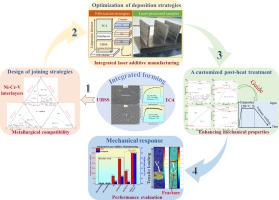
High-strength bonded interfaces of additive manufacturing (AM) multi-material structures are usually obtained through extensive trial-and-error experiments, leading to increased manufacturing costs. In this study, a three-way optimization method is proposed based on thermodynamic calculations, which combines joining methods, deposition strategies, and post-heat treatment to achieve robust metallurgical bonding interfaces in the integrated laser additive manufacturing of extremely property-mismatched materials. The integrated forming of ultra-high strength steel (UHSS) and Ti6Al4V (TC4) was achieved with Ni-Cr-V interlayers via laser-directed energy deposition (LDED). The introduction of Ni-Cr-V interlayers emerged as a pivotal solution for addressing material compatibility between UHSS and TC4. By optimizing deposition strategies, high-quality UHSS-Ni, NiCr, CrV, and V-TC4 bonded interfaces were obtained without cracks or intermetallics. Furthermore, a customized post-heat treatment significantly enhanced the performance of LDED UHSS-Ni-Cr-V-TC4 sample (UTS: 120.9 MPa → 298.3 MPa), surpassing the UTS of the weakest material, Cr. The 3D-DIC results revealed distinct locations where plastic deformation (V region) and ultimate fracture (Cr region) occurred in the heat-treated sample, presenting a novel phenomenon that sharply contrasts with the behaviors displayed by homogeneous materials such as UHSS and TC4. This disparity primarily arises from the properties of materials (elastic modulus/strength). Finally, strategic approaches for fabricating high-quality AM multi-material structures were discussed. These findings enrich and advance the innovative theory of “material-structure-performance/function integrated laser additive manufacturing”, which holds important reference and guiding significance for the subsequent high-quality forming of other AM multi-material structures.
期刊介绍:
Materials Characterization features original articles and state-of-the-art reviews on theoretical and practical aspects of the structure and behaviour of materials.
The Journal focuses on all characterization techniques, including all forms of microscopy (light, electron, acoustic, etc.,) and analysis (especially microanalysis and surface analytical techniques). Developments in both this wide range of techniques and their application to the quantification of the microstructure of materials are essential facets of the Journal.
The Journal provides the Materials Scientist/Engineer with up-to-date information on many types of materials with an underlying theme of explaining the behavior of materials using novel approaches. Materials covered by the journal include:
Metals & Alloys
Ceramics
Nanomaterials
Biomedical materials
Optical materials
Composites
Natural Materials.




 京公网安备 11010802042870号
京ICP备2023020795号-1
京公网安备 11010802042870号
京ICP备2023020795号-1

 分享
分享
 求助内容:
求助内容: 应助结果提醒方式:
 扫码关注我们
