Longfei Shi , Baozhong Ma , Zhihe Cao , Jiancheng Yu , Fei He , Chengyan Wang
{"title":"Environment-friendly and selective extraction of valuable metals from saprolitic laterite via nitric acid pressure leaching: Behavior and mechanism","authors":"Longfei Shi , Baozhong Ma , Zhihe Cao , Jiancheng Yu , Fei He , Chengyan Wang","doi":"10.1016/j.mineng.2025.109255","DOIUrl":null,"url":null,"abstract":"<div><div>Nickel laterite ore is a crucial raw resource for the development of new energy and materials sectors. In this study, an environment-friendly and economical process for saprolitic laterite was proposed using nitric acid pressure leaching technology. Firstly, the dissolution of lizardite and magnetite, oxidation of Fe<sup>2+</sup>, and hydrolysis of Fe<sup>3+</sup> were evaluated via the thermodynamic analysis. Subsequently, the optimal leaching conditions were determined to be as follows: temperature of 150 °C, HNO<sub>3</sub> concentration of 349 g/L, leaching duration of 60 min, and liquid to solid ratio of 3:1 mL/g. The efficient extractions of Ni, Co, Sc, Al, Mg, and Mn were fulfilled. Notably, the hydrolysis reaction of Fe<sup>3+</sup> prevented Fe leaching or assisted in Fe removal from pregnant leaching solution (PLS). The concentration of Fe in PLS was lower than 1 g/L. Furthermore, elevating leaching temperature to 230°C may reduce Al extraction. Density functional theory (DFT) calculations are conducted and reveal that the reaction between HNO<sub>3</sub> and lizardite includes H<sub>3</sub>O<sup>+</sup> adsorption, H<sub>2</sub>O formation and removal, and NO<sub>3</sub><sup>–</sup> adsorption. The adsorption energies of H<sub>3</sub>O<sup>+</sup>, NO<sub>3</sub><sup>–</sup>, and the energy barrier for H<sub>2</sub>O removal are −5.80 eV, −2.90 eV, and 1.08 eV, respectively. Finally, the economic and environmental assessment illustrated that this process can achieve the comprehensive and green utilization of saprolitic laterite with low CO<sub>2</sub> emissions and holds promise for treating other acid-consuming resources.</div></div>","PeriodicalId":18594,"journal":{"name":"Minerals Engineering","volume":"227 ","pages":"Article 109255"},"PeriodicalIF":5.0000,"publicationDate":"2025-03-28","publicationTypes":"Journal Article","fieldsOfStudy":null,"isOpenAccess":false,"openAccessPdf":"","citationCount":"0","resultStr":null,"platform":"Semanticscholar","paperid":null,"PeriodicalName":"Minerals Engineering","FirstCategoryId":"5","ListUrlMain":"https://www.sciencedirect.com/science/article/pii/S0892687525000834","RegionNum":2,"RegionCategory":"工程技术","ArticlePicture":[],"TitleCN":null,"AbstractTextCN":null,"PMCID":null,"EPubDate":"","PubModel":"","JCR":"Q1","JCRName":"ENGINEERING, CHEMICAL","Score":null,"Total":0}
引用次数: 0
Abstract
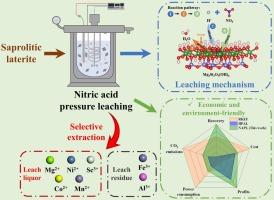
Nickel laterite ore is a crucial raw resource for the development of new energy and materials sectors. In this study, an environment-friendly and economical process for saprolitic laterite was proposed using nitric acid pressure leaching technology. Firstly, the dissolution of lizardite and magnetite, oxidation of Fe2+, and hydrolysis of Fe3+ were evaluated via the thermodynamic analysis. Subsequently, the optimal leaching conditions were determined to be as follows: temperature of 150 °C, HNO3 concentration of 349 g/L, leaching duration of 60 min, and liquid to solid ratio of 3:1 mL/g. The efficient extractions of Ni, Co, Sc, Al, Mg, and Mn were fulfilled. Notably, the hydrolysis reaction of Fe3+ prevented Fe leaching or assisted in Fe removal from pregnant leaching solution (PLS). The concentration of Fe in PLS was lower than 1 g/L. Furthermore, elevating leaching temperature to 230°C may reduce Al extraction. Density functional theory (DFT) calculations are conducted and reveal that the reaction between HNO3 and lizardite includes H3O+ adsorption, H2O formation and removal, and NO3– adsorption. The adsorption energies of H3O+, NO3–, and the energy barrier for H2O removal are −5.80 eV, −2.90 eV, and 1.08 eV, respectively. Finally, the economic and environmental assessment illustrated that this process can achieve the comprehensive and green utilization of saprolitic laterite with low CO2 emissions and holds promise for treating other acid-consuming resources.
期刊介绍:
The purpose of the journal is to provide for the rapid publication of topical papers featuring the latest developments in the allied fields of mineral processing and extractive metallurgy. Its wide ranging coverage of research and practical (operating) topics includes physical separation methods, such as comminution, flotation concentration and dewatering, chemical methods such as bio-, hydro-, and electro-metallurgy, analytical techniques, process control, simulation and instrumentation, and mineralogical aspects of processing. Environmental issues, particularly those pertaining to sustainable development, will also be strongly covered.



 京公网安备 11010802042870号
京ICP备2023020795号-1
京公网安备 11010802042870号
京ICP备2023020795号-1

 分享
分享
 求助内容:
求助内容: 应助结果提醒方式:
 扫码关注我们
