{"title":"Parametric investigation in an open atmosphere laser nitriding process of titanium aiming to minimize cracks","authors":"Kaito Yonemoto, Atsuto Yoshino, Yoshifumi Kitadate, Mitsuhiro Hirano, Naofumi Ohtsu","doi":"10.1016/j.surfcoat.2025.132075","DOIUrl":null,"url":null,"abstract":"<div><div>Open-atmosphere laser nitriding is a new technique for the formation of nitride layers on Ti surfaces in air. To form a crack-free nitride layer, the influence of processing parameters involving the beam-focusing condition and beam-scanning speed was carefully investigated. Ti surface irradiation using a defocused pulsed laser beam enhances energy transfer from the generated laser-induced plasma (LIP), enlarges the surface melting pool, and results in the formation of a thicker nitride layer compared to irradiation by an ideally focused laser beam. In addition, a lower scanning speed was linked to an increase in the number of repetitions of the pulsed beam, facilitating the penetration of the surrounding gases, mainly N, into the melt pool, thereby increasing the N content of the layer. The layer thickness and crystallographic phase of the nitride layer directly influenced the degree of crack formation; specifically, thinner layers mainly comprising TiN<sub>0.3</sub> exhibit significantly fewer cracks. By adjusting the beam parameters, nitride layers with different properties can be deposited on Ti surfaces, thereby broadening the range of Ti industrial applications.</div></div>","PeriodicalId":22009,"journal":{"name":"Surface & Coatings Technology","volume":"505 ","pages":"Article 132075"},"PeriodicalIF":6.1000,"publicationDate":"2025-06-01","publicationTypes":"Journal Article","fieldsOfStudy":null,"isOpenAccess":false,"openAccessPdf":"","citationCount":"0","resultStr":null,"platform":"Semanticscholar","paperid":null,"PeriodicalName":"Surface & Coatings Technology","FirstCategoryId":"88","ListUrlMain":"https://www.sciencedirect.com/science/article/pii/S0257897225003494","RegionNum":2,"RegionCategory":"材料科学","ArticlePicture":[],"TitleCN":null,"AbstractTextCN":null,"PMCID":null,"EPubDate":"2025/3/22 0:00:00","PubModel":"Epub","JCR":"Q1","JCRName":"MATERIALS SCIENCE, COATINGS & FILMS","Score":null,"Total":0}
引用次数: 0
Abstract
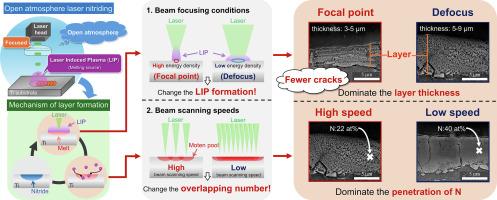
Open-atmosphere laser nitriding is a new technique for the formation of nitride layers on Ti surfaces in air. To form a crack-free nitride layer, the influence of processing parameters involving the beam-focusing condition and beam-scanning speed was carefully investigated. Ti surface irradiation using a defocused pulsed laser beam enhances energy transfer from the generated laser-induced plasma (LIP), enlarges the surface melting pool, and results in the formation of a thicker nitride layer compared to irradiation by an ideally focused laser beam. In addition, a lower scanning speed was linked to an increase in the number of repetitions of the pulsed beam, facilitating the penetration of the surrounding gases, mainly N, into the melt pool, thereby increasing the N content of the layer. The layer thickness and crystallographic phase of the nitride layer directly influenced the degree of crack formation; specifically, thinner layers mainly comprising TiN0.3 exhibit significantly fewer cracks. By adjusting the beam parameters, nitride layers with different properties can be deposited on Ti surfaces, thereby broadening the range of Ti industrial applications.
期刊介绍:
Surface and Coatings Technology is an international archival journal publishing scientific papers on significant developments in surface and interface engineering to modify and improve the surface properties of materials for protection in demanding contact conditions or aggressive environments, or for enhanced functional performance. Contributions range from original scientific articles concerned with fundamental and applied aspects of research or direct applications of metallic, inorganic, organic and composite coatings, to invited reviews of current technology in specific areas. Papers submitted to this journal are expected to be in line with the following aspects in processes, and properties/performance:
A. Processes: Physical and chemical vapour deposition techniques, thermal and plasma spraying, surface modification by directed energy techniques such as ion, electron and laser beams, thermo-chemical treatment, wet chemical and electrochemical processes such as plating, sol-gel coating, anodization, plasma electrolytic oxidation, etc., but excluding painting.
B. Properties/performance: friction performance, wear resistance (e.g., abrasion, erosion, fretting, etc), corrosion and oxidation resistance, thermal protection, diffusion resistance, hydrophilicity/hydrophobicity, and properties relevant to smart materials behaviour and enhanced multifunctional performance for environmental, energy and medical applications, but excluding device aspects.



 京公网安备 11010802042870号
京ICP备2023020795号-1
京公网安备 11010802042870号
京ICP备2023020795号-1

 分享
分享
 求助内容:
求助内容: 应助结果提醒方式:
 扫码关注我们
