Yifan Li , Zhen Han , Miao Wang , Yaxing Yan , Ruihong Ma , Hongping Wang , Wei-Wei Deng
{"title":"Metabolomics and sensory evaluation reveal the influence of four albino tea cultivars on the quality of processed green tea","authors":"Yifan Li , Zhen Han , Miao Wang , Yaxing Yan , Ruihong Ma , Hongping Wang , Wei-Wei Deng","doi":"10.1016/j.foodres.2025.116180","DOIUrl":null,"url":null,"abstract":"<div><div>Green tea processed from albino tea cultivars is characterized by fresh aroma and umami taste. However, research on albino green tea remains limited, and the compounds responsible for its aroma and flavor have yet to be comprehensively analyzed. To develop and utilize various albino tea cultivars, this study employed green tea processed from four albino tea cultivars, namely ‘Tezaobai’ (TZB), ‘Ruixue 1’(RX1), ‘Naibai’ (NB) and ‘Zhongbai 4’ (ZB4), as materials. High-resolution mass spectrometry techniques were utilized to analyze volatile and non-volatile metabolites. The sensory evaluation revealed that TZB exhibited a pronounced bitterness alongside a distinct fruity aroma. NB demonstrated significantly higher sweetness, umami, and roasted aroma compared to other teas. ZB4 was characterized by cooked-corn aroma and astringency. RX1 displayed balanced sensory attributes. Research indicated that the bitterness in TZB stemmed from high alkaloid content, while elevated ethyl acetate levels might contribute to fruity aroma. NB contained substantial amino acids that enhance its sweetness and umami. Maillard reaction products, such as 2-ethyl-3,5-dimethylpyrazine and 2,3-diethyl-5-methylpyrazine, contributed to its roasted aroma. The astringency of ZB4 was significantly influenced by compounds like myricetin-3-galactoside, myricetin, and other flavonoids and glycosides. The prominent cooked-corn aroma in ZB4 came from dimethyl sulfide. In summary, this study offers an initial investigation into the impact of various albino tea cultivars on the quality of green tea. It establishes a theoretical foundation for the selection of high-quality materials for the production of albino green tea and establishes a practical groundwork for the development and utilization of albino tea cultivars.</div></div>","PeriodicalId":323,"journal":{"name":"Food Research International","volume":"209 ","pages":"Article 116180"},"PeriodicalIF":8.0000,"publicationDate":"2025-05-01","publicationTypes":"Journal Article","fieldsOfStudy":null,"isOpenAccess":false,"openAccessPdf":"","citationCount":"0","resultStr":null,"platform":"Semanticscholar","paperid":null,"PeriodicalName":"Food Research International","FirstCategoryId":"97","ListUrlMain":"https://www.sciencedirect.com/science/article/pii/S0963996925005174","RegionNum":1,"RegionCategory":"农林科学","ArticlePicture":[],"TitleCN":null,"AbstractTextCN":null,"PMCID":null,"EPubDate":"2025/3/22 0:00:00","PubModel":"Epub","JCR":"Q1","JCRName":"FOOD SCIENCE & TECHNOLOGY","Score":null,"Total":0}
引用次数: 0
Abstract
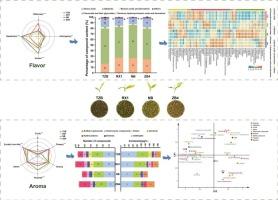
Green tea processed from albino tea cultivars is characterized by fresh aroma and umami taste. However, research on albino green tea remains limited, and the compounds responsible for its aroma and flavor have yet to be comprehensively analyzed. To develop and utilize various albino tea cultivars, this study employed green tea processed from four albino tea cultivars, namely ‘Tezaobai’ (TZB), ‘Ruixue 1’(RX1), ‘Naibai’ (NB) and ‘Zhongbai 4’ (ZB4), as materials. High-resolution mass spectrometry techniques were utilized to analyze volatile and non-volatile metabolites. The sensory evaluation revealed that TZB exhibited a pronounced bitterness alongside a distinct fruity aroma. NB demonstrated significantly higher sweetness, umami, and roasted aroma compared to other teas. ZB4 was characterized by cooked-corn aroma and astringency. RX1 displayed balanced sensory attributes. Research indicated that the bitterness in TZB stemmed from high alkaloid content, while elevated ethyl acetate levels might contribute to fruity aroma. NB contained substantial amino acids that enhance its sweetness and umami. Maillard reaction products, such as 2-ethyl-3,5-dimethylpyrazine and 2,3-diethyl-5-methylpyrazine, contributed to its roasted aroma. The astringency of ZB4 was significantly influenced by compounds like myricetin-3-galactoside, myricetin, and other flavonoids and glycosides. The prominent cooked-corn aroma in ZB4 came from dimethyl sulfide. In summary, this study offers an initial investigation into the impact of various albino tea cultivars on the quality of green tea. It establishes a theoretical foundation for the selection of high-quality materials for the production of albino green tea and establishes a practical groundwork for the development and utilization of albino tea cultivars.
期刊介绍:
Food Research International serves as a rapid dissemination platform for significant and impactful research in food science, technology, engineering, and nutrition. The journal focuses on publishing novel, high-quality, and high-impact review papers, original research papers, and letters to the editors across various disciplines in the science and technology of food. Additionally, it follows a policy of publishing special issues on topical and emergent subjects in food research or related areas. Selected, peer-reviewed papers from scientific meetings, workshops, and conferences on the science, technology, and engineering of foods are also featured in special issues.



 京公网安备 11010802042870号
京ICP备2023020795号-1
京公网安备 11010802042870号
京ICP备2023020795号-1

 分享
分享
 求助内容:
求助内容: 应助结果提醒方式:
 扫码关注我们
