{"title":"A corresponding relationship between formaldehyde and missing •OH reactivity extrapolated in chamber studies using a mixture of nine VOCs and NOx","authors":"Jiaru Li , Kosuke Miyatake , Yu Morino , Kei Sato , Yasuhiro Sadanaga , Yoshihiro Nakashima , Yosuke Sakamoto , Yoshizumi Kajii","doi":"10.1016/j.atmosenv.2025.121190","DOIUrl":null,"url":null,"abstract":"<div><div>•OH reactivity (<span><math><mrow><msup><mi>k</mi><mo>′</mo></msup></mrow></math></span>), which is the inverse of •OH lifetime and can be determined by measuring the decay rate of •OH radicals as total •OH reactivity (<span><math><mrow><msubsup><mi>k</mi><mrow><mi>t</mi><mi>o</mi><mi>t</mi><mi>a</mi><mi>l</mi></mrow><mo>′</mo></msubsup></mrow></math></span>), or summing reactivity from volatile organic compounds (VOCs), NO<sub>x</sub>, and other inorganics as calculated •OH reactivity (<span><math><mrow><msubsup><mi>k</mi><mrow><mi>c</mi><mi>a</mi><mi>l</mi><mi>c</mi></mrow><mo>′</mo></msubsup></mrow></math></span>). <span><math><mrow><msup><mi>k</mi><mo>′</mo></msup></mrow></math></span> is usually underestimated by <span><math><mrow><msubsup><mi>k</mi><mrow><mi>c</mi><mi>a</mi><mi>l</mi><mi>c</mi></mrow><mo>′</mo></msubsup></mrow></math></span>, with the discrepancy named as missing •OH reactivity (<span><math><mrow><msubsup><mi>k</mi><mrow><mi>m</mi><mi>i</mi><mi>s</mi><mi>s</mi><mi>i</mi><mi>n</mi><mi>g</mi></mrow><mo>′</mo></msubsup></mrow></math></span>), mainly representing the reactivity of unknown VOCs. <span><math><mrow><msubsup><mi>k</mi><mrow><mi>m</mi><mi>i</mi><mi>s</mi><mi>s</mi><mi>i</mi><mi>n</mi><mi>g</mi></mrow><mo>′</mo></msubsup></mrow></math></span> plays an important role in understanding the overall reactivity balance and the production of photochemical oxidants. Given that the Master Chemical Mechanism (MCM) can simulate <span><math><mrow><msup><mi>k</mi><mo>′</mo></msup></mrow></math></span> and ozone production, uncertainties arise when apply these models to complex ambient atmospheres. We conducted smog-chamber experiments using VOC mixtures under well-controlled conditions. <span><math><mrow><msubsup><mi>k</mi><mrow><mi>t</mi><mi>o</mi><mi>t</mi><mi>a</mi><mi>l</mi></mrow><mo>′</mo></msubsup></mrow></math></span> and trace species in the smog-chamber were measured and concurrently simulated by MCM model. The MCM reproduced initial time variations of trace species and <span><math><mrow><msubsup><mi>k</mi><mrow><mi>t</mi><mi>o</mi><mi>t</mi><mi>a</mi><mi>l</mi></mrow><mo>′</mo></msubsup></mrow></math></span>. We found a corresponding relationship of <span><math><mrow><msubsup><mi>k</mi><mrow><mi>m</mi><mi>i</mi><mi>s</mi><mi>s</mi><mi>i</mi><mi>n</mi><mi>g</mi></mrow><mo>′</mo></msubsup></mrow></math></span><em>/</em>[HCHO] = 1.5 s<sup>−1</sup> ppbv<sup>−1</sup> based on the smog-chamber experiments and several field campaigns’ results in Japan. We further applied this factor in 2017 Tsukuba campaign to predict <span><math><mrow><msubsup><mi>k</mi><mrow><mi>m</mi><mi>i</mi><mi>s</mi><mi>s</mi><mi>i</mi><mi>n</mi><mi>g</mi></mrow><mo>′</mo></msubsup></mrow></math></span> based on diurnal HCHO concentration and obtained good performance of <span><math><mrow><msubsup><mi>k</mi><mrow><mi>m</mi><mi>i</mi><mi>s</mi><mi>s</mi><mi>i</mi><mi>n</mi><mi>g</mi></mrow><mo>′</mo></msubsup></mrow></math></span> when compared with <span><math><mrow><msubsup><mi>k</mi><mrow><mi>t</mi><mi>o</mi><mi>t</mi><mi>a</mi><mi>l</mi></mrow><mo>′</mo></msubsup><mo>−</mo><msubsup><mi>k</mi><mrow><mi>c</mi><mi>a</mi><mi>l</mi><mi>c</mi></mrow><mo>′</mo></msubsup></mrow></math></span>. Also, ozone production regimes were assessed and cross-compared with conventional sensitivity indicators includes [HCHO]/[NO<sub>2</sub>] and Σ<em>k</em><sub>i</sub>[VOC]<sub>i</sub>/<em>k</em><sub><em>N</em></sub>[NO<sub>x</sub>] based on MCM results. This study confirmed that MCM model well-reproduced the kinetic chemistry of smog-chamber experiments containing VOC mixtures during the initial hours, and we propose to use HCHO concentration for model validation when <span><math><mrow><msubsup><mi>k</mi><mrow><mi>t</mi><mi>o</mi><mi>t</mi><mi>a</mi><mi>l</mi></mrow><mo>′</mo></msubsup></mrow></math></span> is not available.</div></div>","PeriodicalId":250,"journal":{"name":"Atmospheric Environment","volume":"351 ","pages":"Article 121190"},"PeriodicalIF":3.7000,"publicationDate":"2025-06-15","publicationTypes":"Journal Article","fieldsOfStudy":null,"isOpenAccess":false,"openAccessPdf":"","citationCount":"0","resultStr":null,"platform":"Semanticscholar","paperid":null,"PeriodicalName":"Atmospheric Environment","FirstCategoryId":"93","ListUrlMain":"https://www.sciencedirect.com/science/article/pii/S1352231025001657","RegionNum":2,"RegionCategory":"环境科学与生态学","ArticlePicture":[],"TitleCN":null,"AbstractTextCN":null,"PMCID":null,"EPubDate":"2025/3/21 0:00:00","PubModel":"Epub","JCR":"Q2","JCRName":"ENVIRONMENTAL SCIENCES","Score":null,"Total":0}
引用次数: 0
Abstract
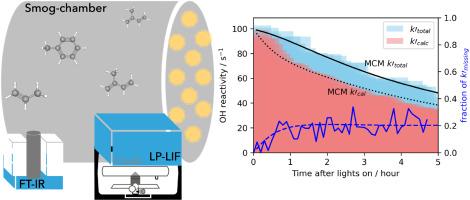
•OH reactivity (), which is the inverse of •OH lifetime and can be determined by measuring the decay rate of •OH radicals as total •OH reactivity (), or summing reactivity from volatile organic compounds (VOCs), NOx, and other inorganics as calculated •OH reactivity (). is usually underestimated by , with the discrepancy named as missing •OH reactivity (), mainly representing the reactivity of unknown VOCs. plays an important role in understanding the overall reactivity balance and the production of photochemical oxidants. Given that the Master Chemical Mechanism (MCM) can simulate and ozone production, uncertainties arise when apply these models to complex ambient atmospheres. We conducted smog-chamber experiments using VOC mixtures under well-controlled conditions. and trace species in the smog-chamber were measured and concurrently simulated by MCM model. The MCM reproduced initial time variations of trace species and . We found a corresponding relationship of /[HCHO] = 1.5 s−1 ppbv−1 based on the smog-chamber experiments and several field campaigns’ results in Japan. We further applied this factor in 2017 Tsukuba campaign to predict based on diurnal HCHO concentration and obtained good performance of when compared with . Also, ozone production regimes were assessed and cross-compared with conventional sensitivity indicators includes [HCHO]/[NO2] and Σki[VOC]i/kN[NOx] based on MCM results. This study confirmed that MCM model well-reproduced the kinetic chemistry of smog-chamber experiments containing VOC mixtures during the initial hours, and we propose to use HCHO concentration for model validation when is not available.
期刊介绍:
Atmospheric Environment has an open access mirror journal Atmospheric Environment: X, sharing the same aims and scope, editorial team, submission system and rigorous peer review.
Atmospheric Environment is the international journal for scientists in different disciplines related to atmospheric composition and its impacts. The journal publishes scientific articles with atmospheric relevance of emissions and depositions of gaseous and particulate compounds, chemical processes and physical effects in the atmosphere, as well as impacts of the changing atmospheric composition on human health, air quality, climate change, and ecosystems.



 京公网安备 11010802042870号
京ICP备2023020795号-1
京公网安备 11010802042870号
京ICP备2023020795号-1

 分享
分享
 求助内容:
求助内容: 应助结果提醒方式:
 扫码关注我们
