Seong-Bin Cho , Sang-Keun Song , Zang-Ho Shon , Jin-Seung Kim , Sung-Bin Lee
{"title":"Intercomparison of health impacts from nationwide PM2.5 pollution using observations and modeling: A case study of the worst event in recent decades","authors":"Seong-Bin Cho , Sang-Keun Song , Zang-Ho Shon , Jin-Seung Kim , Sung-Bin Lee","doi":"10.1016/j.chemosphere.2025.144317","DOIUrl":null,"url":null,"abstract":"<div><div>This study investigated the temporal and spatial characteristics of PM<sub>2.5</sub> and the related human health impacts in various environmental areas of South Korea during high-concentration days in winter (February 15−March 15, 2019). These analyses were performed using PM<sub>2.5</sub> observations and numerical modeling, which included the Community Multi-scale Air Quality model (CMAQ v5.3.2) and the Environmental Benefits Mapping and Analysis Program-Community Edition (BenMAP-CE v1.5.0.4). The mean PM<sub>2.5</sub> concentrations observed on high-concentration days (50.1 μg m<sup>−3</sup> in the southeastern area to 65.2 μg m<sup>−3</sup> in the southwestern area) were 2.1–2.7 times higher than those observed on non-high-concentration days (18.4 μg m<sup>−3</sup> in the southeastern area to 27.0 μg m<sup>−3</sup> in the northwestern area). In addition, many premature deaths and high premature death rates from respiratory and cardiovascular diseases attributable to high PM<sub>2.5</sub> levels were mostly distributed in the western regions of South Korea. These regional differences may be due to a combination of local meteorology and emissions and/or the long-range transport of pollutants. However, the magnitude of these premature deaths varied across areas, genders, and age groups due to differences in PM<sub>2.5</sub> concentrations and mortality rates. The number of premature deaths from cardiovascular diseases due to increased PM<sub>2.5</sub> levels was slightly higher than that from respiratory diseases, owing to the higher mortality rates. The health impact of cardiovascular diseases was estimated to be more severe in women than in men, and vice versa for respiratory diseases.</div></div>","PeriodicalId":276,"journal":{"name":"Chemosphere","volume":"377 ","pages":"Article 144317"},"PeriodicalIF":8.1000,"publicationDate":"2025-03-28","publicationTypes":"Journal Article","fieldsOfStudy":null,"isOpenAccess":false,"openAccessPdf":"","citationCount":"0","resultStr":null,"platform":"Semanticscholar","paperid":null,"PeriodicalName":"Chemosphere","FirstCategoryId":"93","ListUrlMain":"https://www.sciencedirect.com/science/article/pii/S0045653525002590","RegionNum":2,"RegionCategory":"环境科学与生态学","ArticlePicture":[],"TitleCN":null,"AbstractTextCN":null,"PMCID":null,"EPubDate":"","PubModel":"","JCR":"Q1","JCRName":"ENVIRONMENTAL SCIENCES","Score":null,"Total":0}
引用次数: 0
Abstract
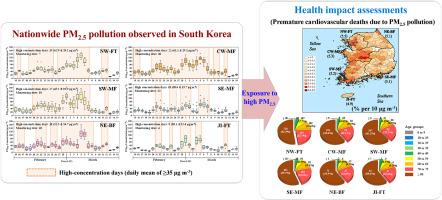
This study investigated the temporal and spatial characteristics of PM2.5 and the related human health impacts in various environmental areas of South Korea during high-concentration days in winter (February 15−March 15, 2019). These analyses were performed using PM2.5 observations and numerical modeling, which included the Community Multi-scale Air Quality model (CMAQ v5.3.2) and the Environmental Benefits Mapping and Analysis Program-Community Edition (BenMAP-CE v1.5.0.4). The mean PM2.5 concentrations observed on high-concentration days (50.1 μg m−3 in the southeastern area to 65.2 μg m−3 in the southwestern area) were 2.1–2.7 times higher than those observed on non-high-concentration days (18.4 μg m−3 in the southeastern area to 27.0 μg m−3 in the northwestern area). In addition, many premature deaths and high premature death rates from respiratory and cardiovascular diseases attributable to high PM2.5 levels were mostly distributed in the western regions of South Korea. These regional differences may be due to a combination of local meteorology and emissions and/or the long-range transport of pollutants. However, the magnitude of these premature deaths varied across areas, genders, and age groups due to differences in PM2.5 concentrations and mortality rates. The number of premature deaths from cardiovascular diseases due to increased PM2.5 levels was slightly higher than that from respiratory diseases, owing to the higher mortality rates. The health impact of cardiovascular diseases was estimated to be more severe in women than in men, and vice versa for respiratory diseases.
期刊介绍:
Chemosphere, being an international multidisciplinary journal, is dedicated to publishing original communications and review articles on chemicals in the environment. The scope covers a wide range of topics, including the identification, quantification, behavior, fate, toxicology, treatment, and remediation of chemicals in the bio-, hydro-, litho-, and atmosphere, ensuring the broad dissemination of research in this field.



 京公网安备 11010802042870号
京ICP备2023020795号-1
京公网安备 11010802042870号
京ICP备2023020795号-1

 分享
分享
 求助内容:
求助内容: 应助结果提醒方式:
 扫码关注我们
