{"title":"Hydrate-based continuous hydrogen gas separation from mixing gas containing carbon dioxide with cyclopentanone","authors":"Leo Kamiya , Ryonosuke Kasai , Satoshi Takeya , Ryo Ohmura","doi":"10.1016/j.ijhydene.2025.03.307","DOIUrl":null,"url":null,"abstract":"<div><div>Clathrate-hydrate-based H<sub>2</sub> separation is superior to conventional separation methods in terms of energy consumption, but the criteria for selecting promoters that facilitate stable hydrate formation and gas separation are unclear. We conducted continuous and batch separation experiments in a CO<sub>2</sub> + H<sub>2</sub> + cyclopentanone (CP-one) system and powder X-ray diffraction (PXRD) measurements of the hydrate formed in this system. While the mole fraction of H<sub>2</sub> in the gas phase increased from 0.60 to 0.90 in continuous separation, CO<sub>2</sub> in the hydrate phase remained at 0.90. PXRD measurements revealed that CO<sub>2</sub> + H<sub>2</sub> + cyclopentanone hydrate possesses the structure II hydrate, suggesting CO<sub>2</sub> and CP-one encapsulation in small and large cages of hydrate. Compared to previous studies using tetrahydropyran and cyclopentane as guest compounds, CP-one with high water solubility facilitated kinetics of the hydrate, encapsulation of CO<sub>2</sub> in the hydrate and more stable separation. This study would provide a comprehensive understanding of selecting guest compounds for hydrate-based separation.</div></div>","PeriodicalId":337,"journal":{"name":"International Journal of Hydrogen Energy","volume":"121 ","pages":"Pages 111-117"},"PeriodicalIF":8.3000,"publicationDate":"2025-04-23","publicationTypes":"Journal Article","fieldsOfStudy":null,"isOpenAccess":false,"openAccessPdf":"","citationCount":"0","resultStr":null,"platform":"Semanticscholar","paperid":null,"PeriodicalName":"International Journal of Hydrogen Energy","FirstCategoryId":"5","ListUrlMain":"https://www.sciencedirect.com/science/article/pii/S0360319925014430","RegionNum":2,"RegionCategory":"工程技术","ArticlePicture":[],"TitleCN":null,"AbstractTextCN":null,"PMCID":null,"EPubDate":"2025/3/28 0:00:00","PubModel":"Epub","JCR":"Q1","JCRName":"CHEMISTRY, PHYSICAL","Score":null,"Total":0}
引用次数: 0
Abstract
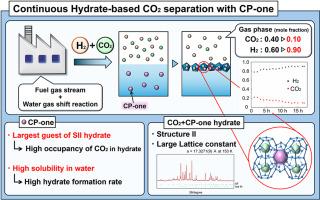
Clathrate-hydrate-based H2 separation is superior to conventional separation methods in terms of energy consumption, but the criteria for selecting promoters that facilitate stable hydrate formation and gas separation are unclear. We conducted continuous and batch separation experiments in a CO2 + H2 + cyclopentanone (CP-one) system and powder X-ray diffraction (PXRD) measurements of the hydrate formed in this system. While the mole fraction of H2 in the gas phase increased from 0.60 to 0.90 in continuous separation, CO2 in the hydrate phase remained at 0.90. PXRD measurements revealed that CO2 + H2 + cyclopentanone hydrate possesses the structure II hydrate, suggesting CO2 and CP-one encapsulation in small and large cages of hydrate. Compared to previous studies using tetrahydropyran and cyclopentane as guest compounds, CP-one with high water solubility facilitated kinetics of the hydrate, encapsulation of CO2 in the hydrate and more stable separation. This study would provide a comprehensive understanding of selecting guest compounds for hydrate-based separation.
期刊介绍:
The objective of the International Journal of Hydrogen Energy is to facilitate the exchange of new ideas, technological advancements, and research findings in the field of Hydrogen Energy among scientists and engineers worldwide. This journal showcases original research, both analytical and experimental, covering various aspects of Hydrogen Energy. These include production, storage, transmission, utilization, enabling technologies, environmental impact, economic considerations, and global perspectives on hydrogen and its carriers such as NH3, CH4, alcohols, etc.
The utilization aspect encompasses various methods such as thermochemical (combustion), photochemical, electrochemical (fuel cells), and nuclear conversion of hydrogen, hydrogen isotopes, and hydrogen carriers into thermal, mechanical, and electrical energies. The applications of these energies can be found in transportation (including aerospace), industrial, commercial, and residential sectors.



 京公网安备 11010802042870号
京ICP备2023020795号-1
京公网安备 11010802042870号
京ICP备2023020795号-1

 分享
分享
 求助内容:
求助内容: 应助结果提醒方式:
 扫码关注我们
