Yao Chen , Xuefei Liu , Gaofu Liu , Gang Wang , Degui Wang , Mingqiang Liu , Yan Wu , Zhen Wang , Abuduwayiti Aierken , Xuan Chen , Changsong Gao , Jinshun Bi , Wei Deng , Xuemin Zhang , Wenting Li , Yanghua Luo , Wentao Liang , Wenjun Xiao
{"title":"Revealing the role of surface reconstruction and charge redistribution in M1M2-N4-Grs for bifunctional oxygen electrocatalysts","authors":"Yao Chen , Xuefei Liu , Gaofu Liu , Gang Wang , Degui Wang , Mingqiang Liu , Yan Wu , Zhen Wang , Abuduwayiti Aierken , Xuan Chen , Changsong Gao , Jinshun Bi , Wei Deng , Xuemin Zhang , Wenting Li , Yanghua Luo , Wentao Liang , Wenjun Xiao","doi":"10.1016/j.ijhydene.2025.03.339","DOIUrl":null,"url":null,"abstract":"<div><div>Motivated by the effectiveness of carbon-based material catalysts in electrocatalytic reactions, we developed 55 M1M2-N4-Grs configurations (where M1, M2 = Sc to Zn) utilizing the novel graphene allotrope, Graphsene. These catalysts were evaluated for their catalytic performance in the oxygen reduction reaction and oxygen evolution reaction using density functional theory calculations. Several catalytic structures can be benchmarked against IrO<sub>2</sub> (110) and Pt (111). Notably, the Cu sites of CuCu–N4-Grs complexe manifest robust bifunctional activity, with overpotentials of 0.50/0.47 V for OER/ORR. Detailed electronic structure analysis reveals that Ti, Mn and Cu synergistically modulate the d-band center of catalytic site, and underscores the limitations of the d-band center as well as the integrated crystal orbital Hamilton population. A charge redistribution effect induced by surface reconstruction was found to further enhance the adsorption behavior of intermediates. Bader charge analysis identified the electronic gain of the ∗OH intermediate as crucial for catalytic activity. This study highlights the pivotal role of synergistic enhancement by bimetallic atomic sites and surface reconstruction in boosting catalytic performance, offering a theoretical framework for the development of efficient, non-precious metal bifunctional electrocatalysts.</div></div>","PeriodicalId":337,"journal":{"name":"International Journal of Hydrogen Energy","volume":"121 ","pages":"Pages 31-41"},"PeriodicalIF":8.3000,"publicationDate":"2025-04-23","publicationTypes":"Journal Article","fieldsOfStudy":null,"isOpenAccess":false,"openAccessPdf":"","citationCount":"0","resultStr":null,"platform":"Semanticscholar","paperid":null,"PeriodicalName":"International Journal of Hydrogen Energy","FirstCategoryId":"5","ListUrlMain":"https://www.sciencedirect.com/science/article/pii/S0360319925014892","RegionNum":2,"RegionCategory":"工程技术","ArticlePicture":[],"TitleCN":null,"AbstractTextCN":null,"PMCID":null,"EPubDate":"2025/3/28 0:00:00","PubModel":"Epub","JCR":"Q1","JCRName":"CHEMISTRY, PHYSICAL","Score":null,"Total":0}
引用次数: 0
Abstract
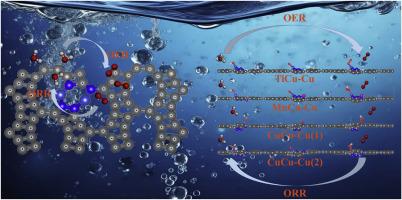
Motivated by the effectiveness of carbon-based material catalysts in electrocatalytic reactions, we developed 55 M1M2-N4-Grs configurations (where M1, M2 = Sc to Zn) utilizing the novel graphene allotrope, Graphsene. These catalysts were evaluated for their catalytic performance in the oxygen reduction reaction and oxygen evolution reaction using density functional theory calculations. Several catalytic structures can be benchmarked against IrO2 (110) and Pt (111). Notably, the Cu sites of CuCu–N4-Grs complexe manifest robust bifunctional activity, with overpotentials of 0.50/0.47 V for OER/ORR. Detailed electronic structure analysis reveals that Ti, Mn and Cu synergistically modulate the d-band center of catalytic site, and underscores the limitations of the d-band center as well as the integrated crystal orbital Hamilton population. A charge redistribution effect induced by surface reconstruction was found to further enhance the adsorption behavior of intermediates. Bader charge analysis identified the electronic gain of the ∗OH intermediate as crucial for catalytic activity. This study highlights the pivotal role of synergistic enhancement by bimetallic atomic sites and surface reconstruction in boosting catalytic performance, offering a theoretical framework for the development of efficient, non-precious metal bifunctional electrocatalysts.
期刊介绍:
The objective of the International Journal of Hydrogen Energy is to facilitate the exchange of new ideas, technological advancements, and research findings in the field of Hydrogen Energy among scientists and engineers worldwide. This journal showcases original research, both analytical and experimental, covering various aspects of Hydrogen Energy. These include production, storage, transmission, utilization, enabling technologies, environmental impact, economic considerations, and global perspectives on hydrogen and its carriers such as NH3, CH4, alcohols, etc.
The utilization aspect encompasses various methods such as thermochemical (combustion), photochemical, electrochemical (fuel cells), and nuclear conversion of hydrogen, hydrogen isotopes, and hydrogen carriers into thermal, mechanical, and electrical energies. The applications of these energies can be found in transportation (including aerospace), industrial, commercial, and residential sectors.



 京公网安备 11010802042870号
京ICP备2023020795号-1
京公网安备 11010802042870号
京ICP备2023020795号-1

 分享
分享
 求助内容:
求助内容: 应助结果提醒方式:
 扫码关注我们
