Boburjon Mukhamedov, Ferenc Tasnádi, Igor A. Abrikosov
{"title":"Machine learning interatomic potential for the low-modulus Ti-Nb-Zr alloys in the vicinity of dynamical instability","authors":"Boburjon Mukhamedov, Ferenc Tasnádi, Igor A. Abrikosov","doi":"10.1016/j.matdes.2025.113865","DOIUrl":null,"url":null,"abstract":"<div><div>Machine learning-augmented first-principles simulations facilitate the exploration of alloying and thermal treatments for tailoring material properties in industrial applications. However, addressing challenges near dynamical instabilities requires rigorous validation of machine-learned interatomic potentials (MLIP) to ensure their reliable applicability. In this study we have trained MLIP using moment tensor potentials to simulate finite temperature elastic properties of multicomponent β-Ti<sub>94-x</sub>Nb<sub>x</sub>Zr<sub>6</sub> alloys. Our simulations predict the presence of the elinvar effect for the wide range of temperatures. Importantly, we predict that in a vicinity of dynamical and mechanical instability, the β-Ti<sub>94-x</sub>Nb<sub>x</sub>Zr<sub>6</sub> alloys demonstrate strongly non-linear concentration-dependence of elastic moduli, which leads to low values of moduli comparable to that of human bone. Moreover, these alloys demonstrate a strong anisotropy of directional Young’s modulus which can be helpful for microstructure tailoring and design of materials with desired elastic properties.</div></div>","PeriodicalId":383,"journal":{"name":"Materials & Design","volume":"253 ","pages":"Article 113865"},"PeriodicalIF":7.9000,"publicationDate":"2025-05-01","publicationTypes":"Journal Article","fieldsOfStudy":null,"isOpenAccess":false,"openAccessPdf":"","citationCount":"0","resultStr":null,"platform":"Semanticscholar","paperid":null,"PeriodicalName":"Materials & Design","FirstCategoryId":"88","ListUrlMain":"https://www.sciencedirect.com/science/article/pii/S0264127525002850","RegionNum":2,"RegionCategory":"材料科学","ArticlePicture":[],"TitleCN":null,"AbstractTextCN":null,"PMCID":null,"EPubDate":"2025/3/21 0:00:00","PubModel":"Epub","JCR":"Q1","JCRName":"MATERIALS SCIENCE, MULTIDISCIPLINARY","Score":null,"Total":0}
引用次数: 0
Abstract
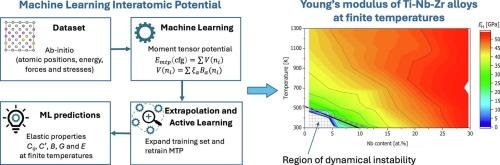
Machine learning-augmented first-principles simulations facilitate the exploration of alloying and thermal treatments for tailoring material properties in industrial applications. However, addressing challenges near dynamical instabilities requires rigorous validation of machine-learned interatomic potentials (MLIP) to ensure their reliable applicability. In this study we have trained MLIP using moment tensor potentials to simulate finite temperature elastic properties of multicomponent β-Ti94-xNbxZr6 alloys. Our simulations predict the presence of the elinvar effect for the wide range of temperatures. Importantly, we predict that in a vicinity of dynamical and mechanical instability, the β-Ti94-xNbxZr6 alloys demonstrate strongly non-linear concentration-dependence of elastic moduli, which leads to low values of moduli comparable to that of human bone. Moreover, these alloys demonstrate a strong anisotropy of directional Young’s modulus which can be helpful for microstructure tailoring and design of materials with desired elastic properties.
期刊介绍:
Materials and Design is a multi-disciplinary journal that publishes original research reports, review articles, and express communications. The journal focuses on studying the structure and properties of inorganic and organic materials, advancements in synthesis, processing, characterization, and testing, the design of materials and engineering systems, and their applications in technology. It aims to bring together various aspects of materials science, engineering, physics, and chemistry.
The journal explores themes ranging from materials to design and aims to reveal the connections between natural and artificial materials, as well as experiment and modeling. Manuscripts submitted to Materials and Design should contain elements of discovery and surprise, as they often contribute new insights into the architecture and function of matter.




 京公网安备 11010802042870号
京ICP备2023020795号-1
京公网安备 11010802042870号
京ICP备2023020795号-1

 分享
分享
 求助内容:
求助内容: 应助结果提醒方式:
 扫码关注我们
