Xia Li , Ke Shi , Le Fang , Ying Peng , Qichun Yang , Guodong Su , Cheng Zhang , Junfeng Wang , Ling Du , Gregory W. McCarty
{"title":"Morphometric and soil chemical properties govern spatiotemporal variations of porewater carbon in coastal mangroves","authors":"Xia Li , Ke Shi , Le Fang , Ying Peng , Qichun Yang , Guodong Su , Cheng Zhang , Junfeng Wang , Ling Du , Gregory W. McCarty","doi":"10.1016/j.jhydrol.2025.133159","DOIUrl":null,"url":null,"abstract":"<div><div>Understanding the spatiotemporal variations in porewater carbon (C) exchange in mangroves is essential for uncovering their roles in lateral C transfer to marine ecosystems and deepening our understanding of global C sequestration. This importance is particularly evident in coastal regions like the Pearl River Delta, where diverse mangroves face increasing anthropogenic pressures. In this study, we investigated how porewater dissolved inorganic C (<em>p</em>DIC) and dissolved organic C (<em>p</em>DOC) varied and interacted in mangroves of the Pearl River Delta, focusing on the key influencing components, including tidal hydrology, water chemistry, soil properties, and morphometric characteristics in shaping C dynamics. Our results revealed a strong consistency (r = 0.870) between the spatiotemporal variability of <em>p</em>DIC and <em>p</em>DOC, exhibiting significant negative trends related to tidal flow hours (<em>p</em>DIC: R<sup>2</sup> = 0.918, <em>p</em>DOC: R<sup>2</sup> = 0.905). Among the influencing components, soil properties had the most substantial influence on <em>p</em>DOC concentrations, accounting for 39 % of its variance, while morphometric characteristics and <em>p</em>DOC concentration had similarly high impacts on <em>p</em>DIC, each accounting for approximately 30 % of its variance. Specifically, soil bulk density (SBD) and soil pH (SpH) contributed negatively, whereas soluble dissolved organic C (SDOC), soil total C (STC), and soil total nitrogen (STN) contributed positively to the overall soil property composition. Within the morphometric component, roundness and perimeter made the strongest positive contributions. Furthermore, this study also demonstrated the feasibility of utilizing several key metrics—especially easily accessible ones like morphometric characteristics and tidal flow hours—to simulate <em>p</em>DIC and <em>p</em>DOC variability in mangroves. This approach offers a straightforward approach for evaluating C exchange dynamics in coastal mangroves and has significant implications for large-scale C flux estimation.</div></div>","PeriodicalId":362,"journal":{"name":"Journal of Hydrology","volume":"657 ","pages":"Article 133159"},"PeriodicalIF":6.3000,"publicationDate":"2025-08-01","publicationTypes":"Journal Article","fieldsOfStudy":null,"isOpenAccess":false,"openAccessPdf":"","citationCount":"0","resultStr":null,"platform":"Semanticscholar","paperid":null,"PeriodicalName":"Journal of Hydrology","FirstCategoryId":"89","ListUrlMain":"https://www.sciencedirect.com/science/article/pii/S0022169425004974","RegionNum":1,"RegionCategory":"地球科学","ArticlePicture":[],"TitleCN":null,"AbstractTextCN":null,"PMCID":null,"EPubDate":"2025/3/24 0:00:00","PubModel":"Epub","JCR":"Q1","JCRName":"ENGINEERING, CIVIL","Score":null,"Total":0}
引用次数: 0
Abstract
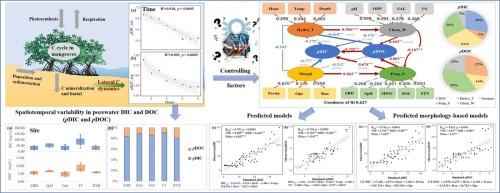
Understanding the spatiotemporal variations in porewater carbon (C) exchange in mangroves is essential for uncovering their roles in lateral C transfer to marine ecosystems and deepening our understanding of global C sequestration. This importance is particularly evident in coastal regions like the Pearl River Delta, where diverse mangroves face increasing anthropogenic pressures. In this study, we investigated how porewater dissolved inorganic C (pDIC) and dissolved organic C (pDOC) varied and interacted in mangroves of the Pearl River Delta, focusing on the key influencing components, including tidal hydrology, water chemistry, soil properties, and morphometric characteristics in shaping C dynamics. Our results revealed a strong consistency (r = 0.870) between the spatiotemporal variability of pDIC and pDOC, exhibiting significant negative trends related to tidal flow hours (pDIC: R2 = 0.918, pDOC: R2 = 0.905). Among the influencing components, soil properties had the most substantial influence on pDOC concentrations, accounting for 39 % of its variance, while morphometric characteristics and pDOC concentration had similarly high impacts on pDIC, each accounting for approximately 30 % of its variance. Specifically, soil bulk density (SBD) and soil pH (SpH) contributed negatively, whereas soluble dissolved organic C (SDOC), soil total C (STC), and soil total nitrogen (STN) contributed positively to the overall soil property composition. Within the morphometric component, roundness and perimeter made the strongest positive contributions. Furthermore, this study also demonstrated the feasibility of utilizing several key metrics—especially easily accessible ones like morphometric characteristics and tidal flow hours—to simulate pDIC and pDOC variability in mangroves. This approach offers a straightforward approach for evaluating C exchange dynamics in coastal mangroves and has significant implications for large-scale C flux estimation.
期刊介绍:
The Journal of Hydrology publishes original research papers and comprehensive reviews in all the subfields of the hydrological sciences including water based management and policy issues that impact on economics and society. These comprise, but are not limited to the physical, chemical, biogeochemical, stochastic and systems aspects of surface and groundwater hydrology, hydrometeorology and hydrogeology. Relevant topics incorporating the insights and methodologies of disciplines such as climatology, water resource systems, hydraulics, agrohydrology, geomorphology, soil science, instrumentation and remote sensing, civil and environmental engineering are included. Social science perspectives on hydrological problems such as resource and ecological economics, environmental sociology, psychology and behavioural science, management and policy analysis are also invited. Multi-and interdisciplinary analyses of hydrological problems are within scope. The science published in the Journal of Hydrology is relevant to catchment scales rather than exclusively to a local scale or site.



 京公网安备 11010802042870号
京ICP备2023020795号-1
京公网安备 11010802042870号
京ICP备2023020795号-1

 分享
分享
 求助内容:
求助内容: 应助结果提醒方式:
 扫码关注我们
