{"title":"Influence of pyrazinamide loaded zeolite imidazole framework (ZIF-8) nanoparticles and effective anticancer effect in breast cancer cells","authors":"Karthick Arumugam, Azar Zochedh, Kaliraj Chandran, Sureba Sukumaran, Karthikeyan Palaniyandi, Asath Bahadur Sultan, Thandavarayan Kathiresan","doi":"10.1007/s11051-025-06289-z","DOIUrl":null,"url":null,"abstract":"<div><p>Zeolite imidazole framework (ZIF-8) nanoparticles have gained popularity in medicine delivery due to their distinct features. The goal of the current work was to synthesize ZIF-8 using 2-methylimidazole and zinc nitrate, followed up by loading of pyrazinamide (Py). Imidazole acts as a bridging ligand between the zinc ions in order to form a coordination polymer network. For characterization, these nanoparticles underwent scanning electron microscopy (SEM), transmission electron microscopy (TEM), energy dispersion x-ray spectrum (EDX), zeta potential, particle size measurement, X-ray diffraction (XRD), and Fourier infrared spectroscopy (FTIR) analysis. TEM and SEM investigation revealed rhombic dodecahedron assembly of ZIF-8 and drug-loaded ZIF-8. Variations in elemental compositions of ZIF-8 and Py@ZIF-8 were assessed through EDX spectrum. Particle size analysis revealed the diameter size falls between 70 and 100 nm, and good stability of nanoparticles was signified through zeta potential. The FTIR band of ZIF-8 and Py@ZIF-8 was recorded in the wavenumber between 4000 and 400 cm<sup>−1</sup>, exhibiting the presence of functional groups. The crystalline nature of ZIF-8 and Py@ZIF-8 was confirmed through XRD analysis. ZIF-8 was exhibited to possess an effective drug-loading potential and a pH-based targeted delivery. Furthermore, cytotoxicity evaluation exhibited MCF-7 cell death at 83.3 µg/mL IC<sub>50</sub> dosage of Py@ZIF-8 in 24 h. The apoptotic cell death and ability to permeabilize mitochondrial membrane were investigated based on IC<sub>50</sub> dosage. These findings highlight the potential uses of ZIF-8 and Py@ZIF-8 in a variety of therapeutic scenarios, such as drug delivery systems, pH-dependent response, and less toxic and potent therapeutic agent for breast cancer.</p></div>","PeriodicalId":653,"journal":{"name":"Journal of Nanoparticle Research","volume":"27 4","pages":""},"PeriodicalIF":2.6000,"publicationDate":"2025-03-28","publicationTypes":"Journal Article","fieldsOfStudy":null,"isOpenAccess":false,"openAccessPdf":"","citationCount":"0","resultStr":null,"platform":"Semanticscholar","paperid":null,"PeriodicalName":"Journal of Nanoparticle Research","FirstCategoryId":"88","ListUrlMain":"https://link.springer.com/article/10.1007/s11051-025-06289-z","RegionNum":4,"RegionCategory":"材料科学","ArticlePicture":[],"TitleCN":null,"AbstractTextCN":null,"PMCID":null,"EPubDate":"","PubModel":"","JCR":"Q3","JCRName":"CHEMISTRY, MULTIDISCIPLINARY","Score":null,"Total":0}
引用次数: 0
Abstract
Zeolite imidazole framework (ZIF-8) nanoparticles have gained popularity in medicine delivery due to their distinct features. The goal of the current work was to synthesize ZIF-8 using 2-methylimidazole and zinc nitrate, followed up by loading of pyrazinamide (Py). Imidazole acts as a bridging ligand between the zinc ions in order to form a coordination polymer network. For characterization, these nanoparticles underwent scanning electron microscopy (SEM), transmission electron microscopy (TEM), energy dispersion x-ray spectrum (EDX), zeta potential, particle size measurement, X-ray diffraction (XRD), and Fourier infrared spectroscopy (FTIR) analysis. TEM and SEM investigation revealed rhombic dodecahedron assembly of ZIF-8 and drug-loaded ZIF-8. Variations in elemental compositions of ZIF-8 and Py@ZIF-8 were assessed through EDX spectrum. Particle size analysis revealed the diameter size falls between 70 and 100 nm, and good stability of nanoparticles was signified through zeta potential. The FTIR band of ZIF-8 and Py@ZIF-8 was recorded in the wavenumber between 4000 and 400 cm−1, exhibiting the presence of functional groups. The crystalline nature of ZIF-8 and Py@ZIF-8 was confirmed through XRD analysis. ZIF-8 was exhibited to possess an effective drug-loading potential and a pH-based targeted delivery. Furthermore, cytotoxicity evaluation exhibited MCF-7 cell death at 83.3 µg/mL IC50 dosage of Py@ZIF-8 in 24 h. The apoptotic cell death and ability to permeabilize mitochondrial membrane were investigated based on IC50 dosage. These findings highlight the potential uses of ZIF-8 and Py@ZIF-8 in a variety of therapeutic scenarios, such as drug delivery systems, pH-dependent response, and less toxic and potent therapeutic agent for breast cancer.
期刊介绍:
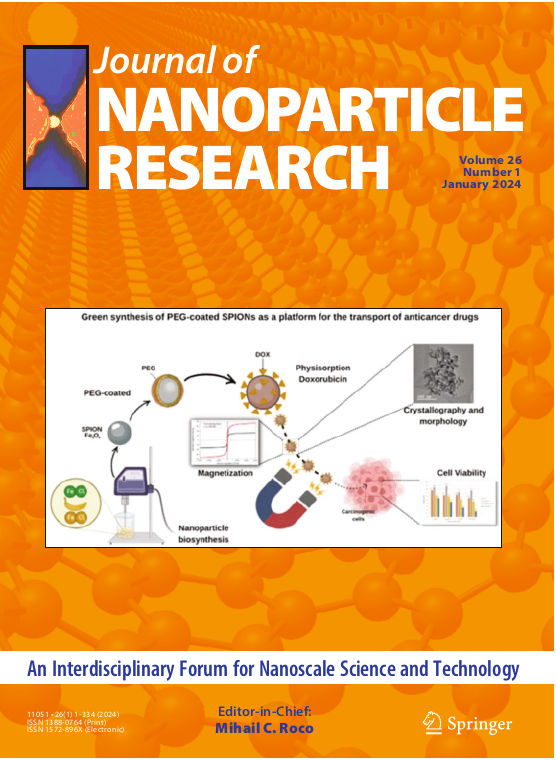
The objective of the Journal of Nanoparticle Research is to disseminate knowledge of the physical, chemical and biological phenomena and processes in structures that have at least one lengthscale ranging from molecular to approximately 100 nm (or submicron in some situations), and exhibit improved and novel properties that are a direct result of their small size.
Nanoparticle research is a key component of nanoscience, nanoengineering and nanotechnology.
The focus of the Journal is on the specific concepts, properties, phenomena, and processes related to particles, tubes, layers, macromolecules, clusters and other finite structures of the nanoscale size range. Synthesis, assembly, transport, reactivity, and stability of such structures are considered. Development of in-situ and ex-situ instrumentation for characterization of nanoparticles and their interfaces should be based on new principles for probing properties and phenomena not well understood at the nanometer scale. Modeling and simulation may include atom-based quantum mechanics; molecular dynamics; single-particle, multi-body and continuum based models; fractals; other methods suitable for modeling particle synthesis, assembling and interaction processes. Realization and application of systems, structures and devices with novel functions obtained via precursor nanoparticles is emphasized. Approaches may include gas-, liquid-, solid-, and vacuum-based processes, size reduction, chemical- and bio-self assembly. Contributions include utilization of nanoparticle systems for enhancing a phenomenon or process and particle assembling into hierarchical structures, as well as formulation and the administration of drugs. Synergistic approaches originating from different disciplines and technologies, and interaction between the research providers and users in this field, are encouraged.



 京公网安备 11010802042870号
京ICP备2023020795号-1
京公网安备 11010802042870号
京ICP备2023020795号-1

 分享
分享
 求助内容:
求助内容: 应助结果提醒方式:
 扫码关注我们
