{"title":"Accounting for item calibration error in computerized adaptive testing.","authors":"Aron Fink, Christoph König, Andreas Frey","doi":"10.3758/s13428-025-02649-8","DOIUrl":null,"url":null,"abstract":"<p><p>In computerized adaptive testing (CAT), item parameter estimates derived from calibration studies are considered to be known and are used as fixed values for adaptive item selection and ability estimation. This is not completely accurate because these item parameter estimates contain a certain degree of error. If this error is random, the typical CAT procedure leads to standard errors of the final ability estimates that are too small. If the calibration error is large, it has been shown that the accuracy of the ability estimates is negatively affected due to the capitalization on chance problem, especially for extreme ability levels. In order to find a solution for this fundamental problem of CAT, we conducted a Monte Carlo simulation study to examine three approaches that can be used to consider the uncertainty of item parameter estimates in CAT. The first two approaches used a measurement error modeling approach in which item parameters were treated as covariates that contained errors. The third approach was fully Bayesian. Each of the approaches was compared with regard to the quality of the resulting ability estimates. The results indicate that each of the three approaches is capable of reducing bias and the mean squared error (MSE) of the ability estimates, especially for high item calibration errors. The Bayesian approach clearly outperformed the other approaches. We recommend the Bayesian approach, especially for application areas in which the recruitment of a large calibration sample is infeasible.</p>","PeriodicalId":8717,"journal":{"name":"Behavior Research Methods","volume":"57 5","pages":"126"},"PeriodicalIF":3.9000,"publicationDate":"2025-03-26","publicationTypes":"Journal Article","fieldsOfStudy":null,"isOpenAccess":false,"openAccessPdf":"https://www.ncbi.nlm.nih.gov/pmc/articles/PMC11947018/pdf/","citationCount":"0","resultStr":null,"platform":"Semanticscholar","paperid":null,"PeriodicalName":"Behavior Research Methods","FirstCategoryId":"102","ListUrlMain":"https://doi.org/10.3758/s13428-025-02649-8","RegionNum":2,"RegionCategory":"心理学","ArticlePicture":[],"TitleCN":null,"AbstractTextCN":null,"PMCID":null,"EPubDate":"","PubModel":"","JCR":"Q1","JCRName":"PSYCHOLOGY, EXPERIMENTAL","Score":null,"Total":0}
引用次数: 0
Abstract
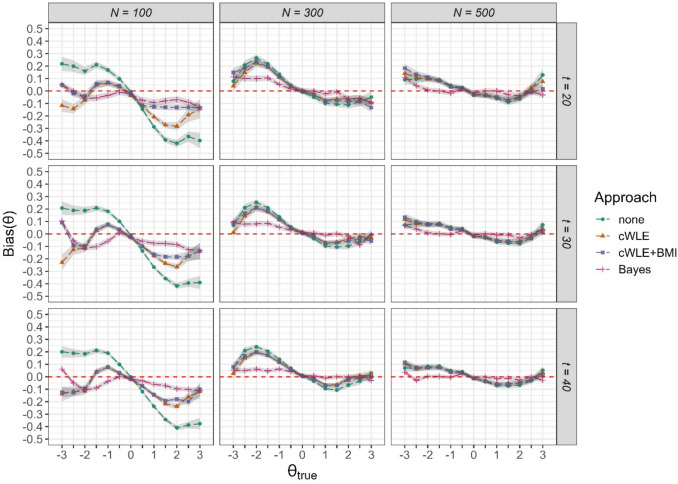
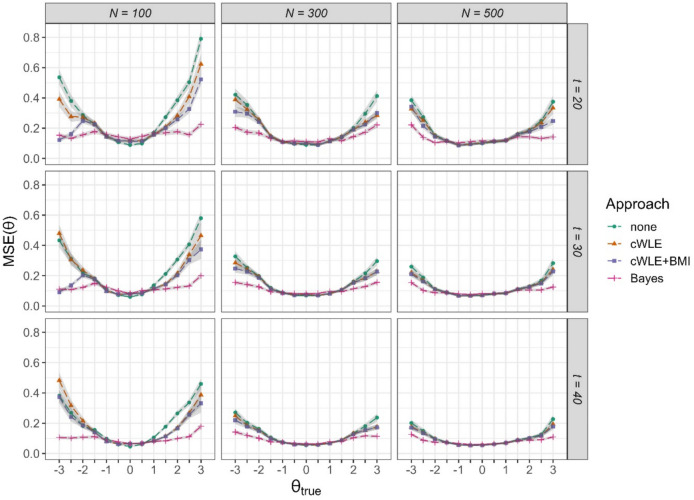
In computerized adaptive testing (CAT), item parameter estimates derived from calibration studies are considered to be known and are used as fixed values for adaptive item selection and ability estimation. This is not completely accurate because these item parameter estimates contain a certain degree of error. If this error is random, the typical CAT procedure leads to standard errors of the final ability estimates that are too small. If the calibration error is large, it has been shown that the accuracy of the ability estimates is negatively affected due to the capitalization on chance problem, especially for extreme ability levels. In order to find a solution for this fundamental problem of CAT, we conducted a Monte Carlo simulation study to examine three approaches that can be used to consider the uncertainty of item parameter estimates in CAT. The first two approaches used a measurement error modeling approach in which item parameters were treated as covariates that contained errors. The third approach was fully Bayesian. Each of the approaches was compared with regard to the quality of the resulting ability estimates. The results indicate that each of the three approaches is capable of reducing bias and the mean squared error (MSE) of the ability estimates, especially for high item calibration errors. The Bayesian approach clearly outperformed the other approaches. We recommend the Bayesian approach, especially for application areas in which the recruitment of a large calibration sample is infeasible.
期刊介绍:
Behavior Research Methods publishes articles concerned with the methods, techniques, and instrumentation of research in experimental psychology. The journal focuses particularly on the use of computer technology in psychological research. An annual special issue is devoted to this field.



 京公网安备 11010802042870号
京ICP备2023020795号-1
京公网安备 11010802042870号
京ICP备2023020795号-1

 分享
分享
 求助内容:
求助内容: 应助结果提醒方式:
 扫码关注我们
