Sara M Tolaney, Komal Jhaveri, Teresa Helsten, Shannon L Puhalla, Alison Conlin, E Claire Dees, Muralidhar Beeram, Sonya C Chapman, Andrew Lithio, Lacey M Litchfield, Matthew P Goetz
{"title":"Abemaciclib in combination with therapies for patients with metastatic breast cancer: a phase 1b study.","authors":"Sara M Tolaney, Komal Jhaveri, Teresa Helsten, Shannon L Puhalla, Alison Conlin, E Claire Dees, Muralidhar Beeram, Sonya C Chapman, Andrew Lithio, Lacey M Litchfield, Matthew P Goetz","doi":"10.3389/fonc.2025.1555921","DOIUrl":null,"url":null,"abstract":"<p><strong>Background: </strong>The oral, selective, and potent small molecule cyclin-dependent kinases (CDK) 4/6 inhibitor (CDK4/6i) abemaciclib has demonstrated efficacy in advanced breast cancer and high-risk early breast cancer. This Phase 1b study evaluated the safety, tolerability, pharmacokinetics, and antitumor activity of abemaciclib in combination with endocrine therapies (Parts A-D), exemestane + everolimus (Part E), or fulvestrant + LY3023414 (a PI3K/mTOR inhibitor; Part G) in patients with hormone receptor-positive (HR+), human epidermal growth factor receptor 2-negative (HER2-) metastatic breast cancer (MBC), or trastuzumab (Part F), or trastuzumab + pertuzumab (Part H) in patients with HER2-positive (HER2+) MBC.</p><p><strong>Patients and methods: </strong>This study enrolled women aged ≥18 years old with either HR+, HER2- (Parts E and G), or HER2+ (Parts F and H) MBC. Additional requirements included measurable disease or non-measurable but evaluable bone disease (Parts E and F), or measurable disease (Parts G and H), an Eastern Cooperative Oncology Group performance status of 0-1, and no prior treatment with CDK4/6i (Parts E, F, and H). Adverse events were graded, and tumor response was assessed.</p><p><strong>Results: </strong>Nineteen patients in Part E received abemaciclib (150 mg, n=15; 200 mg, n=4) with exemestane + everolimus, 24 patients in Part F received abemaciclib (150 mg, n=18; 200 mg, n=6) with trastuzumab, 12 patients in Part G received 150 mg abemaciclib with fulvestrant + LY3023414 (100 mg, n=7; 150 mg, n=5), and four patients in Part H received abemaciclib (100 mg) with trastuzumab + pertuzumab (with prophylactic loperamide). The most common treatment-emergent adverse events (TEAEs) were diarrhea, fatigue, neutropenia, and nausea. Grade ≥3 TEAEs were reported in 16, 18, 10, and 4 patients in Parts E-H, respectively. Abemaciclib had no effect on the pharmacokinetics of the combination study drugs. The objective response rates for patients with measurable disease were 46.2%, 10.0%, 66.7%, and 25.0% in Parts E-H, respectively. A recommended Phase 2 dose was not established for Parts E, G, and H at the dose levels evaluated, and was determined to be 150 mg Q12H in Part F.</p><p><strong>Conclusions: </strong>Overall, our results demonstrate safety profiles consistent with those previously established for abemaciclib and provide preliminary data for these combination therapies in the treatment of HR+, HER2- or HER2+ MBC.</p>","PeriodicalId":12482,"journal":{"name":"Frontiers in Oncology","volume":"15 ","pages":"1555921"},"PeriodicalIF":3.5000,"publicationDate":"2025-03-12","publicationTypes":"Journal Article","fieldsOfStudy":null,"isOpenAccess":false,"openAccessPdf":"https://www.ncbi.nlm.nih.gov/pmc/articles/PMC11937066/pdf/","citationCount":"0","resultStr":null,"platform":"Semanticscholar","paperid":null,"PeriodicalName":"Frontiers in Oncology","FirstCategoryId":"3","ListUrlMain":"https://doi.org/10.3389/fonc.2025.1555921","RegionNum":3,"RegionCategory":"医学","ArticlePicture":[],"TitleCN":null,"AbstractTextCN":null,"PMCID":null,"EPubDate":"2025/1/1 0:00:00","PubModel":"eCollection","JCR":"Q2","JCRName":"ONCOLOGY","Score":null,"Total":0}
引用次数: 0
Abstract
Background: The oral, selective, and potent small molecule cyclin-dependent kinases (CDK) 4/6 inhibitor (CDK4/6i) abemaciclib has demonstrated efficacy in advanced breast cancer and high-risk early breast cancer. This Phase 1b study evaluated the safety, tolerability, pharmacokinetics, and antitumor activity of abemaciclib in combination with endocrine therapies (Parts A-D), exemestane + everolimus (Part E), or fulvestrant + LY3023414 (a PI3K/mTOR inhibitor; Part G) in patients with hormone receptor-positive (HR+), human epidermal growth factor receptor 2-negative (HER2-) metastatic breast cancer (MBC), or trastuzumab (Part F), or trastuzumab + pertuzumab (Part H) in patients with HER2-positive (HER2+) MBC.
Patients and methods: This study enrolled women aged ≥18 years old with either HR+, HER2- (Parts E and G), or HER2+ (Parts F and H) MBC. Additional requirements included measurable disease or non-measurable but evaluable bone disease (Parts E and F), or measurable disease (Parts G and H), an Eastern Cooperative Oncology Group performance status of 0-1, and no prior treatment with CDK4/6i (Parts E, F, and H). Adverse events were graded, and tumor response was assessed.
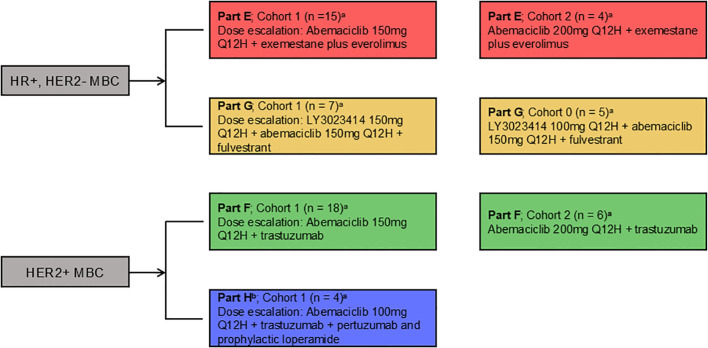
Results: Nineteen patients in Part E received abemaciclib (150 mg, n=15; 200 mg, n=4) with exemestane + everolimus, 24 patients in Part F received abemaciclib (150 mg, n=18; 200 mg, n=6) with trastuzumab, 12 patients in Part G received 150 mg abemaciclib with fulvestrant + LY3023414 (100 mg, n=7; 150 mg, n=5), and four patients in Part H received abemaciclib (100 mg) with trastuzumab + pertuzumab (with prophylactic loperamide). The most common treatment-emergent adverse events (TEAEs) were diarrhea, fatigue, neutropenia, and nausea. Grade ≥3 TEAEs were reported in 16, 18, 10, and 4 patients in Parts E-H, respectively. Abemaciclib had no effect on the pharmacokinetics of the combination study drugs. The objective response rates for patients with measurable disease were 46.2%, 10.0%, 66.7%, and 25.0% in Parts E-H, respectively. A recommended Phase 2 dose was not established for Parts E, G, and H at the dose levels evaluated, and was determined to be 150 mg Q12H in Part F.
Conclusions: Overall, our results demonstrate safety profiles consistent with those previously established for abemaciclib and provide preliminary data for these combination therapies in the treatment of HR+, HER2- or HER2+ MBC.
期刊介绍:
Cancer Imaging and Diagnosis is dedicated to the publication of results from clinical and research studies applied to cancer diagnosis and treatment. The section aims to publish studies from the entire field of cancer imaging: results from routine use of clinical imaging in both radiology and nuclear medicine, results from clinical trials, experimental molecular imaging in humans and small animals, research on new contrast agents in CT, MRI, ultrasound, publication of new technical applications and processing algorithms to improve the standardization of quantitative imaging and image guided interventions for the diagnosis and treatment of cancer.





 京公网安备 11010802042870号
京ICP备2023020795号-1
京公网安备 11010802042870号
京ICP备2023020795号-1

 分享
分享
 求助内容:
求助内容: 应助结果提醒方式:
 扫码关注我们
