Francisco Palmero, Javier A Fernandez, Jeffrey E Habben, Jeffrey R Schussler, Ben Weers, James Bing, Trevor Hefley, P V Vara Prasad, Ignacio A Ciampitti
{"title":"DP202216 maize hybrids shift upper limit of C and N partitioning to grain.","authors":"Francisco Palmero, Javier A Fernandez, Jeffrey E Habben, Jeffrey R Schussler, Ben Weers, James Bing, Trevor Hefley, P V Vara Prasad, Ignacio A Ciampitti","doi":"10.3389/fpls.2025.1459126","DOIUrl":null,"url":null,"abstract":"<p><p>Increasing both harvest index (HI) and nitrogen (N) harvest index (NHI) is a promising approach for improving the effective use of resources in grain crops. Previous studies on maize (<i>Zea mays</i> L.) reported increments in different carbon (C)-N physiological and morphological traits in DP202216 hybrids (<i>ZmGos2-zmm28, event DP202216, Corteva Agrisciences</i>). The objectives of this study were to i) identify changes in the maximum limit (potential) of C and N partitioning to the grains (HI and NHI, respectively) in DP202216 maize hybrids at equal plant growth levels, and ii) determine the main factors underpinning the mechanisms associated with any observed changes in C and N partitioning to grains. Two DP202216 hybrids were evaluated with their respective wild-type (WT) controls during two field growing seasons (2022 and 2023) under three N rates (0 kg ha<sup>-1</sup>, 150 kg ha<sup>-1</sup>, and 300 kg ha<sup>-1</sup>). Long-term <sup>15</sup>N labeling was used to precisely study N remobilization fluxes. The DP202216 plants showed an increase of 2% and 5% in the upper boundary of the HI and NHI, respectively. Furthermore, the DP202216 hybrids incremented 19% the relative allocation of <sup>15</sup>N to grains. This was translated into a higher utilization of N absorbed during vegetative stages in DP202216 hybrids, independently of the amount of N uptake. The hybrids with the DP202216 event increased 9% the number of grains per unit of plant biomass. Our study describes improvements on the upper limit of HI and NHI in DP202216 maize hybrids. We showed that the increase in C and N allocation to the reproductive organs in the DP202216 hybrids was related to higher 'relative' C and N demand by the grains. Thus, the DP202216 trait provides a new genetic tool to improve grain yield potential and yield stability via enhanced resource utilization in maize production, offering the farmers the opportunity to maximize return on investment (ROI) for N input costs.</p>","PeriodicalId":12632,"journal":{"name":"Frontiers in Plant Science","volume":"16 ","pages":"1459126"},"PeriodicalIF":4.1000,"publicationDate":"2025-03-12","publicationTypes":"Journal Article","fieldsOfStudy":null,"isOpenAccess":false,"openAccessPdf":"https://www.ncbi.nlm.nih.gov/pmc/articles/PMC11937006/pdf/","citationCount":"0","resultStr":null,"platform":"Semanticscholar","paperid":null,"PeriodicalName":"Frontiers in Plant Science","FirstCategoryId":"99","ListUrlMain":"https://doi.org/10.3389/fpls.2025.1459126","RegionNum":2,"RegionCategory":"生物学","ArticlePicture":[],"TitleCN":null,"AbstractTextCN":null,"PMCID":null,"EPubDate":"2025/1/1 0:00:00","PubModel":"eCollection","JCR":"Q1","JCRName":"PLANT SCIENCES","Score":null,"Total":0}
引用次数: 0
Abstract
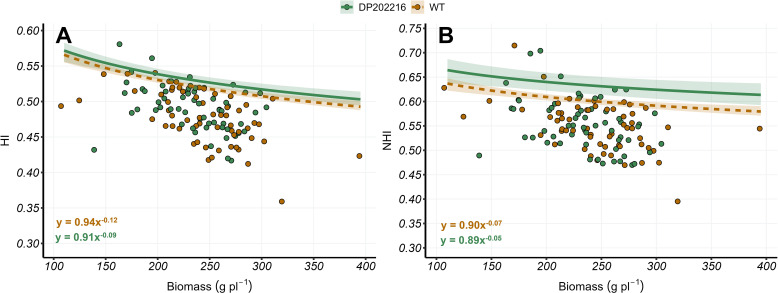
Increasing both harvest index (HI) and nitrogen (N) harvest index (NHI) is a promising approach for improving the effective use of resources in grain crops. Previous studies on maize (Zea mays L.) reported increments in different carbon (C)-N physiological and morphological traits in DP202216 hybrids (ZmGos2-zmm28, event DP202216, Corteva Agrisciences). The objectives of this study were to i) identify changes in the maximum limit (potential) of C and N partitioning to the grains (HI and NHI, respectively) in DP202216 maize hybrids at equal plant growth levels, and ii) determine the main factors underpinning the mechanisms associated with any observed changes in C and N partitioning to grains. Two DP202216 hybrids were evaluated with their respective wild-type (WT) controls during two field growing seasons (2022 and 2023) under three N rates (0 kg ha-1, 150 kg ha-1, and 300 kg ha-1). Long-term 15N labeling was used to precisely study N remobilization fluxes. The DP202216 plants showed an increase of 2% and 5% in the upper boundary of the HI and NHI, respectively. Furthermore, the DP202216 hybrids incremented 19% the relative allocation of 15N to grains. This was translated into a higher utilization of N absorbed during vegetative stages in DP202216 hybrids, independently of the amount of N uptake. The hybrids with the DP202216 event increased 9% the number of grains per unit of plant biomass. Our study describes improvements on the upper limit of HI and NHI in DP202216 maize hybrids. We showed that the increase in C and N allocation to the reproductive organs in the DP202216 hybrids was related to higher 'relative' C and N demand by the grains. Thus, the DP202216 trait provides a new genetic tool to improve grain yield potential and yield stability via enhanced resource utilization in maize production, offering the farmers the opportunity to maximize return on investment (ROI) for N input costs.
提高收获指数和氮素收获指数是提高粮食作物资源有效利用的有效途径。以往对玉米(Zea mays L.)的研究报道了DP202216杂交种(ZmGos2-zmm28,事件DP202216, Corteva Agrisciences)不同碳(C)-N生理和形态性状的增加。本研究的目的是:1)确定在相同植株生长水平下DP202216玉米杂种籽粒C和N分配的最大限度(潜力)(分别为HI和NHI)的变化;2)确定任何观测到的C和N分配变化相关机制的主要因素。在2个大田生长季节(2022年和2023年),分别在0 kg ha-1、150 kg ha-1和300 kg ha-1 3种施氮量下,对2个DP202216杂交种进行了野生型对照评价。长期15N标记用于精确研究N再动员通量。DP202216植株的HI和NHI上界分别提高了2%和5%。此外,DP202216杂交种籽粒氮素相对分配增加了19%。这意味着DP202216杂种在营养阶段吸收的氮的利用率更高,与氮吸收量无关。处理DP202216的杂交种单位生物量籽粒数增加了9%。本研究描述了DP202216玉米杂交种HI和NHI上限的改进。结果表明,DP202216杂交水稻生殖器官碳氮分配的增加与籽粒对碳氮的“相对”需求有关。因此,DP202216性状提供了一种新的遗传工具,通过提高玉米生产中的资源利用率来提高粮食产量潜力和产量稳定性,为农民提供最大限度地提高氮投入成本投资回报率的机会。
期刊介绍:
In an ever changing world, plant science is of the utmost importance for securing the future well-being of humankind. Plants provide oxygen, food, feed, fibers, and building materials. In addition, they are a diverse source of industrial and pharmaceutical chemicals. Plants are centrally important to the health of ecosystems, and their understanding is critical for learning how to manage and maintain a sustainable biosphere. Plant science is extremely interdisciplinary, reaching from agricultural science to paleobotany, and molecular physiology to ecology. It uses the latest developments in computer science, optics, molecular biology and genomics to address challenges in model systems, agricultural crops, and ecosystems. Plant science research inquires into the form, function, development, diversity, reproduction, evolution and uses of both higher and lower plants and their interactions with other organisms throughout the biosphere. Frontiers in Plant Science welcomes outstanding contributions in any field of plant science from basic to applied research, from organismal to molecular studies, from single plant analysis to studies of populations and whole ecosystems, and from molecular to biophysical to computational approaches.
Frontiers in Plant Science publishes articles on the most outstanding discoveries across a wide research spectrum of Plant Science. The mission of Frontiers in Plant Science is to bring all relevant Plant Science areas together on a single platform.





 京公网安备 11010802042870号
京ICP备2023020795号-1
京公网安备 11010802042870号
京ICP备2023020795号-1

 分享
分享
 求助内容:
求助内容: 应助结果提醒方式:
 扫码关注我们
