{"title":"AD-Diff: enhancing Alzheimer's disease prediction accuracy through multimodal fusion.","authors":"Lei Han","doi":"10.3389/fncom.2025.1484540","DOIUrl":null,"url":null,"abstract":"<p><p>Early prediction of Alzheimer's disease (AD) is crucial to improving patient quality of life and treatment outcomes. However, current predictive methods face challenges such as insufficient multimodal information integration and the high cost of PET image acquisition, which limit their effectiveness in practical applications. To address these issues, this paper proposes an innovative model, AD-Diff. This model significantly improves AD prediction accuracy by integrating PET images generated through a diffusion process with cognitive scale data and other modalities. Specifically, the AD-Diff model consists of two core components: the ADdiffusion module and the multimodal Mamba Classifier. The ADdiffusion module uses a 3D diffusion process to generate high-quality PET images, which are then fused with MRI images and tabular data to provide input for the Multimodal Mamba Classifier. Experimental results on the OASIS and ADNI datasets demonstrate that the AD-Diff model performs exceptionally well in both long-term and short-term AD prediction tasks, significantly improving prediction accuracy and reliability. These results highlight the significant advantages of the AD-Diff model in handling complex medical image data and multimodal information, providing an effective tool for the early diagnosis and personalized treatment of Alzheimer's disease.</p>","PeriodicalId":12363,"journal":{"name":"Frontiers in Computational Neuroscience","volume":"19 ","pages":"1484540"},"PeriodicalIF":3.3000,"publicationDate":"2025-03-12","publicationTypes":"Journal Article","fieldsOfStudy":null,"isOpenAccess":false,"openAccessPdf":"https://www.ncbi.nlm.nih.gov/pmc/articles/PMC11937103/pdf/","citationCount":"0","resultStr":null,"platform":"Semanticscholar","paperid":null,"PeriodicalName":"Frontiers in Computational Neuroscience","FirstCategoryId":"3","ListUrlMain":"https://doi.org/10.3389/fncom.2025.1484540","RegionNum":4,"RegionCategory":"医学","ArticlePicture":[],"TitleCN":null,"AbstractTextCN":null,"PMCID":null,"EPubDate":"2025/1/1 0:00:00","PubModel":"eCollection","JCR":"Q2","JCRName":"MATHEMATICAL & COMPUTATIONAL BIOLOGY","Score":null,"Total":0}
引用次数: 0
Abstract
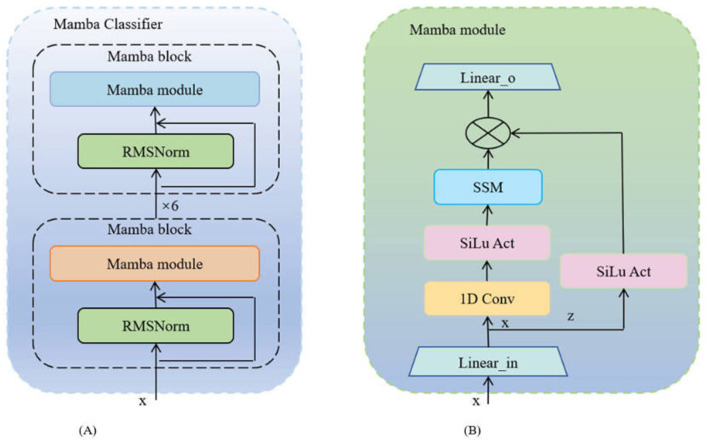
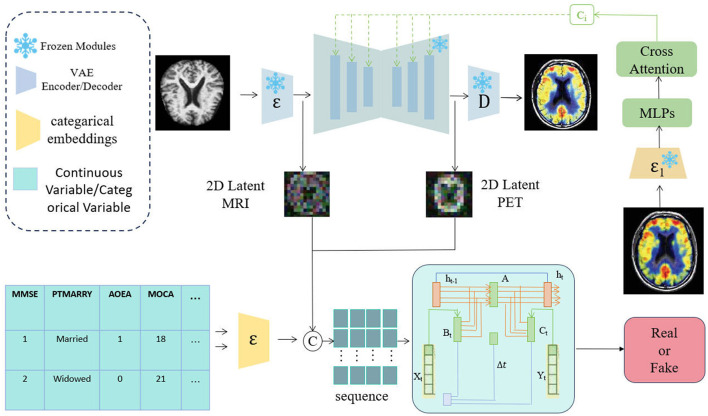
Early prediction of Alzheimer's disease (AD) is crucial to improving patient quality of life and treatment outcomes. However, current predictive methods face challenges such as insufficient multimodal information integration and the high cost of PET image acquisition, which limit their effectiveness in practical applications. To address these issues, this paper proposes an innovative model, AD-Diff. This model significantly improves AD prediction accuracy by integrating PET images generated through a diffusion process with cognitive scale data and other modalities. Specifically, the AD-Diff model consists of two core components: the ADdiffusion module and the multimodal Mamba Classifier. The ADdiffusion module uses a 3D diffusion process to generate high-quality PET images, which are then fused with MRI images and tabular data to provide input for the Multimodal Mamba Classifier. Experimental results on the OASIS and ADNI datasets demonstrate that the AD-Diff model performs exceptionally well in both long-term and short-term AD prediction tasks, significantly improving prediction accuracy and reliability. These results highlight the significant advantages of the AD-Diff model in handling complex medical image data and multimodal information, providing an effective tool for the early diagnosis and personalized treatment of Alzheimer's disease.
期刊介绍:
Frontiers in Computational Neuroscience is a first-tier electronic journal devoted to promoting theoretical modeling of brain function and fostering interdisciplinary interactions between theoretical and experimental neuroscience. Progress in understanding the amazing capabilities of the brain is still limited, and we believe that it will only come with deep theoretical thinking and mutually stimulating cooperation between different disciplines and approaches. We therefore invite original contributions on a wide range of topics that present the fruits of such cooperation, or provide stimuli for future alliances. We aim to provide an interactive forum for cutting-edge theoretical studies of the nervous system, and for promulgating the best theoretical research to the broader neuroscience community. Models of all styles and at all levels are welcome, from biophysically motivated realistic simulations of neurons and synapses to high-level abstract models of inference and decision making. While the journal is primarily focused on theoretically based and driven research, we welcome experimental studies that validate and test theoretical conclusions.
Also: comp neuro





 京公网安备 11010802042870号
京ICP备2023020795号-1
京公网安备 11010802042870号
京ICP备2023020795号-1

 分享
分享
 求助内容:
求助内容: 应助结果提醒方式:
 扫码关注我们
