{"title":"ATM is associated with the prognosis of colorectal cancer: a systematic review.","authors":"Pei Wu, Zelin Wen","doi":"10.3389/fonc.2025.1470939","DOIUrl":null,"url":null,"abstract":"<p><strong>Objective: </strong>Chemosensitivity and radiosensitivity are associated with the prognosis of colorectal cancer, and the expression of the ataxia-telangiectasia mutated (ATM) protein plays an essential role in these processes. The present study examined the relationship between ATM expression and the survival outcomes of colorectal cancer patients and explored the underlying mechanism and promising therapeutic strategies.</p><p><strong>Method: </strong>A search including medical subject headings (MeSH), free terms, and combined words was conducted using Pubmed, EMBASE, and Cochrane. Studies had to meet the inclusion criteria as well as include processes such as data extraction and quality evaluation. The survival outcomes were assessed using hazard ratio (HR) and 95% confidence interval (CI). Heterogeneity, and publication bias were analyzed, and a P value <0.05 was considered statistically significant.</p><p><strong>Results: </strong>Nine studies with 2883 patients were included in the meta-analysis. Low ATM expression level was related to poor overall survival (HR=0.542, 95% CI=0.447-0.637; P=0.000). Disease-free, progression-free, and recurrence-free survival rates were lower in patients with low ATM expression than in those with high ATM expression. There was no significant difference between Stage I-II and Stage III-IV colorectal cancer patients [risk ratio (RR)=1.173, 95% CI=0.970-1.417, P=0.690].</p><p><strong>Conclusions: </strong>Low ATM expression level may be a marker of poor survival in colorectal cancer and contributes to resistance to therapy. Targeting related factors in these pathways to sensitize tumors to treatment is a potential therapeutic strategy, and monitoring ATM status could be a valuable guide independent of the immunotherapy or chemotherapy strategy used.</p>","PeriodicalId":12482,"journal":{"name":"Frontiers in Oncology","volume":"15 ","pages":"1470939"},"PeriodicalIF":3.5000,"publicationDate":"2025-03-12","publicationTypes":"Journal Article","fieldsOfStudy":null,"isOpenAccess":false,"openAccessPdf":"https://www.ncbi.nlm.nih.gov/pmc/articles/PMC11936800/pdf/","citationCount":"0","resultStr":null,"platform":"Semanticscholar","paperid":null,"PeriodicalName":"Frontiers in Oncology","FirstCategoryId":"3","ListUrlMain":"https://doi.org/10.3389/fonc.2025.1470939","RegionNum":3,"RegionCategory":"医学","ArticlePicture":[],"TitleCN":null,"AbstractTextCN":null,"PMCID":null,"EPubDate":"2025/1/1 0:00:00","PubModel":"eCollection","JCR":"Q2","JCRName":"ONCOLOGY","Score":null,"Total":0}
引用次数: 0
Abstract
Objective: Chemosensitivity and radiosensitivity are associated with the prognosis of colorectal cancer, and the expression of the ataxia-telangiectasia mutated (ATM) protein plays an essential role in these processes. The present study examined the relationship between ATM expression and the survival outcomes of colorectal cancer patients and explored the underlying mechanism and promising therapeutic strategies.
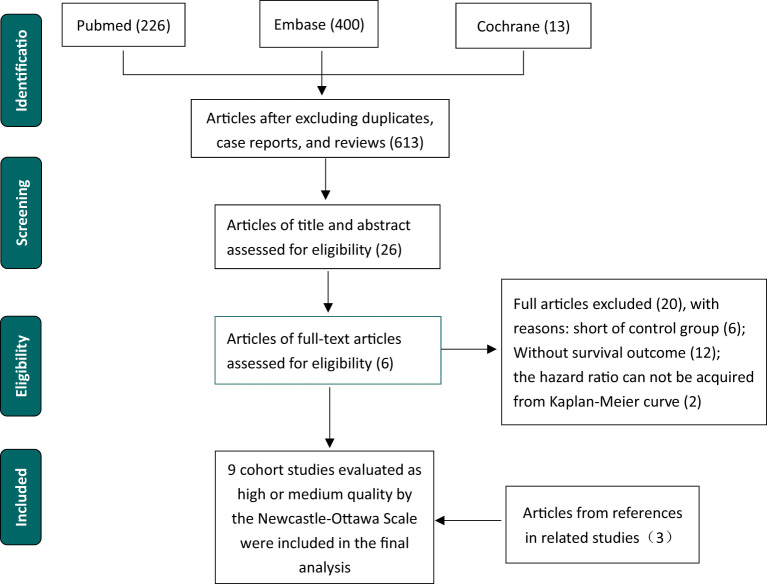
Method: A search including medical subject headings (MeSH), free terms, and combined words was conducted using Pubmed, EMBASE, and Cochrane. Studies had to meet the inclusion criteria as well as include processes such as data extraction and quality evaluation. The survival outcomes were assessed using hazard ratio (HR) and 95% confidence interval (CI). Heterogeneity, and publication bias were analyzed, and a P value <0.05 was considered statistically significant.
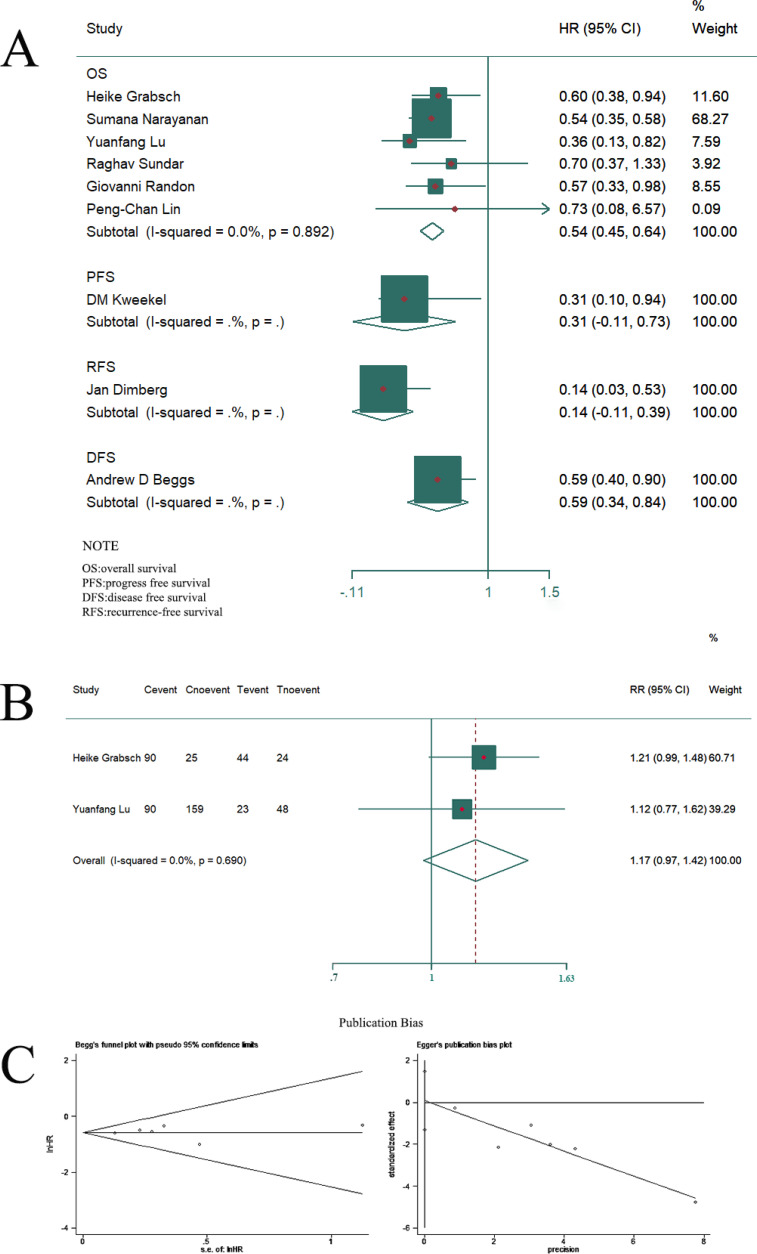
Results: Nine studies with 2883 patients were included in the meta-analysis. Low ATM expression level was related to poor overall survival (HR=0.542, 95% CI=0.447-0.637; P=0.000). Disease-free, progression-free, and recurrence-free survival rates were lower in patients with low ATM expression than in those with high ATM expression. There was no significant difference between Stage I-II and Stage III-IV colorectal cancer patients [risk ratio (RR)=1.173, 95% CI=0.970-1.417, P=0.690].
Conclusions: Low ATM expression level may be a marker of poor survival in colorectal cancer and contributes to resistance to therapy. Targeting related factors in these pathways to sensitize tumors to treatment is a potential therapeutic strategy, and monitoring ATM status could be a valuable guide independent of the immunotherapy or chemotherapy strategy used.
期刊介绍:
Cancer Imaging and Diagnosis is dedicated to the publication of results from clinical and research studies applied to cancer diagnosis and treatment. The section aims to publish studies from the entire field of cancer imaging: results from routine use of clinical imaging in both radiology and nuclear medicine, results from clinical trials, experimental molecular imaging in humans and small animals, research on new contrast agents in CT, MRI, ultrasound, publication of new technical applications and processing algorithms to improve the standardization of quantitative imaging and image guided interventions for the diagnosis and treatment of cancer.




 京公网安备 11010802042870号
京ICP备2023020795号-1
京公网安备 11010802042870号
京ICP备2023020795号-1

 分享
分享
 求助内容:
求助内容: 应助结果提醒方式:
 扫码关注我们
