{"title":"GDF-15 as a biomarker for diagnosis and prognosis of lung cancer: a meta-analysis.","authors":"Teng Pan, Rui Duan, Zihan Xu, Xiaohan He, Xiaojin Luo, Guanglin Zhou, Yu Song, Jinhai Deng, Xuerui Tan, Fengxiang Wei","doi":"10.3389/fonc.2025.1447990","DOIUrl":null,"url":null,"abstract":"<p><strong>Introduction: </strong>Due to the tendency of lung cancer to be diagnosed at advanced stages, many patients are not eligible for curative surgery. Identifying early detection and prognosis biomarkers is crucial for improving outcomes. This study explores the potential of Growth Differentiation Factor 15 (GDF-15) as a biomarker for these purposes.</p><p><strong>Methods: </strong>A thorough review and meta-analysis of literature from PubMed, Embase, the CENTRAL, and the CNKI was performed. We analyzed the diagnostic accuracy of GDF-15, focusing on its sensitivity, specificity, and AUC. Additionally, we investigated the association between three-year overall survival and GDF-15 levels in lung cancer patients. Our analysis included nine studies, encompassing 1296 patients with lung cancer and 1182 healthy controls.</p><p><strong>Results: </strong>GDF-15 showed high diagnostic performance with a sensitivity of 0.80 (95% Confidence Interval (CI): 0.71-0.87), specificity of 0.92 (95% CI: 0.85-0.96), diagnostic odds ratio of 45 (95% CI: 25-79), and an AUC of 0.93 (95% CI: 0.90-0.95). Moreover, the prognosis analysis revealed that the plasma GDF-15 levels were significantly higher in patients than controls (standardized mean difference: 2.91, CI 2.79-3.04 and P < 0.00001), and the odds ratio of 3-year overall survival rate was 4.05 (95% CI: 1.92-8.51 and P = 0.0002).</p><p><strong>Discussion: </strong>GDF-15 exhibits strong potential as both a diagnostic and prognostic biomarker in lung cancer, distinguishing effectively between patients and healthy individuals. These findings support its further exploration and potential integration into clinical practice.</p><p><strong>Systematic review registration: </strong>https://www.crd.york.ac.uk/PROSPERO/, identifier CRD42024519807.</p>","PeriodicalId":12482,"journal":{"name":"Frontiers in Oncology","volume":"15 ","pages":"1447990"},"PeriodicalIF":3.5000,"publicationDate":"2025-03-12","publicationTypes":"Journal Article","fieldsOfStudy":null,"isOpenAccess":false,"openAccessPdf":"https://www.ncbi.nlm.nih.gov/pmc/articles/PMC11936815/pdf/","citationCount":"0","resultStr":null,"platform":"Semanticscholar","paperid":null,"PeriodicalName":"Frontiers in Oncology","FirstCategoryId":"3","ListUrlMain":"https://doi.org/10.3389/fonc.2025.1447990","RegionNum":3,"RegionCategory":"医学","ArticlePicture":[],"TitleCN":null,"AbstractTextCN":null,"PMCID":null,"EPubDate":"2025/1/1 0:00:00","PubModel":"eCollection","JCR":"Q2","JCRName":"ONCOLOGY","Score":null,"Total":0}
引用次数: 0
Abstract
Introduction: Due to the tendency of lung cancer to be diagnosed at advanced stages, many patients are not eligible for curative surgery. Identifying early detection and prognosis biomarkers is crucial for improving outcomes. This study explores the potential of Growth Differentiation Factor 15 (GDF-15) as a biomarker for these purposes.
Methods: A thorough review and meta-analysis of literature from PubMed, Embase, the CENTRAL, and the CNKI was performed. We analyzed the diagnostic accuracy of GDF-15, focusing on its sensitivity, specificity, and AUC. Additionally, we investigated the association between three-year overall survival and GDF-15 levels in lung cancer patients. Our analysis included nine studies, encompassing 1296 patients with lung cancer and 1182 healthy controls.
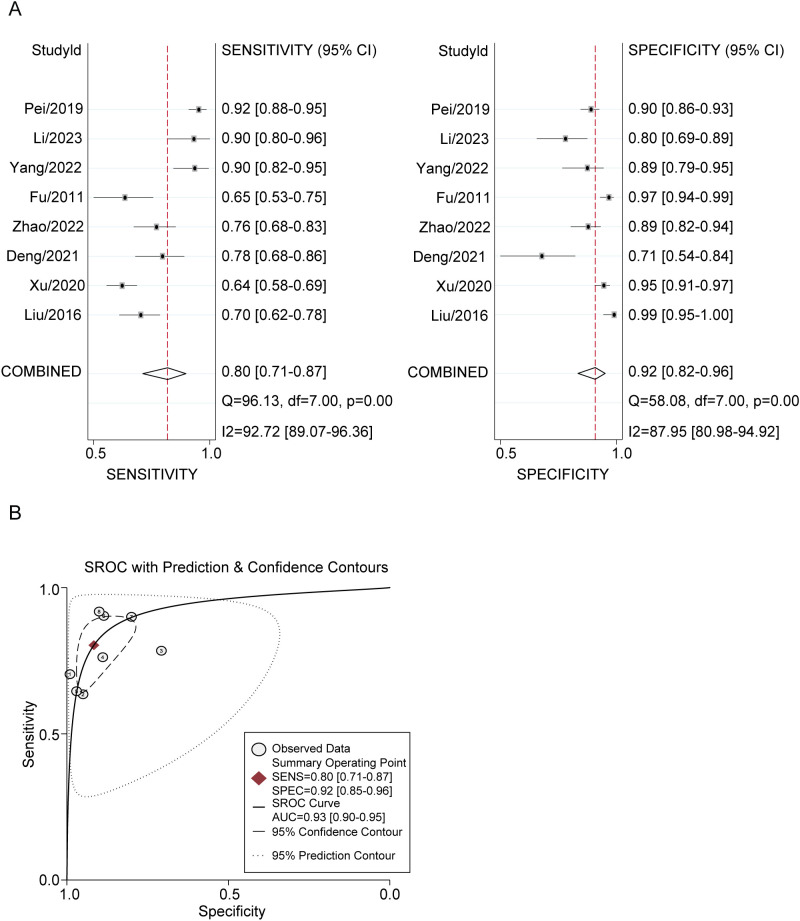
Results: GDF-15 showed high diagnostic performance with a sensitivity of 0.80 (95% Confidence Interval (CI): 0.71-0.87), specificity of 0.92 (95% CI: 0.85-0.96), diagnostic odds ratio of 45 (95% CI: 25-79), and an AUC of 0.93 (95% CI: 0.90-0.95). Moreover, the prognosis analysis revealed that the plasma GDF-15 levels were significantly higher in patients than controls (standardized mean difference: 2.91, CI 2.79-3.04 and P < 0.00001), and the odds ratio of 3-year overall survival rate was 4.05 (95% CI: 1.92-8.51 and P = 0.0002).
Discussion: GDF-15 exhibits strong potential as both a diagnostic and prognostic biomarker in lung cancer, distinguishing effectively between patients and healthy individuals. These findings support its further exploration and potential integration into clinical practice.
期刊介绍:
Cancer Imaging and Diagnosis is dedicated to the publication of results from clinical and research studies applied to cancer diagnosis and treatment. The section aims to publish studies from the entire field of cancer imaging: results from routine use of clinical imaging in both radiology and nuclear medicine, results from clinical trials, experimental molecular imaging in humans and small animals, research on new contrast agents in CT, MRI, ultrasound, publication of new technical applications and processing algorithms to improve the standardization of quantitative imaging and image guided interventions for the diagnosis and treatment of cancer.





 京公网安备 11010802042870号
京ICP备2023020795号-1
京公网安备 11010802042870号
京ICP备2023020795号-1

 分享
分享
 求助内容:
求助内容: 应助结果提醒方式:
 扫码关注我们
