Fulin Jiang, Abbas Ahmed Abdulqader, Yan Yan, Fangyuan Cheng, Tao Xiang, Jinghong Yu, Juan Li, Yong Qiu, Xin Chen
{"title":"Deep learning based quantitative cervical vertebral maturation analysis.","authors":"Fulin Jiang, Abbas Ahmed Abdulqader, Yan Yan, Fangyuan Cheng, Tao Xiang, Jinghong Yu, Juan Li, Yong Qiu, Xin Chen","doi":"10.1186/s13005-025-00498-6","DOIUrl":null,"url":null,"abstract":"<p><strong>Objectives: </strong>This study aimed to enhance clinical diagnostics for quantitative cervical vertebral maturation (QCVM) staging with precise landmark localization. Existing methods are often subjective and time-consuming, while deep learning alternatives withstand the complex anatomical variations. Therefore, we designed an advanced two-stage convolutional neural network customized for improved accuracy in cervical vertebrae analysis.</p><p><strong>Methods: </strong>This study analyzed 2100 cephalometric images. The data distribution to an 8:1:1 for training, validation, and testing. The CVnet system was designed as a two-step method with a comprehensive evaluation of various regions of interest (ROI) sizes to locate 19 cervical vertebral landmarks and classify precision maturation stages. The accuracy of landmark localization was assessed by success detection rate and student t-test. The QCVM diagnostic accuracy test was conducted to evaluate the assistant performances of our system for six junior orthodontists.</p><p><strong>Results: </strong>Upon precise calibration with optimal ROI size, the landmark localization registered an average error of 0.66 ± 0.46 mm and a success detection rate of 98.10% within 2 mm. Additionally, the identification accuracy of QCVM stages was 69.52%, resulting in an enhancement of 10.95% in the staging accuracy of junior orthodontists in the diagnostic test.</p><p><strong>Conclusions: </strong>This study presented a two-stage neural network that successfully automated the identification of cervical vertebral landmarks and the staging of QCVM. By streamlining the workflow and enhancing the accuracy of skeletal maturation estimation, this method offered valuable clinical support, particularly for practitioners with limited experience or access to advanced diagnostic resources, facilitating more consistent and reliable treatment planning.</p>","PeriodicalId":12994,"journal":{"name":"Head & Face Medicine","volume":"21 1","pages":"20"},"PeriodicalIF":2.4000,"publicationDate":"2025-03-26","publicationTypes":"Journal Article","fieldsOfStudy":null,"isOpenAccess":false,"openAccessPdf":"https://www.ncbi.nlm.nih.gov/pmc/articles/PMC11938625/pdf/","citationCount":"0","resultStr":null,"platform":"Semanticscholar","paperid":null,"PeriodicalName":"Head & Face Medicine","FirstCategoryId":"3","ListUrlMain":"https://doi.org/10.1186/s13005-025-00498-6","RegionNum":2,"RegionCategory":"医学","ArticlePicture":[],"TitleCN":null,"AbstractTextCN":null,"PMCID":null,"EPubDate":"","PubModel":"","JCR":"Q2","JCRName":"DENTISTRY, ORAL SURGERY & MEDICINE","Score":null,"Total":0}
引用次数: 0
Abstract
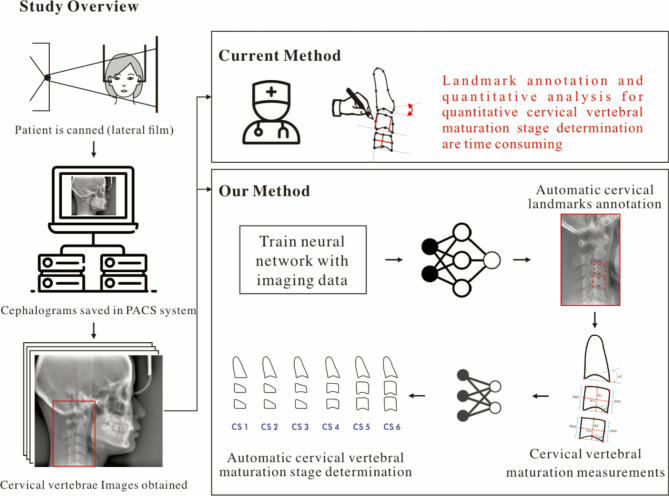
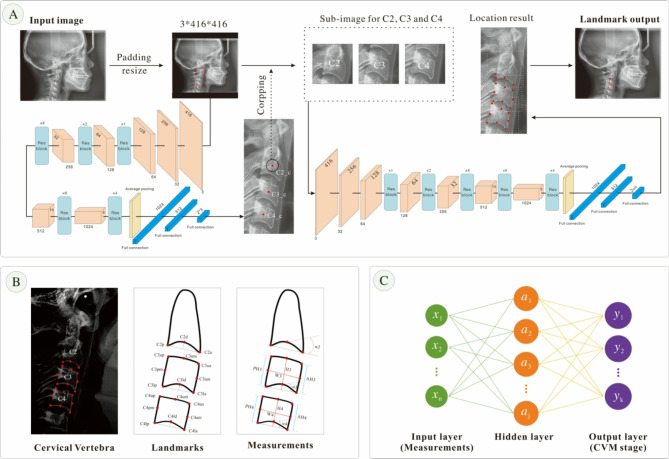
Objectives: This study aimed to enhance clinical diagnostics for quantitative cervical vertebral maturation (QCVM) staging with precise landmark localization. Existing methods are often subjective and time-consuming, while deep learning alternatives withstand the complex anatomical variations. Therefore, we designed an advanced two-stage convolutional neural network customized for improved accuracy in cervical vertebrae analysis.
Methods: This study analyzed 2100 cephalometric images. The data distribution to an 8:1:1 for training, validation, and testing. The CVnet system was designed as a two-step method with a comprehensive evaluation of various regions of interest (ROI) sizes to locate 19 cervical vertebral landmarks and classify precision maturation stages. The accuracy of landmark localization was assessed by success detection rate and student t-test. The QCVM diagnostic accuracy test was conducted to evaluate the assistant performances of our system for six junior orthodontists.
Results: Upon precise calibration with optimal ROI size, the landmark localization registered an average error of 0.66 ± 0.46 mm and a success detection rate of 98.10% within 2 mm. Additionally, the identification accuracy of QCVM stages was 69.52%, resulting in an enhancement of 10.95% in the staging accuracy of junior orthodontists in the diagnostic test.
Conclusions: This study presented a two-stage neural network that successfully automated the identification of cervical vertebral landmarks and the staging of QCVM. By streamlining the workflow and enhancing the accuracy of skeletal maturation estimation, this method offered valuable clinical support, particularly for practitioners with limited experience or access to advanced diagnostic resources, facilitating more consistent and reliable treatment planning.
期刊介绍:
Head & Face Medicine is a multidisciplinary open access journal that publishes basic and clinical research concerning all aspects of cranial, facial and oral conditions.
The journal covers all aspects of cranial, facial and oral diseases and their management. It has been designed as a multidisciplinary journal for clinicians and researchers involved in the diagnostic and therapeutic aspects of diseases which affect the human head and face. The journal is wide-ranging, covering the development, aetiology, epidemiology and therapy of head and face diseases to the basic science that underlies these diseases. Management of head and face diseases includes all aspects of surgical and non-surgical treatments including psychopharmacological therapies.



 京公网安备 11010802042870号
京ICP备2023020795号-1
京公网安备 11010802042870号
京ICP备2023020795号-1

 分享
分享
 求助内容:
求助内容: 应助结果提醒方式:
 扫码关注我们
