Olmo R van den Akker, Robert T Thibault, John P A Ioannidis, Susanne G Schorr, Daniel Strech
{"title":"Transparency in the secondary use of health data: assessing the status quo of guidance and best practices.","authors":"Olmo R van den Akker, Robert T Thibault, John P A Ioannidis, Susanne G Schorr, Daniel Strech","doi":"10.1098/rsos.241364","DOIUrl":null,"url":null,"abstract":"<p><p>We evaluated what guidance exists in the literature to improve the transparency of studies that make secondary use of health data. To find peer-reviewed papers, we searched PubMed and Google Scholar. To find institutional documents, we used our personal expertise to draft a list of health organizations and searched their websites. We quantitatively and qualitatively coded different types of research transparency: registration, methods reporting, results reporting, data sharing and code sharing. We found 56 documents that provide recommendations to improve the transparency of studies making secondary use of health data, mainly in relation to study registration (<i>n</i> = 27) and/or methods reporting (<i>n</i> = 39). Only three documents made recommendations on data sharing or code sharing. Recommendations for study registration and methods reporting mainly came in the form of structured documents like registration templates and reporting guidelines. Aside from the recommendations aimed directly at researchers, we also found recommendations aimed at the wider research community, typically on how to improve research infrastructure. Limitations or challenges of improving transparency were rarely mentioned, highlighting the need for more nuance in providing transparency guidance for studies that make secondary use of health data.</p>","PeriodicalId":21525,"journal":{"name":"Royal Society Open Science","volume":"12 3","pages":"241364"},"PeriodicalIF":2.9000,"publicationDate":"2025-03-26","publicationTypes":"Journal Article","fieldsOfStudy":null,"isOpenAccess":false,"openAccessPdf":"https://www.ncbi.nlm.nih.gov/pmc/articles/PMC11937929/pdf/","citationCount":"0","resultStr":null,"platform":"Semanticscholar","paperid":null,"PeriodicalName":"Royal Society Open Science","FirstCategoryId":"103","ListUrlMain":"https://doi.org/10.1098/rsos.241364","RegionNum":3,"RegionCategory":"综合性期刊","ArticlePicture":[],"TitleCN":null,"AbstractTextCN":null,"PMCID":null,"EPubDate":"2025/3/1 0:00:00","PubModel":"eCollection","JCR":"Q1","JCRName":"MULTIDISCIPLINARY SCIENCES","Score":null,"Total":0}
引用次数: 0
Abstract
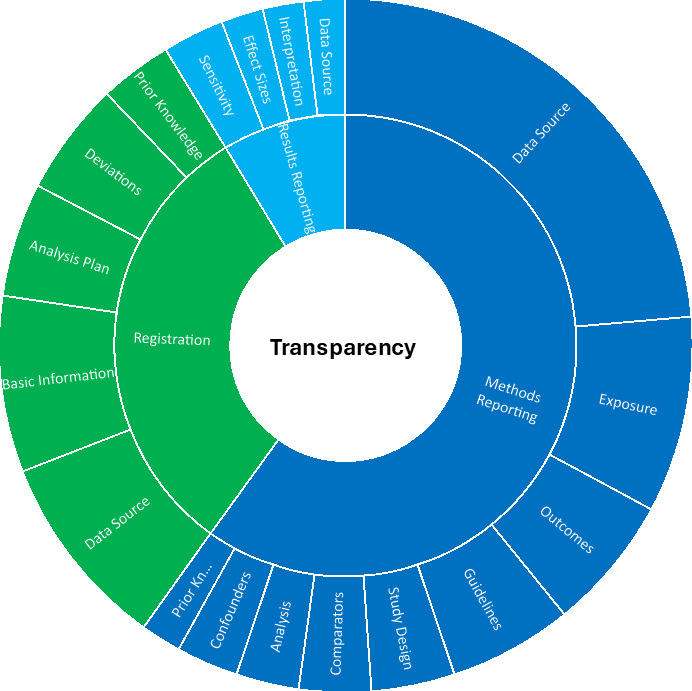
We evaluated what guidance exists in the literature to improve the transparency of studies that make secondary use of health data. To find peer-reviewed papers, we searched PubMed and Google Scholar. To find institutional documents, we used our personal expertise to draft a list of health organizations and searched their websites. We quantitatively and qualitatively coded different types of research transparency: registration, methods reporting, results reporting, data sharing and code sharing. We found 56 documents that provide recommendations to improve the transparency of studies making secondary use of health data, mainly in relation to study registration (n = 27) and/or methods reporting (n = 39). Only three documents made recommendations on data sharing or code sharing. Recommendations for study registration and methods reporting mainly came in the form of structured documents like registration templates and reporting guidelines. Aside from the recommendations aimed directly at researchers, we also found recommendations aimed at the wider research community, typically on how to improve research infrastructure. Limitations or challenges of improving transparency were rarely mentioned, highlighting the need for more nuance in providing transparency guidance for studies that make secondary use of health data.
期刊介绍:
Royal Society Open Science is a new open journal publishing high-quality original research across the entire range of science on the basis of objective peer-review.
The journal covers the entire range of science and mathematics and will allow the Society to publish all the high-quality work it receives without the usual restrictions on scope, length or impact.





 京公网安备 11010802042870号
京ICP备2023020795号-1
京公网安备 11010802042870号
京ICP备2023020795号-1

 分享
分享
 求助内容:
求助内容: 应助结果提醒方式:
 扫码关注我们
