{"title":"Autistic traits relate to reduced reward sensitivity in learning from point-light displays (PLDs).","authors":"Raimund Buehler, Libor Potocar, Nace Mikus, Giorgia Silani","doi":"10.1098/rsos.241349","DOIUrl":null,"url":null,"abstract":"<p><p>A number of studies have linked autistic traits to difficulties in learning from social (versus non-social) stimuli. However, these stimuli are often difficult to match on low-level visual properties, which is especially important given the impact of autistic traits on sensory processing. Additionally, studies often fail to account for dissociable aspects of the learning process in the specification of model parameters (learning rates and reward sensitivity). Here, we investigate whether learning deficits in individuals with high autistic traits exhibit deficits when learning from facial point-light displays (PLDs) depicting emotional expressions. Social and non-social stimuli were created from random arrangements of the same number of point-lights and carefully matched on low-level visual properties. Neurotypical participants (<i>N</i> = 63) were assessed using the autism spectrum quotient (AQ) and completed a total of 96 trials in a reinforcement learning task. Although linear multi-level modelling did not indicate learning deficits, pre-registered computational modelling using a Rescorla-Wagner framework revealed that higher autistic traits were associated with reduced reward sensitivity in the win domain, demonstrating an attenuated response to received feedback during learning. These findings suggest that autistic traits can significantly impact learning from PLD feedback beyond a general deficit in learning rates.</p>","PeriodicalId":21525,"journal":{"name":"Royal Society Open Science","volume":"12 3","pages":"241349"},"PeriodicalIF":2.9000,"publicationDate":"2025-03-26","publicationTypes":"Journal Article","fieldsOfStudy":null,"isOpenAccess":false,"openAccessPdf":"https://www.ncbi.nlm.nih.gov/pmc/articles/PMC11937925/pdf/","citationCount":"0","resultStr":null,"platform":"Semanticscholar","paperid":null,"PeriodicalName":"Royal Society Open Science","FirstCategoryId":"103","ListUrlMain":"https://doi.org/10.1098/rsos.241349","RegionNum":3,"RegionCategory":"综合性期刊","ArticlePicture":[],"TitleCN":null,"AbstractTextCN":null,"PMCID":null,"EPubDate":"2025/3/1 0:00:00","PubModel":"eCollection","JCR":"Q1","JCRName":"MULTIDISCIPLINARY SCIENCES","Score":null,"Total":0}
引用次数: 0
Abstract
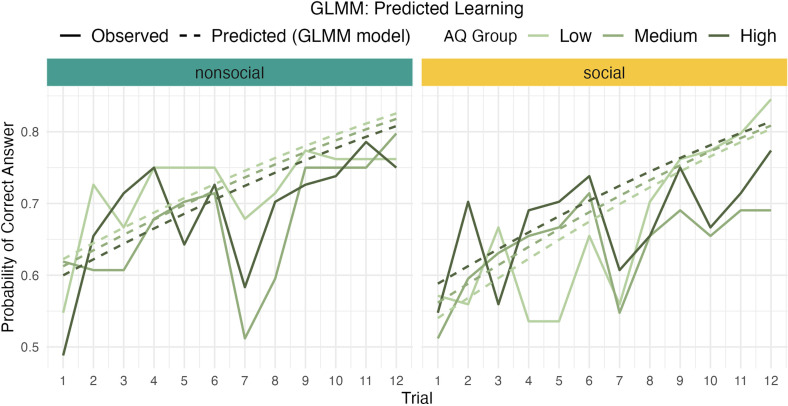
A number of studies have linked autistic traits to difficulties in learning from social (versus non-social) stimuli. However, these stimuli are often difficult to match on low-level visual properties, which is especially important given the impact of autistic traits on sensory processing. Additionally, studies often fail to account for dissociable aspects of the learning process in the specification of model parameters (learning rates and reward sensitivity). Here, we investigate whether learning deficits in individuals with high autistic traits exhibit deficits when learning from facial point-light displays (PLDs) depicting emotional expressions. Social and non-social stimuli were created from random arrangements of the same number of point-lights and carefully matched on low-level visual properties. Neurotypical participants (N = 63) were assessed using the autism spectrum quotient (AQ) and completed a total of 96 trials in a reinforcement learning task. Although linear multi-level modelling did not indicate learning deficits, pre-registered computational modelling using a Rescorla-Wagner framework revealed that higher autistic traits were associated with reduced reward sensitivity in the win domain, demonstrating an attenuated response to received feedback during learning. These findings suggest that autistic traits can significantly impact learning from PLD feedback beyond a general deficit in learning rates.
期刊介绍:
Royal Society Open Science is a new open journal publishing high-quality original research across the entire range of science on the basis of objective peer-review.
The journal covers the entire range of science and mathematics and will allow the Society to publish all the high-quality work it receives without the usual restrictions on scope, length or impact.





 京公网安备 11010802042870号
京ICP备2023020795号-1
京公网安备 11010802042870号
京ICP备2023020795号-1

 分享
分享
 求助内容:
求助内容: 应助结果提醒方式:
 扫码关注我们
