Matthew T Singh, David M Austin, Stephanie C Mullennix, Joshua C Reynolds, J Adam Oostema
{"title":"Productivity and Efficiency Growth During Emergency Medicine Residency Training.","authors":"Matthew T Singh, David M Austin, Stephanie C Mullennix, Joshua C Reynolds, J Adam Oostema","doi":"10.5811/westjem.21227","DOIUrl":null,"url":null,"abstract":"<p><strong>Introduction: </strong>Throughout training, an emergency medicine (EM) resident is required to increase efficiency and productivity to ensure safe practice after graduation. Multitasking is one of the 22 Accreditation Council for Graduate Medical Education (ACGME) EM milestones and is often measured through evaluations and observation. Providing quantitative data to both residents and residency administration on patients seen per hour (PPH) and efficiency could improve a resident experience and training in many ways. Our study was designed to analyze various throughput metrics and productivity trends using applied mathematics and a robust dataset. Our goals were to define the curve of resident PPH over time, adjust for relevant confounders, and analyze additional efficiency metrics related to throughput such as door-to-decision time (DTDT).</p><p><strong>Methods: </strong>We used a retrospective, observational design in a single, tertiary-care center emergency department (ED) that sees approximately 110,000 adult patients per year; our study spanned the period July 1, 2019-December 31, 2021. A total of 42 residents from an ACGME-accredited three-year residency were included in the analysis. We excluded patients <18 years of age. Data was collected using a secure data vendor, and we created an exponential regression model to assess resident PPH data. Additional models were created accounting for patient covariates.</p><p><strong>Results: </strong>We analyzed a total of 79,232 patients over 30 months. Using an exponential equation and adjusting for patient covariates, median PPH started at 0.898 and ended at 1.425 PPH. The median PPH by postgraduate (PGY) year were 1.13 for PGY 1; 1.38 for PGY 2; and 1.38 for PGY 3. Median DTDT in minutes was as follows: 185 minutes for PGY 1; 171 for PGY 2; and 166 for PGY 3.</p><p><strong>Conclusion: </strong>Productivity and efficiency metrics such as PPH and DTDT data are an essential part of working in an ED. Our study shows that residents improve with number of patients seen per hour over three years but tend to plateau in their second year. Door-to-decision time continued to improve throughout their three years of training.</p>","PeriodicalId":23682,"journal":{"name":"Western Journal of Emergency Medicine","volume":"26 2","pages":"246-253"},"PeriodicalIF":2.0000,"publicationDate":"2025-03-01","publicationTypes":"Journal Article","fieldsOfStudy":null,"isOpenAccess":false,"openAccessPdf":"https://www.ncbi.nlm.nih.gov/pmc/articles/PMC11931712/pdf/","citationCount":"0","resultStr":null,"platform":"Semanticscholar","paperid":null,"PeriodicalName":"Western Journal of Emergency Medicine","FirstCategoryId":"3","ListUrlMain":"https://doi.org/10.5811/westjem.21227","RegionNum":3,"RegionCategory":"医学","ArticlePicture":[],"TitleCN":null,"AbstractTextCN":null,"PMCID":null,"EPubDate":"","PubModel":"","JCR":"Q2","JCRName":"EMERGENCY MEDICINE","Score":null,"Total":0}
引用次数: 0
Abstract
Introduction: Throughout training, an emergency medicine (EM) resident is required to increase efficiency and productivity to ensure safe practice after graduation. Multitasking is one of the 22 Accreditation Council for Graduate Medical Education (ACGME) EM milestones and is often measured through evaluations and observation. Providing quantitative data to both residents and residency administration on patients seen per hour (PPH) and efficiency could improve a resident experience and training in many ways. Our study was designed to analyze various throughput metrics and productivity trends using applied mathematics and a robust dataset. Our goals were to define the curve of resident PPH over time, adjust for relevant confounders, and analyze additional efficiency metrics related to throughput such as door-to-decision time (DTDT).
Methods: We used a retrospective, observational design in a single, tertiary-care center emergency department (ED) that sees approximately 110,000 adult patients per year; our study spanned the period July 1, 2019-December 31, 2021. A total of 42 residents from an ACGME-accredited three-year residency were included in the analysis. We excluded patients <18 years of age. Data was collected using a secure data vendor, and we created an exponential regression model to assess resident PPH data. Additional models were created accounting for patient covariates.
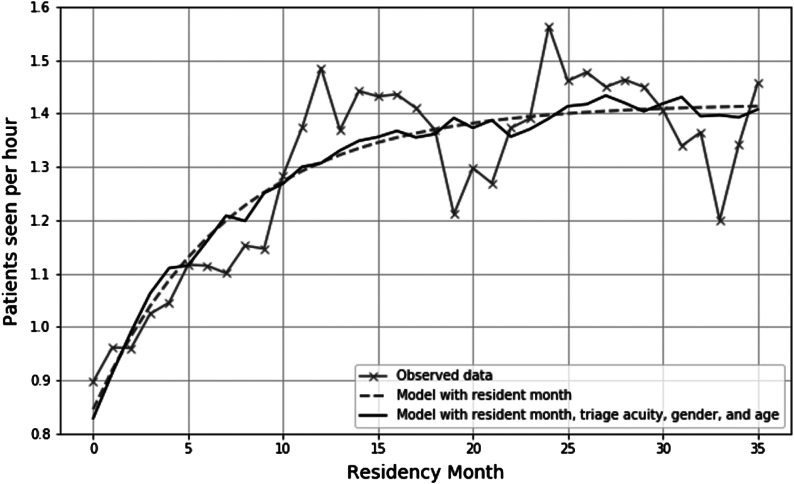
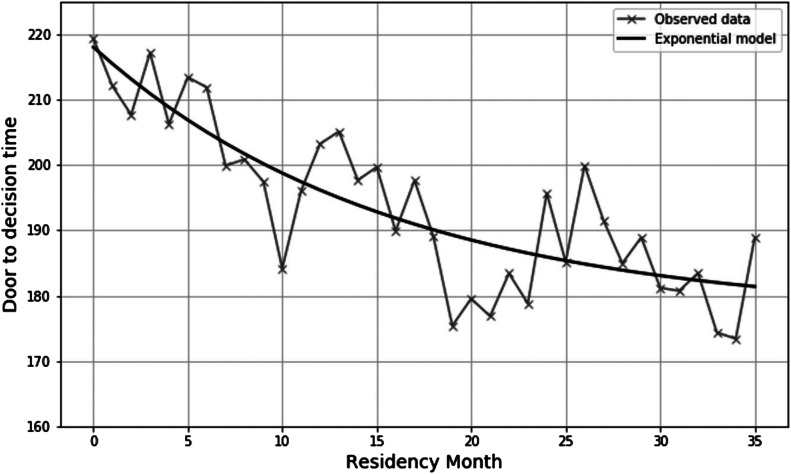
Results: We analyzed a total of 79,232 patients over 30 months. Using an exponential equation and adjusting for patient covariates, median PPH started at 0.898 and ended at 1.425 PPH. The median PPH by postgraduate (PGY) year were 1.13 for PGY 1; 1.38 for PGY 2; and 1.38 for PGY 3. Median DTDT in minutes was as follows: 185 minutes for PGY 1; 171 for PGY 2; and 166 for PGY 3.
Conclusion: Productivity and efficiency metrics such as PPH and DTDT data are an essential part of working in an ED. Our study shows that residents improve with number of patients seen per hour over three years but tend to plateau in their second year. Door-to-decision time continued to improve throughout their three years of training.
期刊介绍:
WestJEM focuses on how the systems and delivery of emergency care affects health, health disparities, and health outcomes in communities and populations worldwide, including the impact of social conditions on the composition of patients seeking care in emergency departments.



 京公网安备 11010802042870号
京ICP备2023020795号-1
京公网安备 11010802042870号
京ICP备2023020795号-1

 分享
分享
 求助内容:
求助内容: 应助结果提醒方式:
 扫码关注我们
