Yuanfang Chai, Chiyuan Miao, Pierre Gentine, Lawrence Mudryk, Chad W. Thackeray, Wouter R. Berghuijs, Yi Wu, Xuewei Fan, Louise Slater, Qiaohong Sun, Francis Zwiers
{"title":"Constrained Earth system models show a stronger reduction in future Northern Hemisphere snowmelt water","authors":"Yuanfang Chai, Chiyuan Miao, Pierre Gentine, Lawrence Mudryk, Chad W. Thackeray, Wouter R. Berghuijs, Yi Wu, Xuewei Fan, Louise Slater, Qiaohong Sun, Francis Zwiers","doi":"10.1038/s41558-025-02308-y","DOIUrl":null,"url":null,"abstract":"Although Earth system models (ESMs) tend to overestimate historical land surface warming, they also overestimate snow amounts in the Northern Hemisphere. By combining ground-based datasets and ESMs, we find that this paradoxical phenomenon is predominantly driven by an overestimation of light snowfall frequency. Using spatially distributed emergent constraints, we show that this paradox persists in mid- (2041–2060) and long-term (2081–2100) projections, affecting more than half of the Northern Hemisphere’s land surface. ESMs underestimate the frequency of freezing days by 12–19% and overestimate snow water equivalent by 28–34%. Constrained projections indicate that the raw ESM outputs overestimate future Northern Hemisphere snowmelt water by 12–16% across 53–60% of the Northern Hemisphere’s land surface. This snowmelt water overprediction implies that the amount of water available in the future for agriculture, industry, ecosystems and domestic use may be lower than unadjusted ESM projections suggest. Many climate models overestimate the snow amount in the Northern Hemisphere despite strong warming. Here the authors find that light snowfall and snow melting processes drive this mismatch and use these relationships to constrain future projections of snow water resources.","PeriodicalId":18974,"journal":{"name":"Nature Climate Change","volume":"15 5","pages":"514-520"},"PeriodicalIF":27.1000,"publicationDate":"2025-03-28","publicationTypes":"Journal Article","fieldsOfStudy":null,"isOpenAccess":false,"openAccessPdf":"","citationCount":"0","resultStr":null,"platform":"Semanticscholar","paperid":null,"PeriodicalName":"Nature Climate Change","FirstCategoryId":"89","ListUrlMain":"https://www.nature.com/articles/s41558-025-02308-y","RegionNum":1,"RegionCategory":"地球科学","ArticlePicture":[],"TitleCN":null,"AbstractTextCN":null,"PMCID":null,"EPubDate":"","PubModel":"","JCR":"Q1","JCRName":"ENVIRONMENTAL SCIENCES","Score":null,"Total":0}
引用次数: 0
Abstract
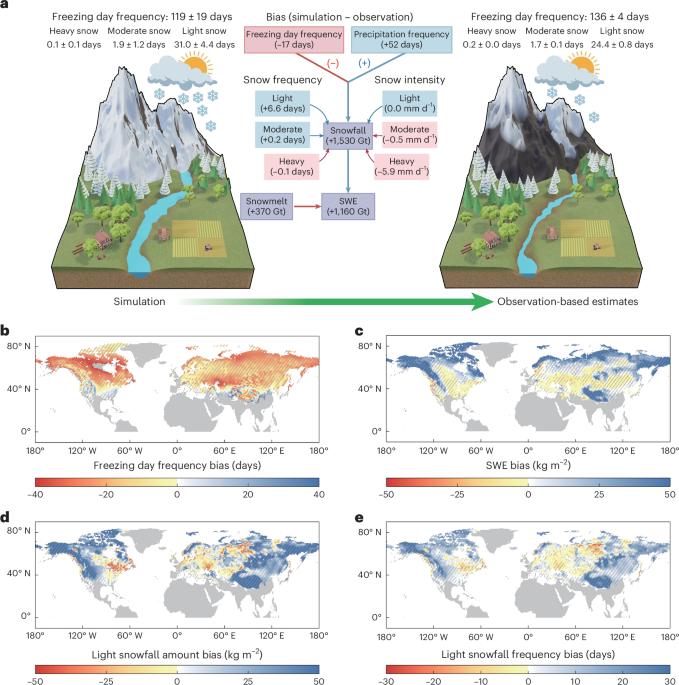
Although Earth system models (ESMs) tend to overestimate historical land surface warming, they also overestimate snow amounts in the Northern Hemisphere. By combining ground-based datasets and ESMs, we find that this paradoxical phenomenon is predominantly driven by an overestimation of light snowfall frequency. Using spatially distributed emergent constraints, we show that this paradox persists in mid- (2041–2060) and long-term (2081–2100) projections, affecting more than half of the Northern Hemisphere’s land surface. ESMs underestimate the frequency of freezing days by 12–19% and overestimate snow water equivalent by 28–34%. Constrained projections indicate that the raw ESM outputs overestimate future Northern Hemisphere snowmelt water by 12–16% across 53–60% of the Northern Hemisphere’s land surface. This snowmelt water overprediction implies that the amount of water available in the future for agriculture, industry, ecosystems and domestic use may be lower than unadjusted ESM projections suggest. Many climate models overestimate the snow amount in the Northern Hemisphere despite strong warming. Here the authors find that light snowfall and snow melting processes drive this mismatch and use these relationships to constrain future projections of snow water resources.
期刊介绍:
Nature Climate Change is dedicated to addressing the scientific challenge of understanding Earth's changing climate and its societal implications. As a monthly journal, it publishes significant and cutting-edge research on the nature, causes, and impacts of global climate change, as well as its implications for the economy, policy, and the world at large.
The journal publishes original research spanning the natural and social sciences, synthesizing interdisciplinary research to provide a comprehensive understanding of climate change. It upholds the high standards set by all Nature-branded journals, ensuring top-tier original research through a fair and rigorous review process, broad readership access, high standards of copy editing and production, rapid publication, and independence from academic societies and other vested interests.
Nature Climate Change serves as a platform for discussion among experts, publishing opinion, analysis, and review articles. It also features Research Highlights to highlight important developments in the field and original reporting from renowned science journalists in the form of feature articles.
Topics covered in the journal include adaptation, atmospheric science, ecology, economics, energy, impacts and vulnerability, mitigation, oceanography, policy, sociology, and sustainability, among others.




 京公网安备 11010802042870号
京ICP备2023020795号-1
京公网安备 11010802042870号
京ICP备2023020795号-1

 分享
分享
 求助内容:
求助内容: 应助结果提醒方式:
 扫码关注我们
