Jinying Liu, Huabing Huang, Xuejiao Hou, Lian Feng, Xuehui Pi, Ethan D. Kyzivat, Yunlin Zhang, Samuel G. Woodman, Linling Tang, Xiao Cheng, Peng Gong
{"title":"Expansion of aquatic vegetation in northern lakes amplified methane emissions","authors":"Jinying Liu, Huabing Huang, Xuejiao Hou, Lian Feng, Xuehui Pi, Ethan D. Kyzivat, Yunlin Zhang, Samuel G. Woodman, Linling Tang, Xiao Cheng, Peng Gong","doi":"10.1038/s41561-025-01667-7","DOIUrl":null,"url":null,"abstract":"Aquatic vegetation contributes to lake methane emissions, but changes in aquatic vegetation in northern (>40° N) lakes remain unknown, hindering evaluations of its importance in estimating lake emissions. Here we use Landsat imagery to monitor aquatic vegetation (mainly emergent and floating vegetation) in 2.7 million northern lakes from 1984 to 2021. Vegetation was observed in 1.2 million lakes, with a total maximum vegetation area of 12.0 × 10⁴ km2, a mean vegetation occurrence of 1.68 ± 3.8% and a greenness of 0.66 ± 0.05. From the 1980s–1990s to 2010s, significant (P < 0.05) increases in maximum vegetation area (+2.3 × 10⁴ km2) and vegetation occurrence (+73.7%) were observed and 72.5% of lakes experienced higher greenness. Vegetation expansion was affected by the temperature in sparsely populated regions, whereas lake area and fertilizer usage played vital roles in densely populated areas. The methane emission estimate that includes contributions from both aquatic vegetation and open water (1.31 [0.73, 1.89] Tg CH4 yr−1) is 13% higher than that calculated for open water (1.16 [0.63, 1.68] Tg CH4 yr−1). The long-term net increase in total methane emissions including aquatic vegetation is 125% higher than that of open water due to vegetation expansion. This highlights the necessity of incorporating aquatic vegetation in estimates of methane emissions from northern lakes. Areas of aquatic vegetation have expanded in northern lakes between 1984 and 2021, and this expansion is probably an additional climate feedback that enhances methane emissions, according to a monitoring study using Landsat imagery.","PeriodicalId":19053,"journal":{"name":"Nature Geoscience","volume":"18 4","pages":"322-329"},"PeriodicalIF":16.1000,"publicationDate":"2025-03-28","publicationTypes":"Journal Article","fieldsOfStudy":null,"isOpenAccess":false,"openAccessPdf":"","citationCount":"0","resultStr":null,"platform":"Semanticscholar","paperid":null,"PeriodicalName":"Nature Geoscience","FirstCategoryId":"89","ListUrlMain":"https://www.nature.com/articles/s41561-025-01667-7","RegionNum":1,"RegionCategory":"地球科学","ArticlePicture":[],"TitleCN":null,"AbstractTextCN":null,"PMCID":null,"EPubDate":"","PubModel":"","JCR":"Q1","JCRName":"GEOSCIENCES, MULTIDISCIPLINARY","Score":null,"Total":0}
引用次数: 0
Abstract
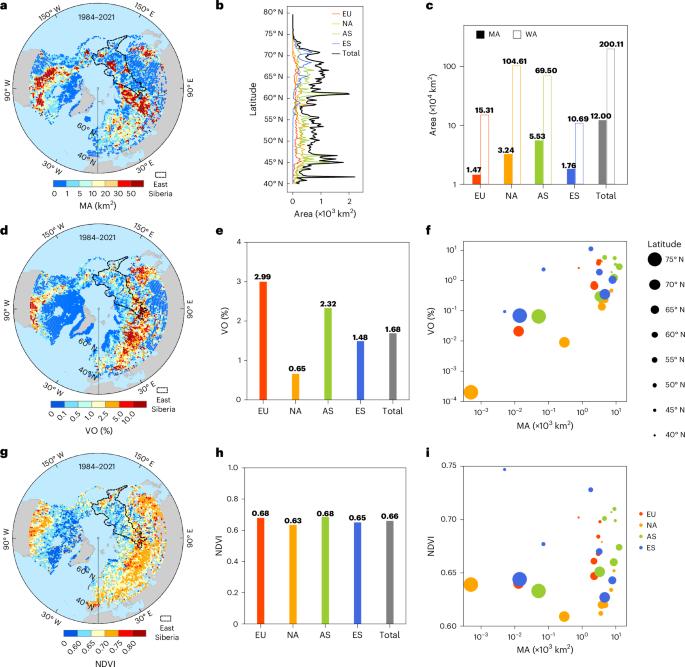
Aquatic vegetation contributes to lake methane emissions, but changes in aquatic vegetation in northern (>40° N) lakes remain unknown, hindering evaluations of its importance in estimating lake emissions. Here we use Landsat imagery to monitor aquatic vegetation (mainly emergent and floating vegetation) in 2.7 million northern lakes from 1984 to 2021. Vegetation was observed in 1.2 million lakes, with a total maximum vegetation area of 12.0 × 10⁴ km2, a mean vegetation occurrence of 1.68 ± 3.8% and a greenness of 0.66 ± 0.05. From the 1980s–1990s to 2010s, significant (P < 0.05) increases in maximum vegetation area (+2.3 × 10⁴ km2) and vegetation occurrence (+73.7%) were observed and 72.5% of lakes experienced higher greenness. Vegetation expansion was affected by the temperature in sparsely populated regions, whereas lake area and fertilizer usage played vital roles in densely populated areas. The methane emission estimate that includes contributions from both aquatic vegetation and open water (1.31 [0.73, 1.89] Tg CH4 yr−1) is 13% higher than that calculated for open water (1.16 [0.63, 1.68] Tg CH4 yr−1). The long-term net increase in total methane emissions including aquatic vegetation is 125% higher than that of open water due to vegetation expansion. This highlights the necessity of incorporating aquatic vegetation in estimates of methane emissions from northern lakes. Areas of aquatic vegetation have expanded in northern lakes between 1984 and 2021, and this expansion is probably an additional climate feedback that enhances methane emissions, according to a monitoring study using Landsat imagery.
期刊介绍:
Nature Geoscience is a monthly interdisciplinary journal that gathers top-tier research spanning Earth Sciences and related fields.
The journal covers all geoscience disciplines, including fieldwork, modeling, and theoretical studies.
Topics include atmospheric science, biogeochemistry, climate science, geobiology, geochemistry, geoinformatics, remote sensing, geology, geomagnetism, paleomagnetism, geomorphology, geophysics, glaciology, hydrology, limnology, mineralogy, oceanography, paleontology, paleoclimatology, paleoceanography, petrology, planetary science, seismology, space physics, tectonics, and volcanology.
Nature Geoscience upholds its commitment to publishing significant, high-quality Earth Sciences research through fair, rapid, and rigorous peer review, overseen by a team of full-time professional editors.




 京公网安备 11010802042870号
京ICP备2023020795号-1
京公网安备 11010802042870号
京ICP备2023020795号-1

 分享
分享
 求助内容:
求助内容: 应助结果提醒方式:
 扫码关注我们
