Junlin Hua, Stephen P. Grand, Thorsten W. Becker, Helen A. Janiszewski, Chujie Liu, Daniel T. Trugman, Hejun Zhu
{"title":"Seismic full-waveform tomography of active cratonic thinning beneath North America consistent with slab-induced dripping","authors":"Junlin Hua, Stephen P. Grand, Thorsten W. Becker, Helen A. Janiszewski, Chujie Liu, Daniel T. Trugman, Hejun Zhu","doi":"10.1038/s41561-025-01671-x","DOIUrl":null,"url":null,"abstract":"Continental cratons are characterized by thick lithospheric roots that remain intact for billions of years. However, some cratonic roots appear to have been thinned or completely removed in the geological past. The mechanisms for thinning have been difficult to distinguish for these past events. Here we present a full-waveform seismic tomographic model for North America that allows the resolution of fine-scale structures and reveals an extensive craton-thinning event that is ongoing. The seismic images show extensive drip-like features that suggest the transport of lithospheric materials from the base of the craton beneath the central United States to the mantle transition zone, and thus active lithospheric thinning. Geodynamic modelling suggests that the dripping may be mobilized by large-scale mantle flow induced by the sinking of the Farallon slab that is currently in the lower mantle. Dripping lithosphere could be further facilitated by prior lithospheric weakening, for example by volatiles released from the slab. Our seismological observations of active extensive thinning of cratonic lithosphere support lithospheric removal could be a result of external mantle processes, which we hypothesize may include the deep mantle effects of subduction. Drip-like features imaged in a seismic tomography model are consistent with extensive ongoing thinning of cratonic lithosphere beneath North America.","PeriodicalId":19053,"journal":{"name":"Nature Geoscience","volume":"18 4","pages":"358-364"},"PeriodicalIF":16.1000,"publicationDate":"2025-03-28","publicationTypes":"Journal Article","fieldsOfStudy":null,"isOpenAccess":false,"openAccessPdf":"","citationCount":"0","resultStr":null,"platform":"Semanticscholar","paperid":null,"PeriodicalName":"Nature Geoscience","FirstCategoryId":"89","ListUrlMain":"https://www.nature.com/articles/s41561-025-01671-x","RegionNum":1,"RegionCategory":"地球科学","ArticlePicture":[],"TitleCN":null,"AbstractTextCN":null,"PMCID":null,"EPubDate":"","PubModel":"","JCR":"Q1","JCRName":"GEOSCIENCES, MULTIDISCIPLINARY","Score":null,"Total":0}
引用次数: 0
Abstract
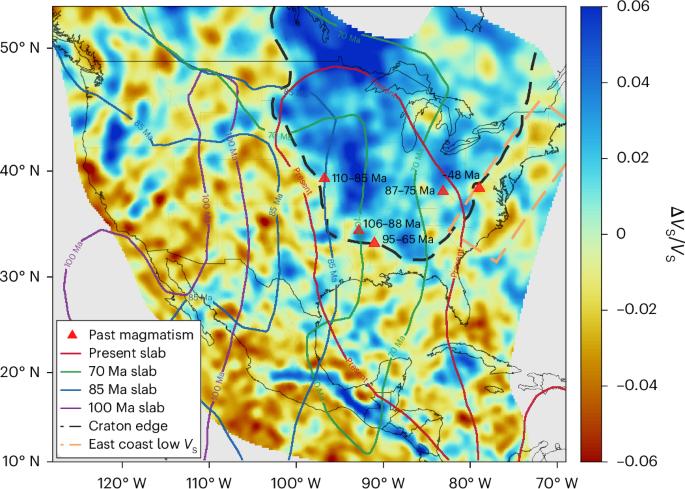
Continental cratons are characterized by thick lithospheric roots that remain intact for billions of years. However, some cratonic roots appear to have been thinned or completely removed in the geological past. The mechanisms for thinning have been difficult to distinguish for these past events. Here we present a full-waveform seismic tomographic model for North America that allows the resolution of fine-scale structures and reveals an extensive craton-thinning event that is ongoing. The seismic images show extensive drip-like features that suggest the transport of lithospheric materials from the base of the craton beneath the central United States to the mantle transition zone, and thus active lithospheric thinning. Geodynamic modelling suggests that the dripping may be mobilized by large-scale mantle flow induced by the sinking of the Farallon slab that is currently in the lower mantle. Dripping lithosphere could be further facilitated by prior lithospheric weakening, for example by volatiles released from the slab. Our seismological observations of active extensive thinning of cratonic lithosphere support lithospheric removal could be a result of external mantle processes, which we hypothesize may include the deep mantle effects of subduction. Drip-like features imaged in a seismic tomography model are consistent with extensive ongoing thinning of cratonic lithosphere beneath North America.
期刊介绍:
Nature Geoscience is a monthly interdisciplinary journal that gathers top-tier research spanning Earth Sciences and related fields.
The journal covers all geoscience disciplines, including fieldwork, modeling, and theoretical studies.
Topics include atmospheric science, biogeochemistry, climate science, geobiology, geochemistry, geoinformatics, remote sensing, geology, geomagnetism, paleomagnetism, geomorphology, geophysics, glaciology, hydrology, limnology, mineralogy, oceanography, paleontology, paleoclimatology, paleoceanography, petrology, planetary science, seismology, space physics, tectonics, and volcanology.
Nature Geoscience upholds its commitment to publishing significant, high-quality Earth Sciences research through fair, rapid, and rigorous peer review, overseen by a team of full-time professional editors.



 京公网安备 11010802042870号
京ICP备2023020795号-1
京公网安备 11010802042870号
京ICP备2023020795号-1

 分享
分享
 求助内容:
求助内容: 应助结果提醒方式:
 扫码关注我们
