Fanglin Wu, Haolin Tang, Jian Wang, Xilai Xue, Thomas Diemant, Shan Fang, Huihua Li, Ziyuan Lyu, Hao Li, En Xie, Hongzhen Lin, Jae-Kwang Kim, Guk-Tae Kim and Stefano Passerini
{"title":"Robust interphase derived from a dual-cation ionic liquid electrolyte enabling exceptional stability for nickel-rich layered cathodes†","authors":"Fanglin Wu, Haolin Tang, Jian Wang, Xilai Xue, Thomas Diemant, Shan Fang, Huihua Li, Ziyuan Lyu, Hao Li, En Xie, Hongzhen Lin, Jae-Kwang Kim, Guk-Tae Kim and Stefano Passerini","doi":"10.1039/D5EE00669D","DOIUrl":null,"url":null,"abstract":"<p >Nickel-rich layered cathodes suffer from unstable interfaces and structural collapse, leading to poor cycling stability in conventional carbonate-based electrolytes. Ionic liquid electrolytes have the potential to enable high-safety and high-specific energy in lithium metal batteries employing nickel-rich cathodes. However, their practical performance is limited by their low ionic conductivity and unsatisfactory interphase formation, which allow operation only at relatively low current densities. In this work, a dual-cation-IL-based electrolyte was employed comprising NaPF<small><sub>6</sub></small> as an additive for tuning the solvation structure. This electrolyte, which exhibited high ionic conductivity (5.06 mS cm<small><sup>−1</sup></small> at 20 °C), enabled Li||LiNi<small><sub>0.83</sub></small>Co<small><sub>0.11</sub></small>Mn<small><sub>0.05</sub></small>B<small><sub>0.01</sub></small>O<small><sub>2</sub></small> cells operating in the voltage range of 3.0–4.3 V with excellent capacity retention after 500 cycles at 1 C (95.2%) and a 1500-cycle-long lifespan (>80%). Even after reducing the operative temperature to 0 °C, the cells could deliver high discharge capacity (above 150 mA h g<small><sup>−1</sup></small>) at 0.5C without capacity decay. <em>Ex situ</em> X-ray photoelectron spectroscopy and time-of-flight secondary-ion mass spectrometry analyses revealed that the electrode/electrolyte interphase derived from the NaPF<small><sub>6</sub></small> additive was more robust and uniform, possibly facilitating sodium co-deposition on the anode surface against Li dendrite growth. Meanwhile, the inorganic-dominated cathode/electrolyte interphase (CEI) considerably protected the cathode structure and inhibited lattice distortion and microcracks, as revealed by atom-level electron microscopy and <em>in situ</em> X-ray diffraction.</p>","PeriodicalId":72,"journal":{"name":"Energy & Environmental Science","volume":" 10","pages":" 4740-4752"},"PeriodicalIF":30.8000,"publicationDate":"2025-03-28","publicationTypes":"Journal Article","fieldsOfStudy":null,"isOpenAccess":false,"openAccessPdf":"https://pubs.rsc.org/en/content/articlepdf/2025/ee/d5ee00669d?page=search","citationCount":"0","resultStr":null,"platform":"Semanticscholar","paperid":null,"PeriodicalName":"Energy & Environmental Science","FirstCategoryId":"88","ListUrlMain":"https://pubs.rsc.org/en/content/articlelanding/2025/ee/d5ee00669d","RegionNum":1,"RegionCategory":"材料科学","ArticlePicture":[],"TitleCN":null,"AbstractTextCN":null,"PMCID":null,"EPubDate":"","PubModel":"","JCR":"Q1","JCRName":"CHEMISTRY, MULTIDISCIPLINARY","Score":null,"Total":0}
引用次数: 0
Abstract
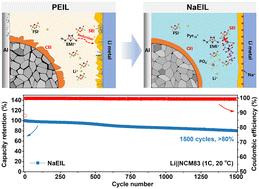
Nickel-rich layered cathodes suffer from unstable interfaces and structural collapse, leading to poor cycling stability in conventional carbonate-based electrolytes. Ionic liquid electrolytes have the potential to enable high-safety and high-specific energy in lithium metal batteries employing nickel-rich cathodes. However, their practical performance is limited by their low ionic conductivity and unsatisfactory interphase formation, which allow operation only at relatively low current densities. In this work, a dual-cation-IL-based electrolyte was employed comprising NaPF6 as an additive for tuning the solvation structure. This electrolyte, which exhibited high ionic conductivity (5.06 mS cm−1 at 20 °C), enabled Li||LiNi0.83Co0.11Mn0.05B0.01O2 cells operating in the voltage range of 3.0–4.3 V with excellent capacity retention after 500 cycles at 1 C (95.2%) and a 1500-cycle-long lifespan (>80%). Even after reducing the operative temperature to 0 °C, the cells could deliver high discharge capacity (above 150 mA h g−1) at 0.5C without capacity decay. Ex situ X-ray photoelectron spectroscopy and time-of-flight secondary-ion mass spectrometry analyses revealed that the electrode/electrolyte interphase derived from the NaPF6 additive was more robust and uniform, possibly facilitating sodium co-deposition on the anode surface against Li dendrite growth. Meanwhile, the inorganic-dominated cathode/electrolyte interphase (CEI) considerably protected the cathode structure and inhibited lattice distortion and microcracks, as revealed by atom-level electron microscopy and in situ X-ray diffraction.
期刊介绍:
Energy & Environmental Science, a peer-reviewed scientific journal, publishes original research and review articles covering interdisciplinary topics in the (bio)chemical and (bio)physical sciences, as well as chemical engineering disciplines. Published monthly by the Royal Society of Chemistry (RSC), a not-for-profit publisher, Energy & Environmental Science is recognized as a leading journal. It boasts an impressive impact factor of 8.500 as of 2009, ranking 8th among 140 journals in the category "Chemistry, Multidisciplinary," second among 71 journals in "Energy & Fuels," second among 128 journals in "Engineering, Chemical," and first among 181 scientific journals in "Environmental Sciences."
Energy & Environmental Science publishes various types of articles, including Research Papers (original scientific work), Review Articles, Perspectives, and Minireviews (feature review-type articles of broad interest), Communications (original scientific work of an urgent nature), Opinions (personal, often speculative viewpoints or hypotheses on current topics), and Analysis Articles (in-depth examination of energy-related issues).



 京公网安备 11010802042870号
京ICP备2023020795号-1
京公网安备 11010802042870号
京ICP备2023020795号-1

 分享
分享
 求助内容:
求助内容: 应助结果提醒方式:
 扫码关注我们
