Performance and Mechanism Analysis of Hexagonal Co(OH)F/Carbon Quantum Dots Composite Sensor Synthesized by PVP-Assisted Method for Acetone Gas Detection
{"title":"Performance and Mechanism Analysis of Hexagonal Co(OH)F/Carbon Quantum Dots Composite Sensor Synthesized by PVP-Assisted Method for Acetone Gas Detection","authors":"Zhijia Liao, Ninghao Chu, Yuxiang Hu, Zhenyu Yuan, Yanbai Shen, Fanli Meng","doi":"10.1021/acssensors.5c00235","DOIUrl":null,"url":null,"abstract":"Acetone gas sensitivity detection holds significant application value in environmental monitoring, industrial safety, and health assessment. This study presents the first report on the assembly of carbon quantum dots (CQDs) on the surface of hollow hexagonal Co(OH)F for efficient acetone gas detection. The fabricated sensor exhibits the ability to detect acetone at a low concentration of 200 ppb at 120 °C, demonstrating excellent moisture resistance and long-term stability. The incorporation of CQDs not only reduces the operating temperature but also enhances the gas-sensing performance of Co(OH)F, offering a simple and eco-friendly strategy for optimizing gas sensors. We systematically analyzed the synergistic effect between CQDs and Co(OH)F and their role in acetone detection. The surface functional groups of CQDs combine with the Co(OH)F surface, improving electron transfer efficiency and potentially lowering the activation energy of acetone molecule reactions through catalytic effects, enabling efficient low-temperature detection. The modification of Co(OH)F surface chemistry by CQDs strengthens the gas recognition capability. The coupling of CQDs with metal hydroxyl fluoride plays a crucial role through multiple mechanisms, providing an innovative approach for the development of high-performance gas sensors.","PeriodicalId":24,"journal":{"name":"ACS Sensors","volume":"37 1","pages":""},"PeriodicalIF":9.1000,"publicationDate":"2025-03-28","publicationTypes":"Journal Article","fieldsOfStudy":null,"isOpenAccess":false,"openAccessPdf":"","citationCount":"0","resultStr":null,"platform":"Semanticscholar","paperid":null,"PeriodicalName":"ACS Sensors","FirstCategoryId":"92","ListUrlMain":"https://doi.org/10.1021/acssensors.5c00235","RegionNum":1,"RegionCategory":"化学","ArticlePicture":[],"TitleCN":null,"AbstractTextCN":null,"PMCID":null,"EPubDate":"","PubModel":"","JCR":"Q1","JCRName":"CHEMISTRY, ANALYTICAL","Score":null,"Total":0}
引用次数: 0
Abstract
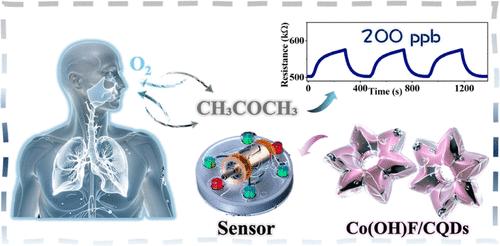
Acetone gas sensitivity detection holds significant application value in environmental monitoring, industrial safety, and health assessment. This study presents the first report on the assembly of carbon quantum dots (CQDs) on the surface of hollow hexagonal Co(OH)F for efficient acetone gas detection. The fabricated sensor exhibits the ability to detect acetone at a low concentration of 200 ppb at 120 °C, demonstrating excellent moisture resistance and long-term stability. The incorporation of CQDs not only reduces the operating temperature but also enhances the gas-sensing performance of Co(OH)F, offering a simple and eco-friendly strategy for optimizing gas sensors. We systematically analyzed the synergistic effect between CQDs and Co(OH)F and their role in acetone detection. The surface functional groups of CQDs combine with the Co(OH)F surface, improving electron transfer efficiency and potentially lowering the activation energy of acetone molecule reactions through catalytic effects, enabling efficient low-temperature detection. The modification of Co(OH)F surface chemistry by CQDs strengthens the gas recognition capability. The coupling of CQDs with metal hydroxyl fluoride plays a crucial role through multiple mechanisms, providing an innovative approach for the development of high-performance gas sensors.
期刊介绍:
ACS Sensors is a peer-reviewed research journal that focuses on the dissemination of new and original knowledge in the field of sensor science, particularly those that selectively sense chemical or biological species or processes. The journal covers a broad range of topics, including but not limited to biosensors, chemical sensors, gas sensors, intracellular sensors, single molecule sensors, cell chips, and microfluidic devices. It aims to publish articles that address conceptual advances in sensing technology applicable to various types of analytes or application papers that report on the use of existing sensing concepts in new ways or for new analytes.




 京公网安备 11010802042870号
京ICP备2023020795号-1
京公网安备 11010802042870号
京ICP备2023020795号-1

 分享
分享
 求助内容:
求助内容: 应助结果提醒方式:
 扫码关注我们
